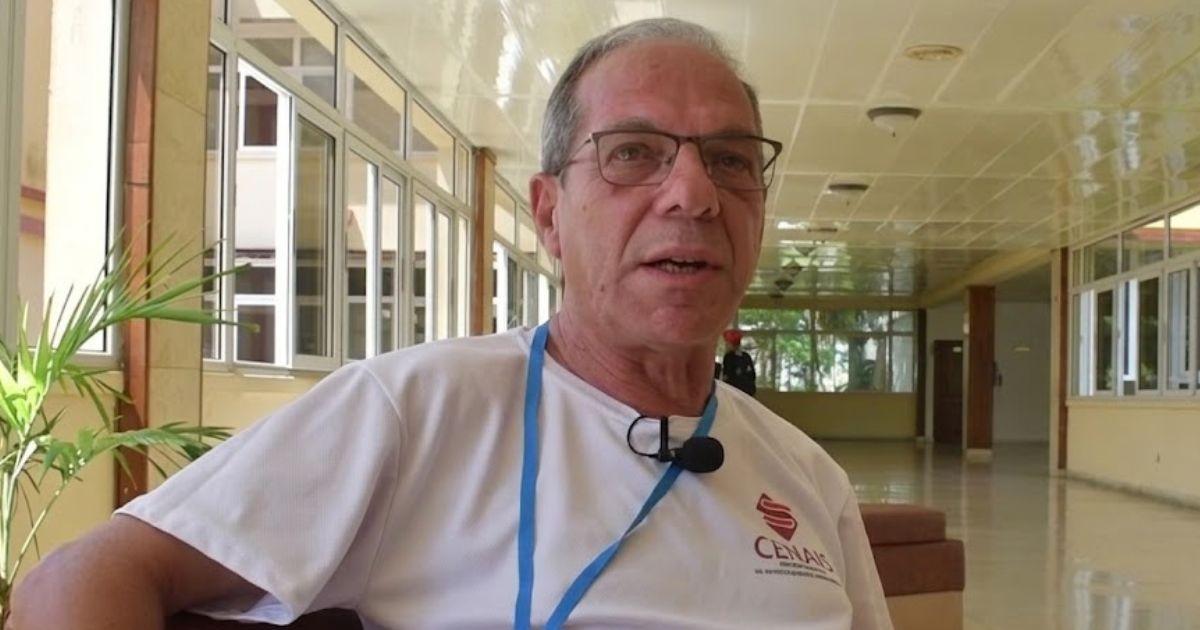
Enrique Diego Arango, the head of Cuba's Seismological Service, addressed the concerns stirred by June's increased seismic activity to clarify misconceptions: the series of earthquakes occurring worldwide this month are not directly connected.
During an interview with OnCuba, Arango responded to the worries voiced by readers following the catastrophic seismic event in Venezuela.
This month saw an unusual concentration of seismic activity in various regions: on June 8, an earthquake shook western Cuba; on June 19, earthquakes were recorded in Ivory Coast, Russia, and New Zealand; June 24 marked the most critical day with a seismic doublet of magnitudes 7.2 and 7.5 in Venezuela—the largest in the nation's history—along with tremors in Japan, Papua New Guinea, and California. Additional events occurred on June 26 in the Philippines, Puerto Rico, and the Dominican Republic.
Arango clarified why these events are not causally linked: "There is no direct relationship. It often happens that when a strong earthquake occurs somewhere, the vibrations can trigger other zones where energy is on the verge of release, causing an earthquake. It's like shaking a mango tree: the ripe ones fall off."
He also dismissed the notion of "seismic seasons": "There are occasions, not seasons, when several earthquakes happen to occur in a short timeframe. Each earthquake occurs in a zone, primarily at plate boundaries, where energy accumulates over a period proportional to its magnitude."
Another speculation circulating on social media—that certain countries possess weapons capable of causing earthquakes—was outright dismissed by Arango: "Completely false. Moving the Earth's crust over thousands of square kilometers would require enormous energy, which would not go undetected."
Regarding seismic risks for Cuba, Arango pointed out that the southeastern part of the archipelago, near the Oriente fault, is the most hazardous area. The most intense historical earthquakes in this region reached magnitudes of 7.6 in 1776 and 7.3 in 1852.
The energy accumulated since the 1932 earthquake—magnitude 6.75 and intensity VIII on the MSK scale—could result in a similar event between Santiago de Cuba and Guantánamo.
This year, Cuba has already experienced two alarming episodes: a 6.2 magnitude quake in the west on June 8, felt as far as Miami, and a 6.0 magnitude event in the east on March 17, which caused over 900 aftershocks within 24 hours.
Arango acknowledged that long-term seismic predictions are possible, albeit probabilistically, by considering seismic history and high-risk zones.
However, he warned that the current situation in the country exacerbates the scenario: "There is significant accumulated seismic vulnerability, combined with the country's well-known challenges, which would greatly complicate the situation."
Understanding Seismic Activity and Risks
Why aren't the recent global earthquakes directly related?
According to Enrique Diego Arango, while earthquakes can trigger other events in regions on the brink of releasing energy, there is no direct causal link between them.
Is there such a thing as a "seismic season"?
No, there are no seismic seasons. Earthquakes may coincide in a short period, but they occur based on energy accumulation at plate boundaries.
What areas in Cuba are most at risk for earthquakes?
The southeastern part of Cuba, near the Oriente fault, is the most at risk for seismic activity.