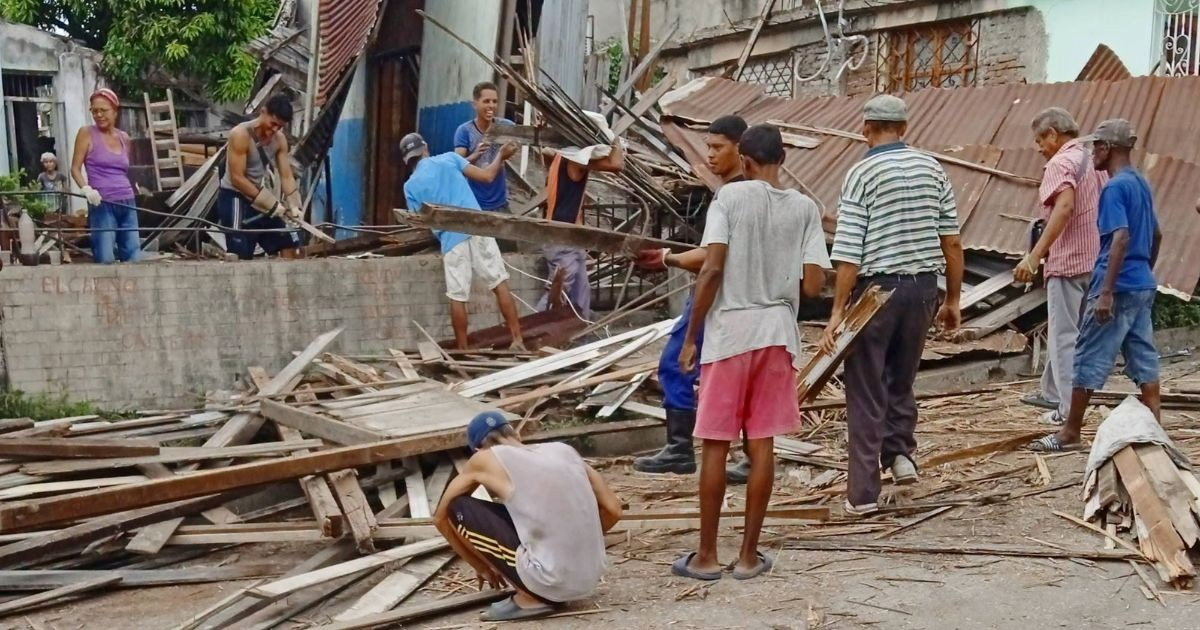
In the early hours of Sunday morning, a house in the Mariana de la Torre neighborhood of Santiago de Cuba completely collapsed. The wooden remnants of the structure were swiftly distributed among neighbors to be used as cooking fuel, according to Aris Arias Batalla, the provincial head of Operations, Rescue, and Aquatic Safety at the Cuban Red Cross in Santiago de Cuba.
The incident occurred around 7:30 a.m. at 406 11th Street, between 2nd and 4th Streets in the neighborhood.
The house, owned by young Andrés Hadfeg Villafañe, was constructed from wood with a zinc roof and had been visibly leaning for some time, indicating severe deterioration.
"The wooden house with a zinc roof had been showing an obvious tilt for some time, and unfortunately, it collapsed this morning," wrote Arias Batalla, who captured the aftermath in photographs.
Thankfully, there were no injuries, fatalities, or entrapments reported beneath the debris.
Following the collapse, dozens of residents spontaneously organized to sort through the debris.
Andrés Villafañe himself chose to distribute the wooden materials to those around him for use as firewood in cooking, a gesture that poignantly encapsulates the dual crises plaguing Cuba: housing and energy shortages.
A Dual Crisis Reflecting Broader Issues
This scenario is not unusual in Santiago de Cuba.
The province has been grappling with a long-standing housing deficit, exacerbated by Hurricane Melissa, which in October 2025, damaged over 137,000 homes in the area, with 22,000 completely destroyed.
Recovery efforts have been minimal due to a shortage of materials and government bureaucracy.
The Mariana de la Torre neighborhood, where this collapse occurred, is among the city's most vulnerable areas, characterized by wooden and zinc structures that suffer from years of neglect and deterioration without state intervention.
Energy Scarcity Compounds the Struggle
Adding to the housing crisis is the ongoing energy emergency. Power outages in Santiago de Cuba can last up to 20 hours a day, and the scarcity of liquefied gas forces many Cubans to rely on wood, charcoal, and any available combustible material.
In March of this year, images of wood-burning stoves on apartment balconies in Santiago went viral, symbolizing the everyday desperation faced by residents.
The immediate use of lumber from a collapsed house to ignite a stove is not merely anecdotal; it is a stark illustration of the material collapse that the Cuban regime has neither resolved nor adequately addressed for decades.
Just recently, on May 6th, the facade of a building on Jagüey Street in central Santiago collapsed. Though there were no injuries, the incident posed electrical risks to nearby residents.
Cuba's national housing deficit exceeds 800,000 homes, with Santiago ranking among the hardest-hit provinces.
Understanding the Housing and Energy Crisis in Cuba
What caused the house to collapse in Santiago de Cuba?
The house, made of wood with a zinc roof, had been visibly leaning for a long time, indicating advanced deterioration, which ultimately led to its collapse.
How are residents coping with the energy crisis in Santiago de Cuba?
Due to frequent power outages and a lack of liquefied gas, residents are using wood, charcoal, and other available combustible materials for cooking.
What is the housing deficit situation in Cuba?
Cuba faces a national housing deficit exceeding 800,000 homes, with Santiago de Cuba among the provinces most severely affected.