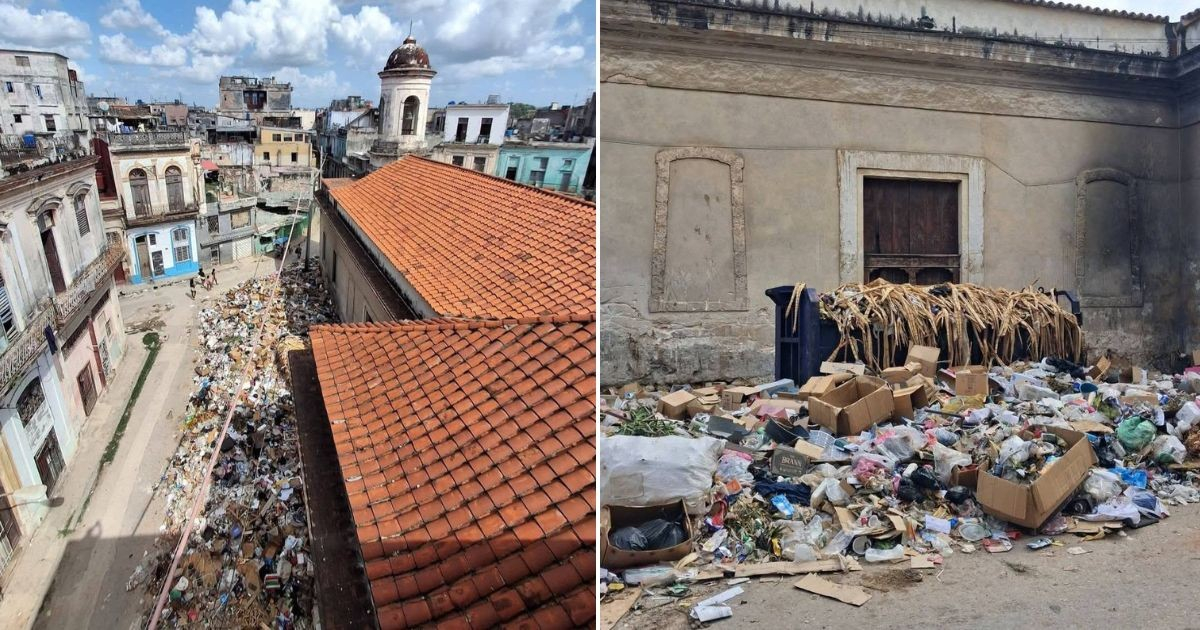
In Centro Habana's Los Sitios neighborhood, the persistent buildup of garbage outside the Church of St. Jude Thaddeus and St. Nicholas of Bari has reached a critical point. Cuban historian and professor Carlos Jesús Alfonso bitterly remarked that even the patron saint of desperate causes can't seem to ensure regular waste collection at his own church's doorstep.
Alfonso took to Facebook to voice his frustration, combining outrage with sarcasm to highlight the negligence of Cuban authorities towards a problem that the Piarist Fathers—administrators of the church and the Calasanz Cultural Center located at San Nicolas Street #830—have been reporting for months without any effective response.
Ignored Pleas and Mounting Frustration
"Right outside the temple, the recurring pile-up of waste has become more than just a hygiene issue; it's a living monument to neglect," Alfonso wrote. He added that the priests' "continuous, polite, and desperate appeals" have failed to move the responsible authorities.
Accompanying photos reveal heaps of cardboard boxes, plastic bags, debris, and organic waste obstructing the building's entrance, with a blue container overflowing.
Recurring Fires and Unfulfilled Promises
This issue is not recent. Since April 9, 2026, the mounting trash has sparked three fires outside the church: the first destroyed the main entrance door; the second, on April 23, filled the air with toxic smoke while firefighters failed to respond; the third, in the early hours of June 19, obliterated a side door.
After each incident, the Piarists publicly documented their appeals to municipal, provincial, and national government levels but saw no tangible outcomes. "They have listened. They have made plans. They have promised. Yet, actions never follow," they reported on April 24.
A Citywide Crisis in Waste Management
The root of the problem lies in the breakdown of Havana's waste management system, which worsened in February 2026. Only 44 of the city's 106 garbage trucks are operational, leaving between 13,000 and 23,814 cubic meters of waste uncollected daily.
Havana has merely 10,000 containers, though it requires between 20,000 and 30,000. The regime has responded with temporary measures—such as "Operation Clean-Up," the "Cuba Recycles 2026" initiative, and deploying military service youth to collect trash—but these have not addressed the structural issues.
The situation at the Piarists' church is not isolated. On June 2, the Parish of St. Anthony Mary Claret in Santiago de Cuba issued a similar public complaint, detailing waste accumulation, rodents, and fires outside their church, describing the situation as "untenable."
Health Consequences and Calls for Action
The public health implications of this crisis are dire. In 2025, Cuba reported 81,909 cases of dengue and chikungunya, with 65 fatalities. By June 2026, the Ministry of Public Health warned of a potential new dengue outbreak, with the first cases of the season confirmed in Matanzas.
Alfonso concluded his statement with a direct call to action: "Faith sustains the soul of our people, but filth and vectors make our bodies sick. Keeping the city clean requires not faith, but shame and effective management."
Understanding the Waste Management Crisis in Havana
What is causing the waste management crisis in Havana?
The crisis is primarily due to a shortage of operational garbage trucks and containers, resulting in uncollected waste and contributing to severe public health risks.
How has the Cuban government responded to the waste crisis?
The government implemented temporary measures like "Operation Clean-Up" and "Cuba Recycles 2026," along with deploying military service youth to collect trash, but these have not resolved the underlying issues.
What are the health impacts of the waste crisis in Cuba?
The crisis has led to significant health concerns, with outbreaks of diseases like dengue and chikungunya, posing serious risks to the population.