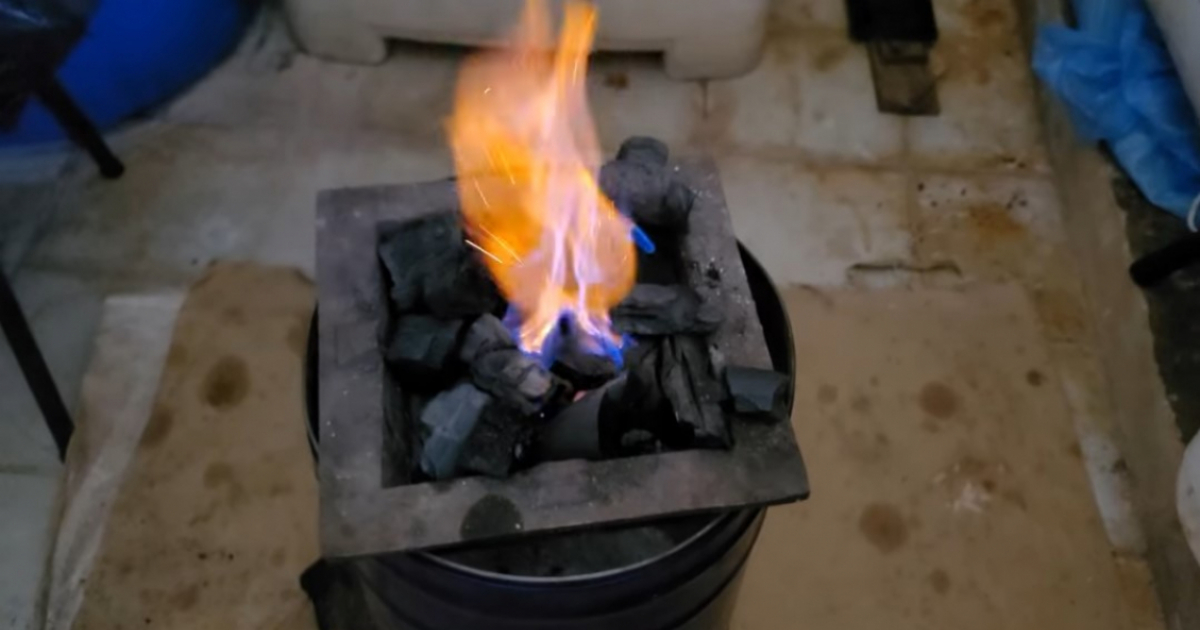
A nine-month-old infant who sustained serious burns in Santiago de Cuba while his family was cooking with charcoal during a power outage has been discharged from the hospital.
The information was confirmed by independent journalist Yosmany Mayeta Labrada on his Facebook page.
"The child who suffered burns in Santiago de Cuba in mid-June, as his parents cooked with charcoal, has now been released. Many thanks for your prayers," he posted.
The unfortunate incident occurred on June 13 on Vargas Street, between San Antonio and San Ricardo, in central Santiago de Cuba. Sparks from a makeshift charcoal stove ignited the chair where the baby was seated.
Adults did not notice immediately, and by the time they responded, the child had already sustained significant injuries. It was the baby's grandfather who stepped in to extinguish the flames before emergency services arrived.
The child was initially taken to the Hospital Infantil Sur La Colonia Española, and unconfirmed reports suggested he was later moved to the Burn Unit of the Hospital Clínico Quirúrgico Juan Bruno Zayas, which reportedly lacks essential medical supplies, according to family members.
Government Policies and the Energy Crisis
From the outset, the case has been shrouded in institutional secrecy. Mayeta Labrada reported that the family faced pressure not to publicize the incident and that the hospital lacked resources.
"I urge you to contact the father; the hospital has nothing, and the family is under pressure not to reveal details. It's just a nine-month-old baby," wrote the journalist, even sharing the father's phone number for direct public support.
This accident is not an isolated incident but rather a direct consequence of government policies that have shifted the energy crisis burden onto Cuban families.
In March, Miguel Díaz-Canel officially directed the provision of cooking materials, from charcoal to wood, as a state policy, effectively institutionalizing regression.
This directive comes amidst the worst energy crisis in decades: May saw a historical electricity deficit of 2,174 MW, leaving 70% of the island without power simultaneously.
Economic Disparities and Public Reactions
The stark irony of this crisis is that while the regime advises the populace to cook with charcoal, a Cuban company exported over 150 tons of this fuel to Europe in the first quarter of 2026, generating more than $55,000.
In Santiago, the price of a can of charcoal skyrocketed from 200 to 800 pesos, and a sack containing five cans reached 4,000 Cuban pesos, nearly double the minimum monthly wage.
The pattern of institutional silencing regarding accidents related to the energy crisis is recurring. In May, officials from the Rescue and Salvage Corps publicly denied injuries in a fire in Santiago that left an elderly woman with severe burns, who was also sent to the Juan Bruno Zayas Burn Unit.
On June 24, an animal rights activist from Mayabeque suffered hand burns while cooking with charcoal for her rescued dogs during a power outage lasting more than 24 hours.
While the baby's discharge, roughly two weeks after the accident, brings relief to his family, the crisis that caused his burns remains unresolved. Santiago de Cuba recorded at least six significant fires between February and May, many directly linked to alternative cooking methods, and Díaz-Canel himself admitted on June 18 that the slogan of "creative resistance" is "no longer enough."
Understanding Cuba's Energy Crisis and Its Impact
Why did the baby suffer burns in Santiago de Cuba?
The baby was burned when sparks from a charcoal stove ignited the chair he was sitting on during a power outage.
What actions have the Cuban government taken regarding the energy crisis?
The government, led by Miguel Díaz-Canel, has directed the use of cooking materials such as charcoal and wood, amidst a severe energy crisis.
How has the energy crisis affected the Cuban economy?
The crisis has led to significant electricity deficits and increased prices for essential resources like charcoal, impacting everyday life and the economy.