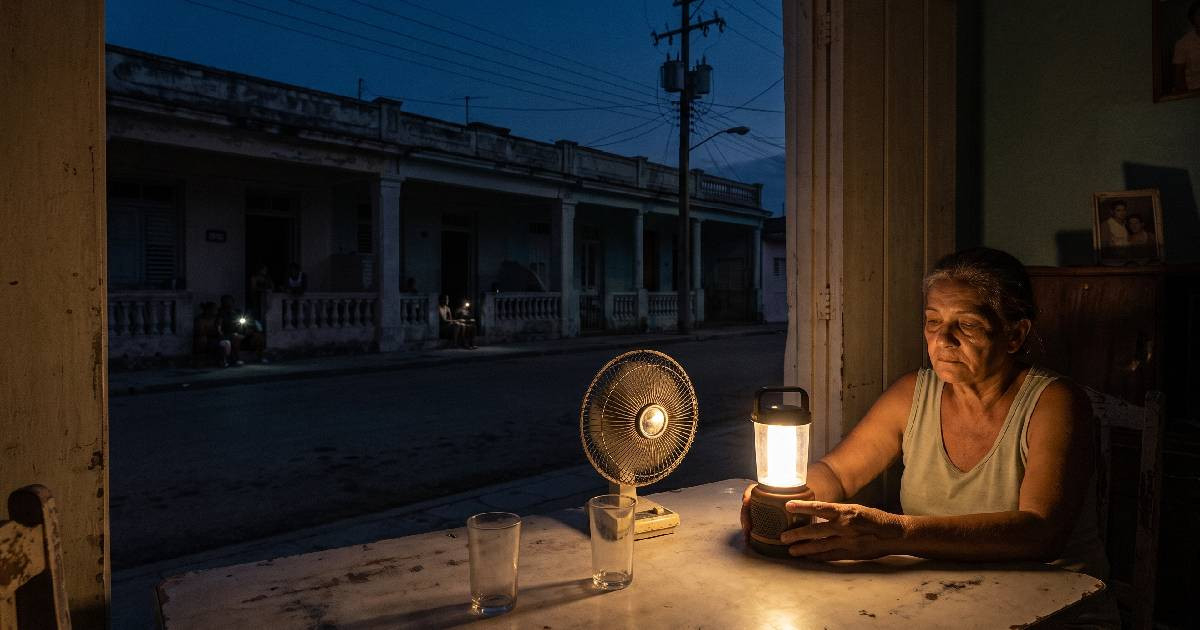
The so-called "democratization" of power outages in Holguín has sparked a wave of criticism on social media, where many Cubans see the move as merely institutionalizing the equal distribution of the electrical crisis rather than addressing the province's energy collapse.
Digital creator José Poveda Cruz took to Facebook on Saturday to sarcastically comment that "electrical democratization has finally arrived in Holguín," a supposed fair distribution where "everyone sacrifices, everyone stays in the dark."
In his satirical post, he described the new blackout schedule as "equality in the shadows," eliminating privileged circuits and spreading suffering with "administrative precision."
The post emphasizes that darkness has become the only truly equalizing factor for the population. Poveda paints a picture where relief no longer comes from improved service but from knowing that the neighbor is also without electricity, summarizing it as a form of "thermal communism" where heat, mosquitoes, and nights without a fan become shared experiences.
Current State of the Electrical Crisis in Holguín
The decision comes amid the worst deterioration of the electrical system in Holguín, with the province having only 70 MW to meet a maximum demand of 240 MW, less than 30% of the required capacity.
From this generation, 26 MW are reserved for essential services, and around 20 MW are allocated to the nickel industry, leaving just 14 MW to supply a residential demand estimated at 190 MW.
In practice, this setup means most residential circuits receive about three hours of electricity for every 39 or 40 hours without power.
A resident from the Vista Alegre neighborhood, in what is known as the City of Parks, confirmed to CiberCuba on Saturday that she went 51 consecutive hours without electricity, from Thursday until shortly before midday on Saturday when power was restored. However, she warned that the service was likely to be cut again just two hours later, with no certainty of when it would return.
Official Acknowledgment and Consequences
The general director of Holguín’s Electric Company, Ruber Reynaldo González, admitted the gravity of the situation, acknowledging that families understandably connect all their appliances when power returns, despite this demand overwhelming an already deteriorated network.
This overload further exacerbates the crisis. According to the director, each restoration of service results in the failure of 10 to 20 transformers, while the capacity to replace them is much lower. For instance, the company might receive only six transformers to replace 25 damaged units.
Public Reactions and Protest
The electrical crisis has been steadily worsening throughout 2026. In March, three-hour service rotations were implemented; by April, cuts reached up to 18 hours daily; by late May, blackouts extended beyond 24 consecutive hours, and with summer's arrival, nights without ventilation have directly affected the population's living conditions.
Citizen reactions reflect a mix of resignation, irony, and criticism of the government’s crisis management. One voice precisely summarizes: "The competition of blackouts between circuits isn't to demand improvement, but to ensure everyone suffers equally."
Another highlights the core issue: "The Cuban has descended so much in human condition that the fight isn't for everyone to have power, but for everyone to be in darkness."
One resident reported enduring over 20 days of continuous outages from 4 PM until after 8 AM, with the beach circuit prioritized. "Here it doesn’t matter if you scream, shout, or kick," she wrote.
Another citizen directly blames the regime: "If due to governmental mismanagement, which no media dares to point out, we fell into this endless crisis, there shouldn't be a part living in a different Cuba; if there's a crisis, the crisis is for everyone."
Growing discontent is also reflected in protests. The Cuban Conflict Observatory recorded 153 demonstrations related to the lack of electricity and water in April 2026 alone, out of a total of 1,133 protests reported that month, marking a 29.5% increase compared to the same period the previous year.
Understanding the Energy Crisis in Holguín
What is the "democratization" of blackouts in Holguín?
The "democratization" of blackouts refers to a new system aiming to distribute the electrical crisis equally across Holguín, where power outages are scheduled to affect all areas equally, eliminating preferential treatment of any circuits.
How are residents reacting to the power crisis?
Residents have responded with a mix of frustration, irony, and criticism, questioning the government's handling of the crisis and expressing discontent through social media and public protests.
What is the impact of power outages on daily life in Holguín?
Power outages severely impact daily life, leaving residents without electricity for extended periods, affecting their ability to cool their homes, preserve food, and perform other essential activities.