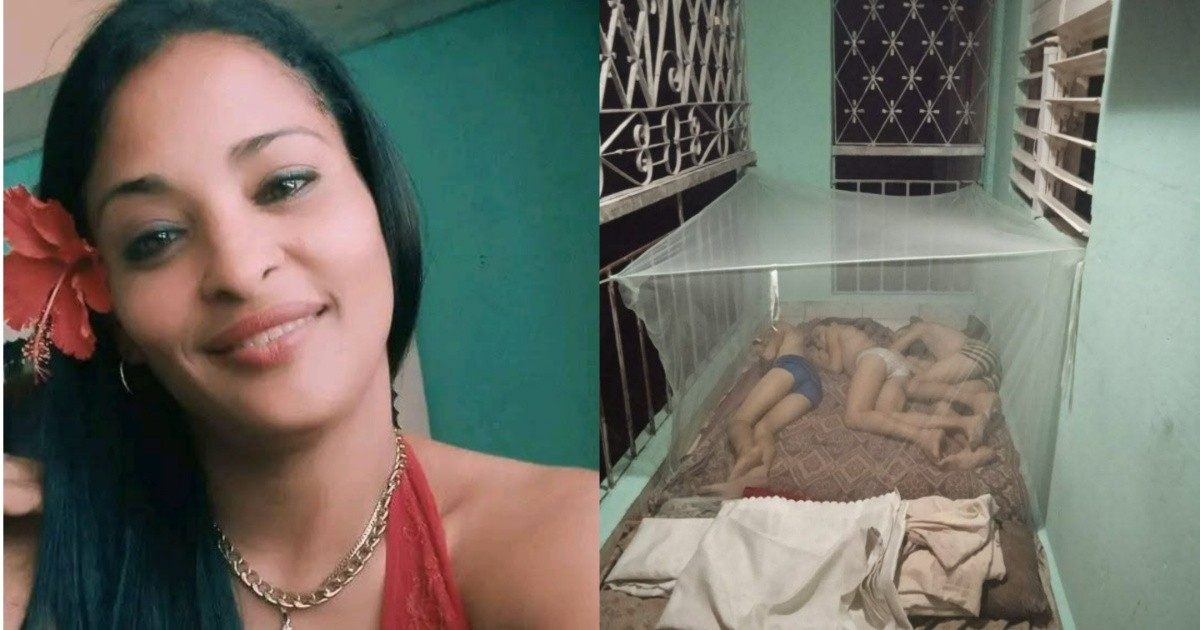
Yurisleidis Remedios, a Cuban mother, made an urgent plea on Facebook this past Friday, seeking assistance to obtain a solar panel. This would allow her to cool the room where her three children, all diagnosed with infectious mononucleosis, sleep.
“I AM ASKING FOR HELP, MY CHILDREN HAVE A VIRUS THAT HAS NO CURE CALLED INFECTIOUS MONONUCLEOSIS [...] they cannot be dehydrated or sweat, their lymph nodes are swollen right now, please, I need someone who can help me with a solar panel [...] if my children sweat at night, they might face complications,” she wrote.
The post includes images of her three kids sleeping on a mattress laid directly on the floor, under a mosquito net on a porch.
Accompanying the post are medical documents signed by Dr. Camila Amat Fong, confirming the children's diagnosis.
The Challenges of Mononucleosis
Mononucleosis, caused by the Epstein-Barr virus and often referred to as the "kissing disease," leads to high fevers reaching up to 104.9°F, intense night sweats, swollen lymph nodes, and extreme fatigue. While there is no specific antiviral treatment, the illness typically resolves on its own within three to four weeks with proper rest, hydration, and pain relief.
Yurisleidis' concerns about night sweating are medically sound: combining high fever with the severe heat due to constant power outages could worsen dehydration and overall malaise, particularly when lymph nodes are swollen and there's potential liver or spleen involvement.
Community Responses and Broader Context
The post sparked mixed reactions. Dianelys Garcia clarified that the illness "resolves on its own and disappears," noting her daughter recovered and is now 34. Ynamsay Estrada, 57, shared her experience of overcoming the same illness as a child after hospital treatment.
However, Linda Cubana defended the mother's concerns: "It's unbelievable to see some comments downplaying the children's illness... only a mother knows how it feels to have sick children, especially in a country where resources are scarce."
This situation unfolds amid Cuba's most severe energy crisis in decades. By June 2026, the country is experiencing power deficits ranging between 1,780 and 2,200 MW, causing blackouts lasting up to 26 hours daily in Havana and power cuts extending to two consecutive days in other provinces. Only eight of the 16 thermoelectric plants are operational.
Yurisleidis' case is not unique. In April, the humanitarian initiative "Dar es Dar" launched an urgent campaign to procure portable power stations for six severely ill children in Pinar del Río, whose survival depends on electric medical devices.
In March, a solidarity campaign raised funds to install solar panels in homes of sick girls in Cuba, and in February, a severely disabled man in Villa Clara issued a desperate call for help amid chronic blackouts.
Recently, six Catalan municipalities donated 20,000 euros to install solar panels at the Rural Hospital Center in Songo la Maya, Santiago de Cuba, where power outages exceed 20 hours daily. This highlights how the electricity shortage has become a direct threat to the health of Cuba's most vulnerable populations.
Understanding the Impact of Cuba's Energy Crisis
What challenges are faced by those with mononucleosis in Cuba?
Individuals with mononucleosis in Cuba face severe challenges due to high fevers and environmental heat, exacerbated by frequent power outages. This can worsen dehydration and general discomfort, particularly when access to cooling and medical care is limited.
How is the Cuban energy crisis affecting healthcare?
The energy crisis in Cuba is severely impacting healthcare by causing prolonged power outages that disrupt medical facilities' operations. This situation endangers patients who rely on electronic medical devices and adequate climate control for their treatment and recovery.