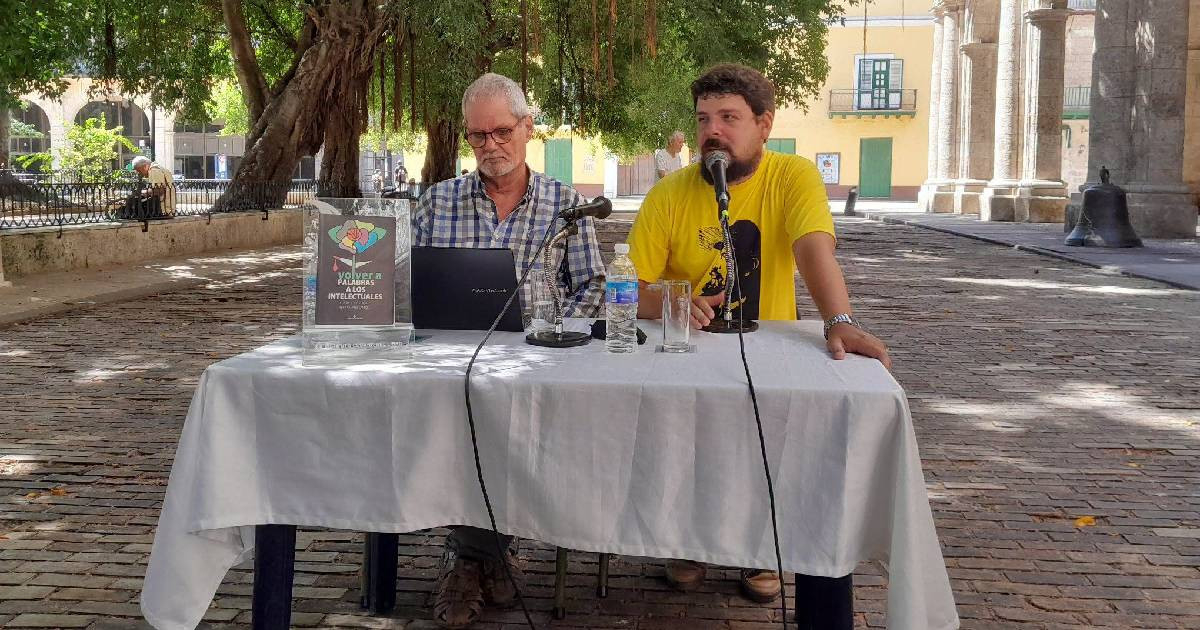
The Cuban regime's cultural machinery unveiled a new book in Havana on Saturday titled Return to Words to the Intellectuals. This compilation seeks to reaffirm Fidel Castro’s 1961 speech as the cornerstone of Cuba's cultural policy, while real debates about censorship and freedom of expression remain suppressed on the island.
The event was part of the "Saturday of Books" series at the Cuban Book Institute, located on Madera Street in Old Havana's Historic Center. Essayist Enrique Ubieta introduced the work, which was compiled by historian Elier Ramírez Cañedo and published by the Editorial Ciencias Sociales.
Official presenter Michel Torres Corona, director of the Nuevo Milenio Publishing Group, described the book as "a collection of valuable essays and texts to understand the speech that became a pivotal element of Cuban cultural policy," according to a post on the Cuban Book Institute's Facebook page.
The volume features analyses by 14 Cuban intellectuals, including Armando Hart, Roberto Fernández Retamar, Ana Cairo, Graziella Pogolotti, and Miguel Barnet.
In the foreword, Ramírez echoes Isabel Monal's assertion that Words to the Intellectuals was "more a point of arrival than a starting point," linking it to the foundational legacy of the Union of Writers and Artists of Cuba (Uneac), established in 1961.
Ubieta concluded the event by stating that "the debate over Words to the Intellectuals remains open, as do the discussion spaces for engaging with these topics and proposing new analyses, always relevant in discussions about cultural policy and its manifestations."
Anniversaries and Celebrations Amidst Suppression
This presentation is part of the official commemoration of the 65th anniversary of Castro's speech, delivered on June 16, 23, and 30, 1961, at the José Martí National Library, which established the doctrine "Within the Revolution, everything; against the Revolution, nothing."
The celebration also coincides with the Centenary Year of Commander-in-Chief Fidel Castro Ruz, whose birthday falls on August 13.
Last week, Uneac opened the Soldier of Ideas exhibit featuring posters dedicated to Castro, in an event attended by Communist Party officials.
Reality Contrasts with Official Narratives
However, the official celebrations starkly contrast with the harsh reality documented on the island. The Cuban Institute for Freedom of Expression and Press (Iclep) recorded 1,188 violations of freedom of expression in 2025, a 54.7% increase compared to the previous year.
Cuba ranks 160th out of 180 countries in the 2026 Press Freedom Index by Reporters Without Borders, the second-lowest in the Americas, only ahead of Nicaragua. According to Prisoners Defenders, there were 1,281 political prisoners in Cuba as of May.
Among those imprisoned are young creators like Ernesto Ricardo Medina and Kamil Zayas Pérez of the audiovisual project El4tico. They have been detained since February 6 in Holguín on charges that could lead to up to nine years in prison for exercising the freedom of expression that the 1961 speech claimed to protect.
Analyst José Manuel González Rubines pointed out this week that, rather than opening up, the Cuban state "criminalizes all forms of expression, whether digital or physical."
Normando Hernández, director of Iclep, succinctly captured the situation: "The dictatorship doesn't reform its repressive practices; it perfects them."
Understanding Cuba's Ongoing Censorship Issues
What is the significance of the book Return to Words to the Intellectuals?
The book seeks to reaffirm Fidel Castro’s 1961 speech as a foundational element of Cuba's cultural policy, despite ongoing suppression of debates about censorship and freedom of expression on the island.
How does the current reality in Cuba contrast with official celebrations?
Official celebrations for the anniversary of Castro's speech conflict with documented increases in censorship and repression, as highlighted by organizations like Iclep and Reporters Without Borders.