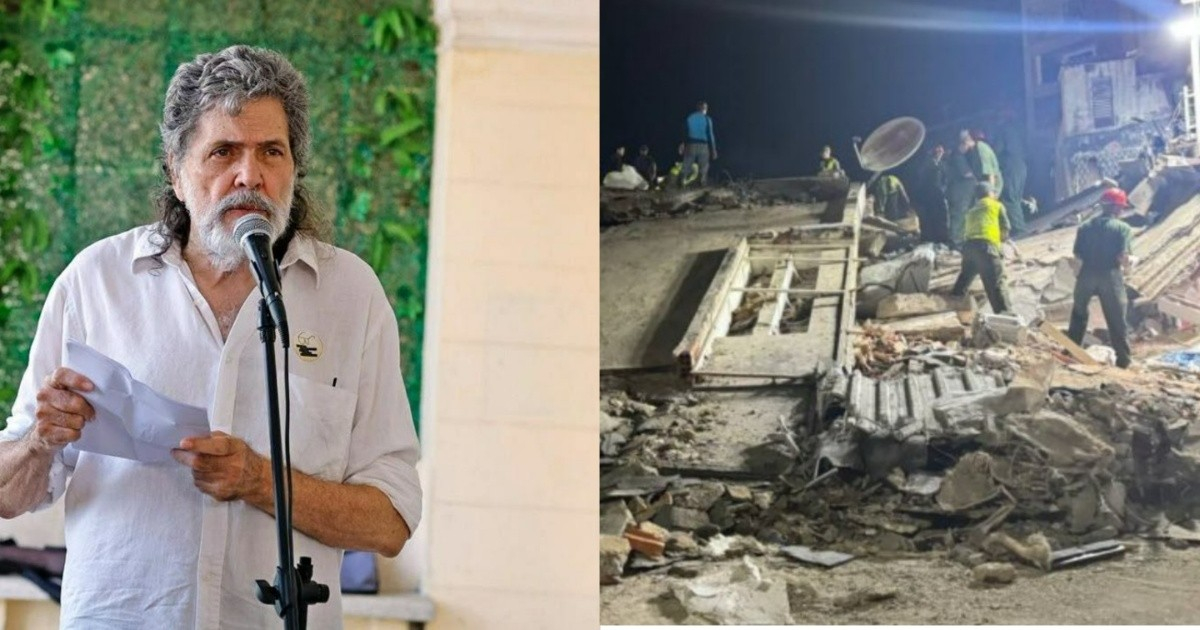
Abel Prieto, head of Casa de las Américas and a key advisor to Cuba's ruling regime, has seized upon the recent earthquake disaster in Venezuela to launch yet another anti-imperialist propaganda campaign. He took to Facebook to post an image of armed U.S. Marines, casting doubt on Washington's humanitarian motives.
On Saturday, Prieto shared a photograph depicting U.S. Marine Corps soldiers in camouflage gear, tactical vests, assault rifles, and combat backpacks aboard a naval vessel, with a CH-53E helicopter in the background. His accompanying text left little room for interpretation: "These images of Yankee 'rescuers' sent to Venezuela by U.S. Southern Command are circulating online. 'Humanitarian Rambos'? Who knows? Our full solidarity with the Venezuelan people!!! Cuban doctors are there, saving lives on the front lines!!!"
Prieto's post appears aimed at casting suspicion on the U.S. humanitarian response at a time when Venezuela is grappling with its worst recorded seismic disaster. The "seismic doublet" on June 24 claimed at least 920 lives, injured 3,360, and affected over 6.76 million people, according to official Venezuelan figures.
U.S. Aid Officially Welcomed by Venezuela
What Prieto deliberately leaves out is that Venezuela officially accepted U.S. aid. Secretary of State Marco Rubio announced the dispatch of search and rescue teams from Virginia and California, alongside $150 million in humanitarian assistance. U.S. Southern Command deployed C-17 Globemaster aircraft, Osprey and Chinook helicopters, and the USS Fort Lauderdale and USS Billings ships, with Major General Kevin J. Jarrard personally traveling to Caracas to oversee the mission.
Prietó also fails to mention that at least 30 Cubans remain missing or trapped under the rubble in Venezuela, as reported by independent outlet elToque, including two children. The Cuban regime has systematically ignored this reality in its official narrative, which focuses on portraying its doctors as the only true humanitarians in the region.
The Propaganda Pattern
Prietó's move follows a well-trodden path. In May 2026, he labeled Cubans who support Trump and Rubio as "rabid annexationists," and in January, he described Cuba as being in a "national emergency" following an executive order by the U.S. president. His rhetoric of "David facing a lying and cowardly Goliath" is a constant feature of the discourse the regime's ideological apparatus tasks him with maintaining.
The image Prieto uses as "evidence" of supposed military intentions by Washington depicts a standard boarding operation, with no verified direct link to the rescue mission in Venezuela. Armed personnel's presence in humanitarian missions is customary in unstable areas, and this deployment includes over 1,600 international rescuers from 16 countries, including Spain, France, Colombia, and Chile.
What the Cuban official frames as an indictment of imperialism is, in truth, an exploitation of a tragedy that has left hundreds of thousands of Venezuelans homeless, to fuel the discourse of a regime that has spent decades using medical missions in Venezuela as a bargaining chip for subsidized oil. Meanwhile, its citizens trapped under debris await news that Havana does not provide.
Key Questions on U.S. Aid to Venezuela
What is the U.S. humanitarian response to the Venezuelan earthquake?
The United States has sent specialized search and rescue teams and pledged $150 million in humanitarian assistance to Venezuela. U.S. Southern Command also deployed aircraft, helicopters, and naval vessels to aid in the relief efforts.
How has Cuba responded to the disaster in Venezuela?
Cuba has sent doctors to help with the emergency response in Venezuela. However, the Cuban regime's official narrative has focused on presenting these doctors as the sole true humanitarians, while ignoring the plight of Cuban citizens missing or trapped in the disaster.
Who are the international participants in the Venezuelan rescue efforts?
The rescue operation in Venezuela involves over 1,600 international rescuers from 16 countries, including Spain, France, Colombia, and Chile, alongside U.S. teams.