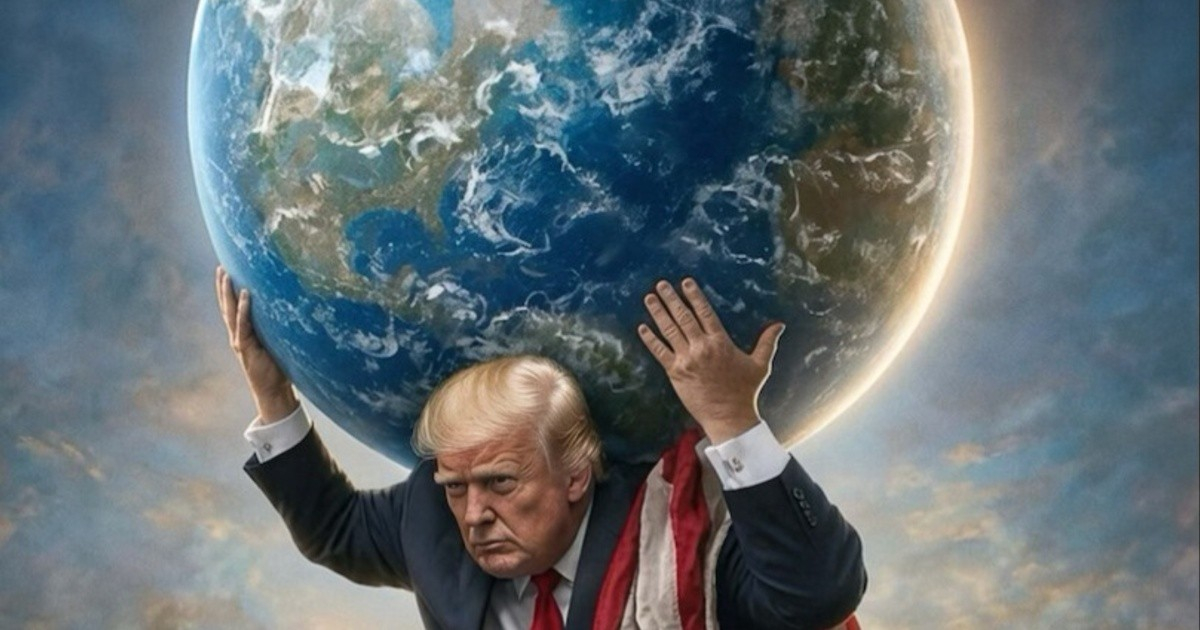
This past Saturday, Donald Trump shared an AI-generated image on his X account, depicting himself as the mythological Greek titan Atlas, solemnly bearing the weight of the world on his shoulders.
The hyper-realistic illustration showcases Trump in a dark suit, red tie, and an American flag-colored sash draped like a cape. He stands atop rocky terrain against a mountainous backdrop, with epic lighting and a halo encircling the globe.
The symbolism is unmistakable: Atlas, a figure from Greek mythology, is destined to support the world eternally, and this image likens Trump to an indispensable leader shouldering global responsibilities.
Interestingly, this depiction contradicts the White House's own National Security Strategy released in December 2025, which stated that "the era of carrying the entire world order like Atlas has ended." This highlights a significant divergence from the administration's official stance.
This isn't the first time Trump has resorted to AI-generated images with messianic or heroic undertones. In April 2026, he posted on Truth Social an image portraying himself as Jesus Christ healing a patient in a hospital bed, clad in a white robe with hands emitting light, surrounded by American flags, fighter jets, and angelic figures. The image was removed after more than 12 hours following backlash, labeled blasphemous even by his conservative and Catholic allies.
Activist Isabel Brown described it as "repugnant," while Riley Gaines warned that "God should not be mocked." Trump defended the image, claiming it was meant to depict him as a Red Cross doctor.
Days later, another AI image surfaced showing Jesus embracing Trump with the American flag in the background, and he had previously shared an illustration of himself dressed as the Pope.
By May 2026, Trump had escalated this approach with war-themed memes featuring phrases like "It Was The Calm Before The Storm" and animations of warships with the text "Fire. Boom." These were also shared via the official White House Rapid Response 47 account.
In January 2026, he posted AI-generated maps depicting Canada, Greenland, and Venezuela under the American flag, blending a heroic image with specific geopolitical provocations.
The pattern is clear: Trump employs AI imagery as a deliberate political communication tool, projecting a narrative of absolute power and messianic leadership amid international tensions, particularly the conflict with Iran and the depletion of U.S. military resources.
The Atlas image shared this Saturday is the latest addition to this strategy, reinforcing a narrative celebrated by his supporters and criticized by his detractors as an unprecedented display of megalomania in U.S. presidential communication.
Understanding Trump's Use of AI Imagery
Why does Trump use AI-generated imagery?
Trump uses AI-generated imagery to project a narrative of absolute power and leadership, often incorporating symbolic and messianic themes to influence public perception.
How has the public reacted to these AI images?
The public reaction has been mixed, with some supporters celebrating the imagery, while critics, including some of his conservative and Catholic allies, have condemned it as blasphemous and inappropriate.
What was the response to Trump's depiction as Jesus?
The depiction of Trump as Jesus was met with significant backlash, labeled as blasphemous by many, prompting its removal after a short period online.