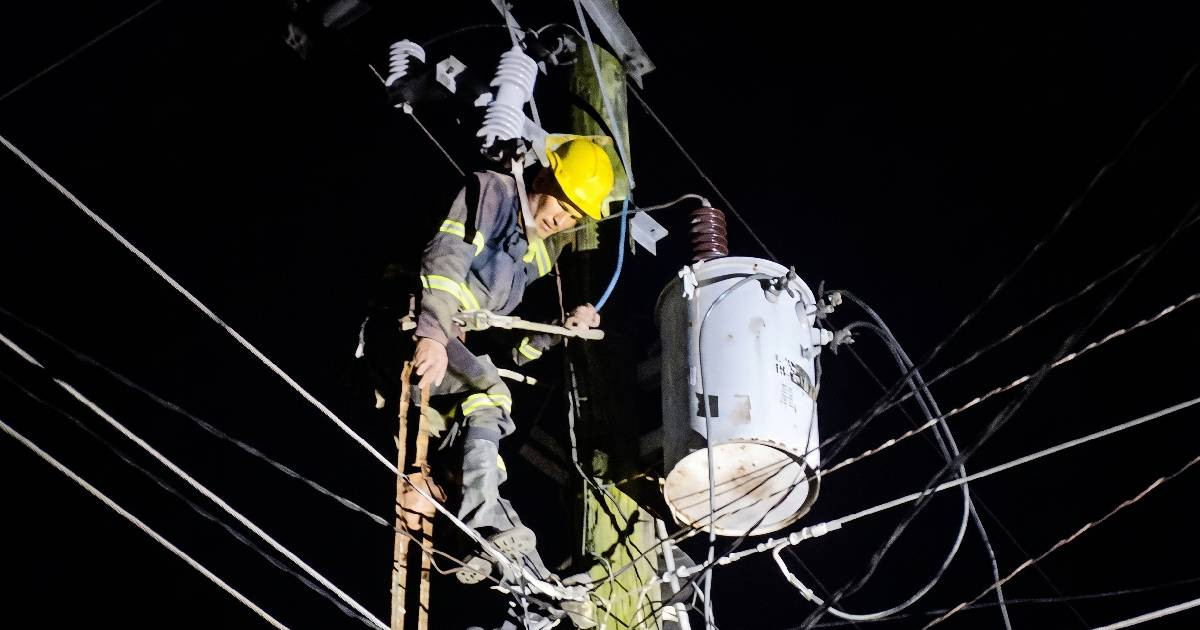
The electric grid in Sancti Spíritus is experiencing an unprecedented crisis, with blackouts lasting over 40 to 50 continuous hours, interrupted by service windows of just three hours or less. This alarming situation was acknowledged on Saturday by Roberto Hernández Rojas, the general director of the region's Electric Company.
"We've been waking up to more than 40 hours of power outages consecutively. The longer the blackout, the greater the overload when the circuit is restored," Hernández warned during an interview with Radio Sancti Spíritus.
He described the circumstances as "extremely complex," attributing the crisis not only to local issues but also to the imbalance within the National Electric System (SEN).
Critical Energy Deficit Across the Island
This past Saturday, the SEN forecast predicted a deficit of 2,165 MW during peak hours, with only 1,015 MW available against a demand of 3,150 MW, creating another weekend of critical energy shortages for the entire island.
A major factor exacerbating the provincial situation is the so-called "coincidence factor." When power returns after prolonged outages, residents simultaneously switch on all their appliances, causing a demand surge far beyond the circuit's capacity.
"In those three hours, we try to accomplish everything we'd normally do in a full day. Turbines are fired up, air conditioners are turned on, cooking, laundry, ironing, and charging devices all happen at once. The coincidence factor is nearly one: as soon as electricity is back, everything gets connected," Hernández explained.
Infrastructure Overload and Damage
This surge pushes circuits to 200% of their nominal capacity, leading to explosions and fires in transformers and stretching primary circuit conductors to their limits.
As of 2026, the province has approximately 60 damaged transformers, with 14 residential units out of service, awaiting national manufacturing and resource allocation for replacements. The Electric Company is inundated with 90 to 120 daily outage reports.
Cabaiguán is the hardest-hit municipality. Unlike other areas, it operates at a lower voltage since it wasn't upgraded to the 13 kV system during the so-called Energy Revolution, necessitating more robust conductors and transformers, which the grid lacks. Some communities have been suffering outages since the start of the month, according to reports.
"We've been forced to undertake rapid measures, like building a new substation in El Naranjal and splitting circuit 20 to serve one half, then the other, as the conductor can't manage the entire circuit," the director detailed.
Widespread Communication Breakdown
An additional severe consequence is the complete loss of communications. When power goes out, the municipality of Yaguajay becomes isolated due to the absence of backup batteries for telephone towers.
The company is working to restore its own frequency modulation channels in Fomento, Jatibonico, and Cabaiguán to at least ensure one communication channel, the media reported.
The dire situation in Sancti Spíritus mirrors complaints from the circuit 116 neighborhood. Ayaini Valdés highlighted that 70 families have endured seven days without electricity following a transformer explosion that the company couldn't replace due to a lack of parts.
"How long will this mistreatment and injustice continue? Seven days without power, with children, elderly people, and those who need electricity," Valdés demanded.
This scenario occurs amid the worst period in Cuba's electrical history. On June 25, Cuba recorded an all-time high in electrical deficit, with a 2,208 MW maximum impact, while Matanzas communities faced up to 85 consecutive hours without power.
Faced with this reality, Hernández was clear about the system's limitations: "All electricity is possible, but it requires investments, and today we lack the necessary resources."
Understanding the Electric Crisis in Sancti Spíritus
What is causing the prolonged blackouts in Sancti Spíritus?
The blackouts are primarily due to the imbalance in the National Electric System and local grid issues, compounded by high demand when power is restored after long outages.
How are the blackouts affecting daily life in Sancti Spíritus?
Residents experience severe disruptions, trying to complete all daily tasks in short service windows, leading to overloaded circuits and damaged infrastructure.
What measures are being taken to address the grid issues?
Efforts include constructing new substations and splitting circuits to manage loads, though long-term solutions require substantial investment and resources.