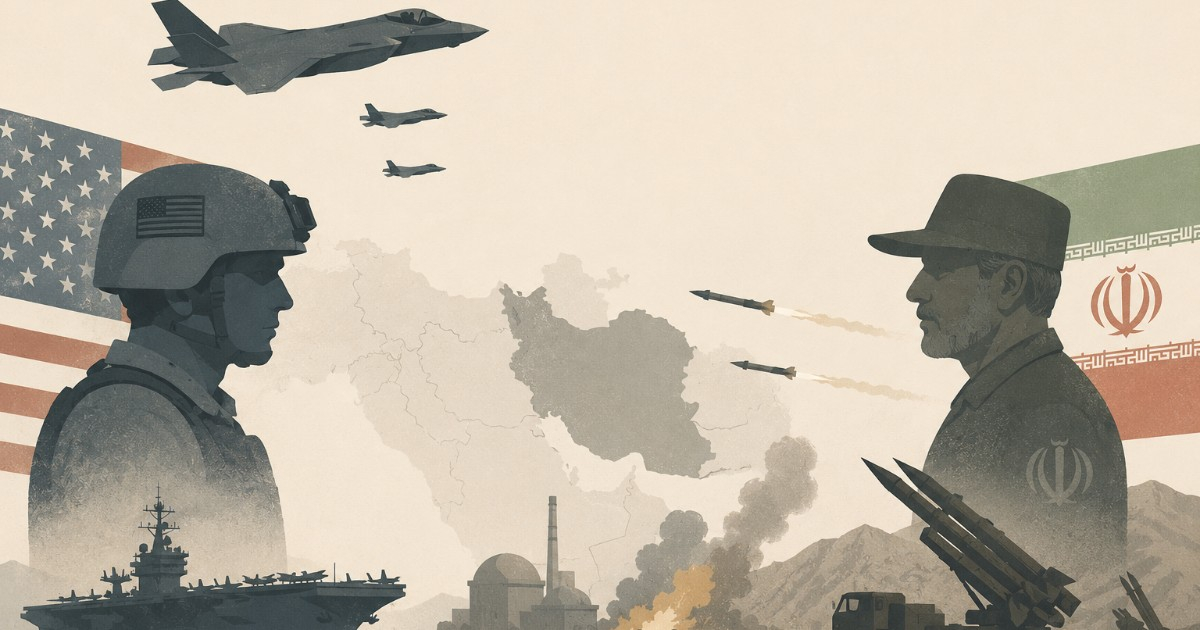
On Saturday, Iran's Revolutionary Guard announced that it had targeted U.S. military positions close to the Strait of Hormuz. This action was described as a direct retaliation to airstrikes carried out by Washington on Friday against military sites on Iran's southern coast, as reported by the EFE agency.
The elite force declared in a statement released by the Tasnim news agency, "The Revolutionary Guard Navy responded to this aggression by attacking positions where the terrorist U.S. Army forces are deployed."
Simultaneously, Iran launched a drone strike on Bahrain, home to the U.S. Navy's Fifth Fleet, hitting a vessel in the Strait of Hormuz. This further escalated tensions in a region already experiencing weeks of military buildup.
The Iranian offensive occurred just 24 hours after the U.S. military bombed missile, drone storage, and coastal radar sites in Iran on Friday at 5 p.m. Eastern Time. Iranian state television reported damage to air defense areas on the Persian Gulf coast, including the cities of Abbas Qesh and Sir.
This U.S. retaliation was in response to an Iranian attack on Thursday on the Singapore-flagged merchant ship M/V Ever Lovely as it exited the Strait of Hormuz off the coast of Oman. U.S. forces shot down three out of four launched drones, but one hit the ship's upper deck, causing material damage without injuries. The U.S. Central Command (CENTCOM) labeled the attack a violation that "undermined the freedom of navigation" in the strategic maritime corridor, and former President Donald Trump condemned it as a "senseless" and "foolish" breach of the ceasefire.
The Revolutionary Guard justified the attack on the Ever Lovely, claiming the vessel was on an unauthorized route and cited clause 5 of the Islamabad Memorandum of Understanding, signed on June 17 with mediation by Pakistan and Qatar. This agreement grants Iran control over Strait transit and established a ceasefire that included unfreezing at least $12 billion in Iranian assets.
"According to clause 5 of the Islamabad Memorandum of Understanding, the organization and control of transit in the Strait of Hormuz belong to the Islamic Republic of Iran. However, the United States attempted to violate this agreement through various provocations, thus receiving the appropriate response," stated the Revolutionary Guard, accusing Washington of breaching the memorandum.
The Iranian military body also warned that any further U.S. aggression would result in a "broader" response, a threat that increases the risk of an unpredictable escalation affecting the passage of 20% of the world's oil through the Strait of Hormuz.
The conflict between these powers began in late February 2026 with "Operation Epic Fury," a joint air campaign by the U.S. and Israel, causing several closures of the Strait. A U.S. official noted that Friday's strikes against Iran "do not signal a return to large-scale combat operations," though Iran's new offensive on Saturday puts the fragile truce negotiated just ten days ago in serious jeopardy.
Understanding the Recent Tensions in the Strait of Hormuz
What triggered the recent Iranian attack near the Strait of Hormuz?
The Iranian attack was a direct response to U.S. airstrikes on Iranian military positions on the southern coast, which took place on Friday.
How did the U.S. respond to the Iranian attack on the M/V Ever Lovely?
The U.S. responded by bombing missile, drone storage, and coastal radar sites in Iran, asserting the need to uphold freedom of navigation in the Strait.
What is the Islamabad Memorandum of Understanding?
The Islamabad Memorandum of Understanding, mediated by Pakistan and Qatar, grants Iran control over transit in the Strait of Hormuz and includes a ceasefire agreement involving the unfreezing of Iranian assets.
What are the potential consequences of the ongoing conflict in the Strait of Hormuz?
The conflict poses a significant risk to global oil supply, as the Strait of Hormuz is a critical passageway for 20% of the world's oil. Further escalation could disrupt this vital shipping route.