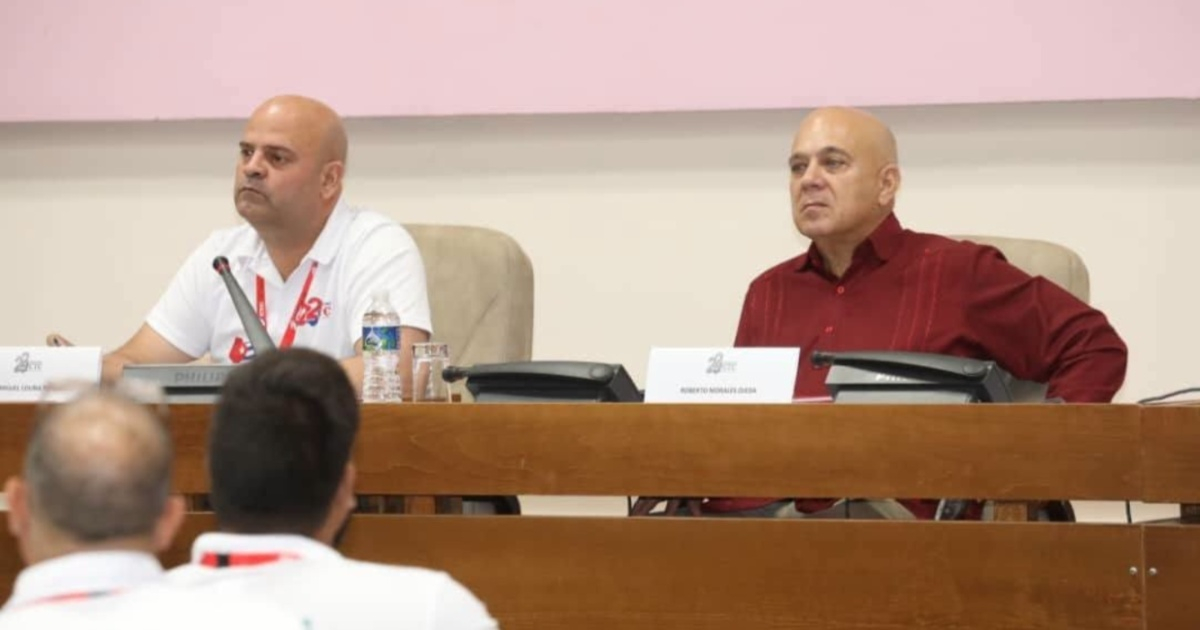
Roberto Morales Ojeda, a key figure in the Political Bureau of the Communist Party of Cuba, declared on Saturday that the 22nd Congress of the Central de Trabajadores de Cuba (CTC) was conducted with "transparency and commitment." He shared this sentiment on his personal Facebook page following the conclusion of the labor assembly held in Havana.
The congress took place on Friday and Saturday under the slogan "For Cuba, Together We Create," bringing together 759 delegates. Of these, 198 attended in person at the Palace of Conventions in Havana, while 561 joined via videoconference from the country's 15 provinces. This hybrid format, ascribed by the regime to the "current circumstances" in Cuba, reflects the ongoing challenges faced by the nation.
Miguel Díaz-Canel presided over the event, with attendance from Vice President Salvador Valdés Mesa and former second secretary of the PCC, José Ramón Machado Ventura.
Economic Crisis Highlighted at the Congress
The sessions were described as "constrained, modest, and pragmatic," echoing the severe economic crisis plaguing Cuba. The nation faces prolonged blackouts, widespread shortages, and a projected GDP decline of 6.5% by 2026, marking the worst performance in Latin America for the second consecutive year, according to CEPAL.
Central to the discussions were issues like the erosion of wages due to inflation, the predicament of workers forced to shift jobs due to energy shortages, and the concept of "union democracy."
Debate Over Economic Reforms
The congress also critically examined the non-state sector, which now comprises over half of the workforce in industries such as transportation, commerce, construction, and communications.
Morales Ojeda emphasized the "active role of the labor movement in the transformations approved to strengthen the economy and produce outcomes that allow us to progress and overcome the country's challenging situation." Nonetheless, he attributed the crisis to the U.S. embargo, following the regime's customary narrative.
This congress aligns with a series of 176 economic reforms approved by the regime on June 18, including opening up to foreign investment in private businesses, establishing private banks, and lifting the cap of 100 employees for small and medium-sized enterprises.
The Illusion of Union Democracy
Díaz-Canel approached the assembly with the message that workers must "create wealth" within what he termed a "wartime economy."
The CTC remains the sole permitted union organization in Cuba, under the Communist Party's control. The new Labor Code, consulted with over two million workers in 2025, does not recognize the right to strike or allow independent unions, making any mention of "union democracy" a stark contradiction to the actual labor landscape in Cuba.
On Saturday, the election of the new national secretariat of the CTC was also scheduled. The organization has been led by Osnay Miguel Colina Rodríguez since July 2025, following the removal of Ulises Guilarte after a 12-year tenure as head of the labor central.
Understanding the Economic and Labor Challenges in Cuba
What was the main focus of the 22nd Congress of the Central de Trabajadores de Cuba?
The congress focused on addressing Cuba's economic crisis, including wage erosion due to inflation, the challenges faced by workers amid energy shortages, and discussions on "union democracy."
Why is the mention of "union democracy" considered contradictory in Cuba?
The term "union democracy" is seen as contradictory because Cuba does not allow independent unions, and the only legal union, the CTC, is controlled by the Communist Party, restricting genuine democratic practices.
What economic reforms were discussed during the congress?
The congress discussed a series of 176 economic reforms, including attracting foreign investment in private enterprises, creating private banks, and removing the employee cap for small and medium-sized businesses.