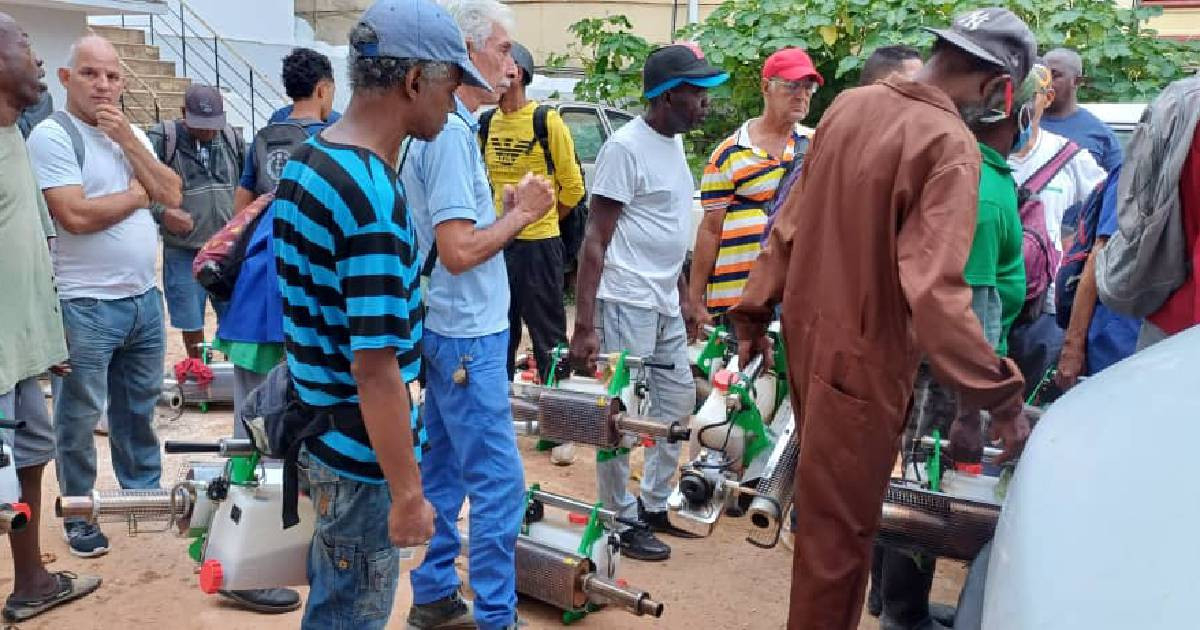
The Cuban government announced plans on Friday to mobilize unemployed or temporarily suspended workers into community work brigades. This initiative was proposed by Miguel Díaz-Canel during the 22nd Congress of the Cuban Workers' Central (CTC), held at the Havana Convention Palace.
Díaz-Canel argued that since workers spend more time in their neighborhoods than at their workplaces, the labor movement needs to reorganize outside of traditional work centers.
"How do we organize them into community work brigades to assist with energy issues, food production, care for people with disabilities, repair things for people, and provide services to the community? We can only achieve this with your participation," Díaz-Canel stated to the congress delegates, according to the official report by Cubadebate.
The event gathered 759 delegates, with 561 joining via videoconference from the provinces, reflecting the severe economic and energy crisis currently affecting the country.
Osnay Miguel Colina Rodríguez, the new president of the CTC, presented the central report and also suggested creating comprehensive community brigades comprising plumbers, masons, carpenters, and electricians who are unable to work at their usual sites due to the crisis.
Díaz-Canel described the current situation as a "war economy" and outlined five governmental priorities: national defense, the implementation of the 2026 Economic and Social Program, boosting national production, attracting foreign investment, and ensuring food sovereignty.
He emphasized that none of these goals can be achieved without worker mobilization: "Without the active participation of workers, the recently approved economic and social transformations will not yield the results the country desires."
Historical Labor Crisis Amid Economic Turmoil
This proposal comes amid a labor crisis of historic proportions. Official statistics indicate that nearly half of working-age individuals in Sancti Spíritus are unemployed.
Nationwide, more than half of working-age Cubans are neither employed nor seeking jobs, according to the National Employment Survey conducted in July 2025.
The average state salary was 6,930 pesos in 2025, roughly equivalent to $13 at the informal exchange rate, discouraging formal employment and driving the population toward the private sector or emigration.
The community brigade initiative overlaps with the "My Neighborhood for the Homeland" program, approved by the Council of State in March, which includes a Productive Neighborhood front to engage the population in local tasks. Critics argue that this serves as an enhanced social control mechanism over communities burdened by blackouts and shortages.
The new Labor Code, published in June, will take effect 90 days after its publication in the Official Gazette. Decree 149/2026 already regulates temporarily suspended workers, guaranteeing them 100% of their salary for the first month and 60% thereafter.
Understanding Cuba's Labor Challenges
What is the purpose of the community work brigades proposed by Díaz-Canel?
The community work brigades aim to organize unemployed or suspended workers to assist with local issues such as energy, food production, and community services, fostering worker participation in addressing the nation’s current crisis.
How does the current economic situation affect employment in Cuba?
Cuba's economic crisis has led to a significant portion of the workforce being unemployed, with many turning to the private sector or considering emigration due to insufficient state salaries and lack of job opportunities.
What are the criticisms of the "My Neighborhood for the Homeland" program?
Critics argue that the program acts as a strengthened social control mechanism over communities already struggling with blackouts and shortages, rather than genuinely addressing local needs.