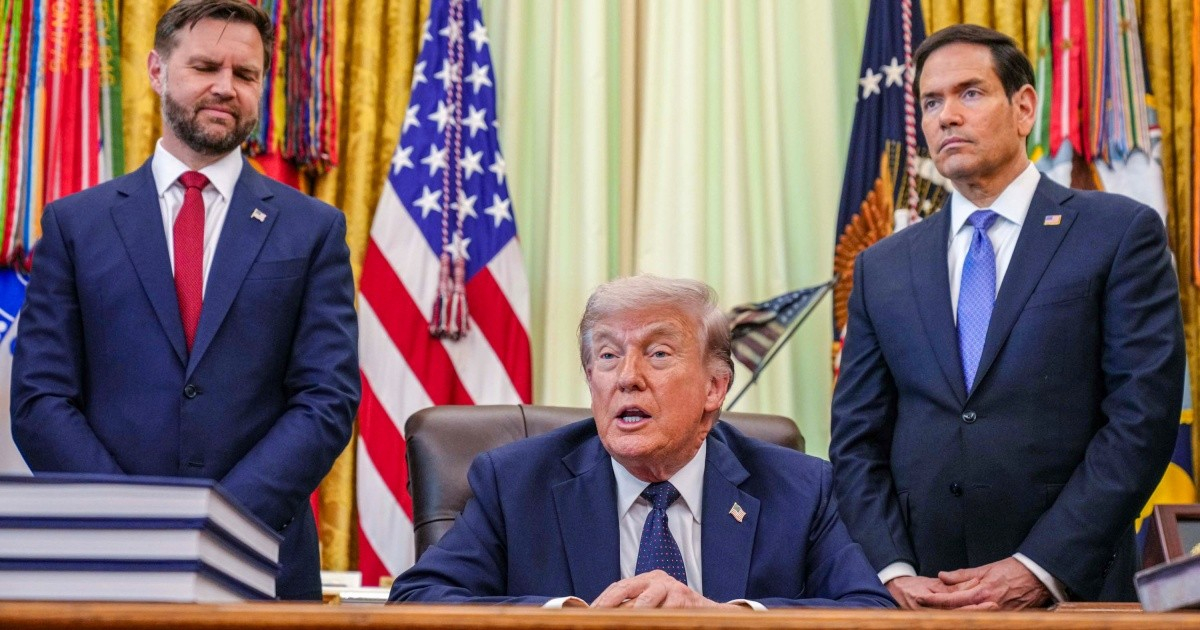
On Friday, Donald Trump and Secretary of State Marco Rubio reached out to Venezuela's interim president, Delcy Rodríguez, to reiterate Washington's support for the Caribbean nation amidst the humanitarian crisis triggered by the devastating earthquakes on June 24.
Rodríguez shared news of the call on her X account with a brief yet diplomatically significant statement: "I received a call from President @realDonaldTrump and Secretary of State @marcorubio, who reaffirmed the United States Government's support during this challenging time for Venezuela."
This communication occurred two days after two major earthquakes, measuring 7.2 and 7.5 on the Richter scale and occurring just 39 seconds apart, struck the northern region. Their epicenter was approximately 21 kilometers west of Morón in Carabobo state.
According to Rodríguez's updated official report on Friday, the death toll stands at 589 with 2,980 injured. However, Venezuelan Parliament President Jorge Rodríguez reported that by June 25, the figures had risen to 920 deceased and 3,360 injured.
This call marks the second high-level engagement by the Trump administration in response to the disaster. On June 25, Rubio had already reached out to Rodríguez to extend condolences and announce the immediate deployment of rescue teams, making it the second high-level communication in less than 24 hours.
Rubio also revealed the allocation of $150 million in humanitarian aid: $100 million through the UN Office for the Coordination of Humanitarian Affairs and $50 million for on-the-ground organizations.
The U.S. Southern Command mobilized military forces, ships, and aircraft to assist in rescue operations, while the Treasury Department temporarily lifted sanctions until October 23 to ease financial transactions related to relief efforts.
From the outset, Trump set the tone by posting on Truth Social on June 24 that the U.S. was "ready, willing, and able" to aid Venezuela, referring to Venezuelans as "our new and great friends."
The UN estimates that up to 6.76 million individuals might have been impacted by these seismic events, the most powerful recorded in Venezuela since 1900. The structural damage has led to the closure of Maiquetía International Airport, complicating international aid delivery, with over 137 aftershocks and at least 7,000 missing persons reported.
This latest call also underscores the profound diplomatic shift between Washington and Caracas. After Nicolás Maduro's capture in January 2026, Trump formally acknowledged Rodríguez's government in March, with the U.S. flag raised at the Caracas embassy on the 14th of that month.
Rodríguez had previously noted on June 25 that "Venezuela will never forget the helping hand extended to our people in these trying times," a sentiment that gains further significance following this direct engagement with Trump and Rubio.
Key Insights into U.S. Support for Venezuela Post-Earthquakes
What was the magnitude of the earthquakes that struck Venezuela?
The earthquakes that hit Venezuela had magnitudes of 7.2 and 7.5 on the Richter scale.
How is the U.S. supporting Venezuela after the earthquakes?
The U.S. is providing support through humanitarian aid, military assistance, and temporary suspension of sanctions to facilitate relief efforts.
What diplomatic changes occurred between the U.S. and Venezuela?
Following Nicolás Maduro's capture, the U.S. recognized Delcy Rodríguez's government, marking a significant diplomatic shift.