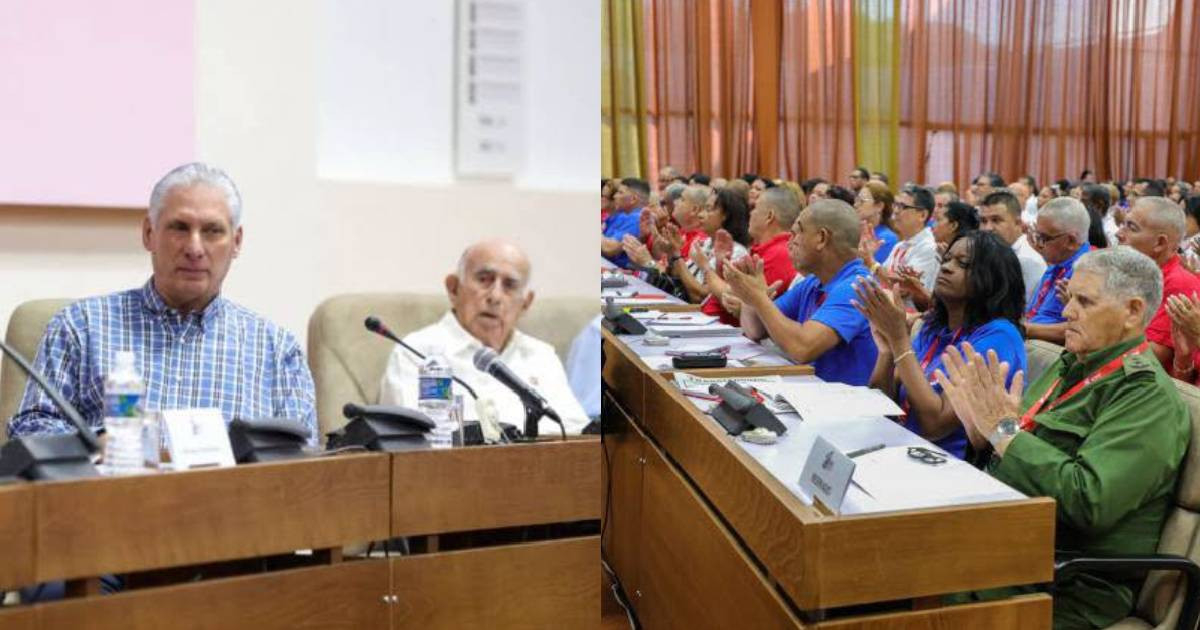
This past Friday, Cuba's leader Miguel Díaz-Canel made an appearance at the afternoon session of the 22nd Congress of the Central de Trabajadores de Cuba (CTC), held at Havana's Convention Palace. This move by the regime aims to bolster the standing of the official labor organization amidst an unparalleled economic crisis.
Accompanying the president were Roberto Morales Ojeda, a member of the Political Bureau of the Partido Comunista de Cuba (PCC); Vice President Salvador Valdés Mesa; and former Second Secretary of the PCC José Ramón Machado Ventura, along with other party and government officials, according to the Cuban News Agency.
The congress, attended by 759 delegates—561 participating via videoconference from various provinces and the others present physically—operates under the slogan "For Cuba, Together We Create." This hybrid format is a necessity due to the island's prevailing energy and economic crises.
During the event, Deputy Prime Minister Oscar Pérez Oliva-Fraga presented to the delegates 176 recent economic and social transformations approved by the National Assembly of People's Power. Meanwhile, the Minister of Labor and Social Security, Jesús Otamendiz Campos, elaborated on the changes to the Labor Code.
"Without implementing these economic and social transformations, we cannot achieve the objectives set in the Government Program," stated Pérez Oliva-Fraga, as highlighted in an extensive report by the official newspaper Granma.
The central report of the congress, delivered by Osnay Miguel Colina Rodríguez, head of the organizing committee, provided a critical assessment of the past six years of the labor movement and set forth priorities for the future.
Colina outlined that the lead-up to the congress involved 74,167 meetings of labor collectives, with 92.2% of members participating, leading to 42,430 suggestions and proposals, according to sources.
The congress also served as a platform to award the commemorative seal for the CTC's 85th anniversary to "Cuban fighters who opposed American forces during the kidnapping of Venezuelan President Nicolás Maduro," a political propaganda gesture that does little to address the real issues faced by Cuban workers.
The backdrop of the event stands in stark contrast to official rhetoric: the minimum wage was increased to 3,210 pesos, a 53% hike, yet independent economists estimate an individual requires at least 96,000 pesos monthly to cover basic needs—thirty times the minimum wage.
Recently, the official newspaper Invasor acknowledged that wages are "the main source of discontent" among workers, exposing the disconnect between the labor congress and the everyday reality of Cubans.
The very necessity of the CTC has been openly questioned. Elizabeth González Aznar, a citizen, recently published an open letter questioning the cost of maintaining the CTC and other mass organizations linked to the PCC.
"These organizations contribute nothing economically, yet they consume a significant portion of the state's budget and resources," she emphasized.
The new Labor Code, which underwent a public consultation involving over two million workers between September and November 2025, fails to recognize the right to strike or allow for independent unions, thereby maintaining the CTC's monopoly on labor representation—a body that has operated as a compliant arm of the PCC since 1961 without genuine independence.
Frequently Asked Questions About the CTC and Labor Issues in Cuba
What is the role of the Central de Trabajadores de Cuba (CTC)?
The CTC is the official labor organization in Cuba, historically serving as an extension of the Communist Party of Cuba (PCC) to represent workers' interests, although its independence and effectiveness have been widely criticized.
How has the economic crisis affected Cuban workers?
The economic crisis has severely impacted Cuban workers, with the minimum wage significantly below the estimated cost of living, leading to widespread dissatisfaction and criticism of the government's economic policies.
Why is the CTC's relevance being questioned?
The CTC's relevance is being questioned due to its perceived lack of independence from the PCC and its failure to effectively address the economic and labor issues faced by Cuban workers.