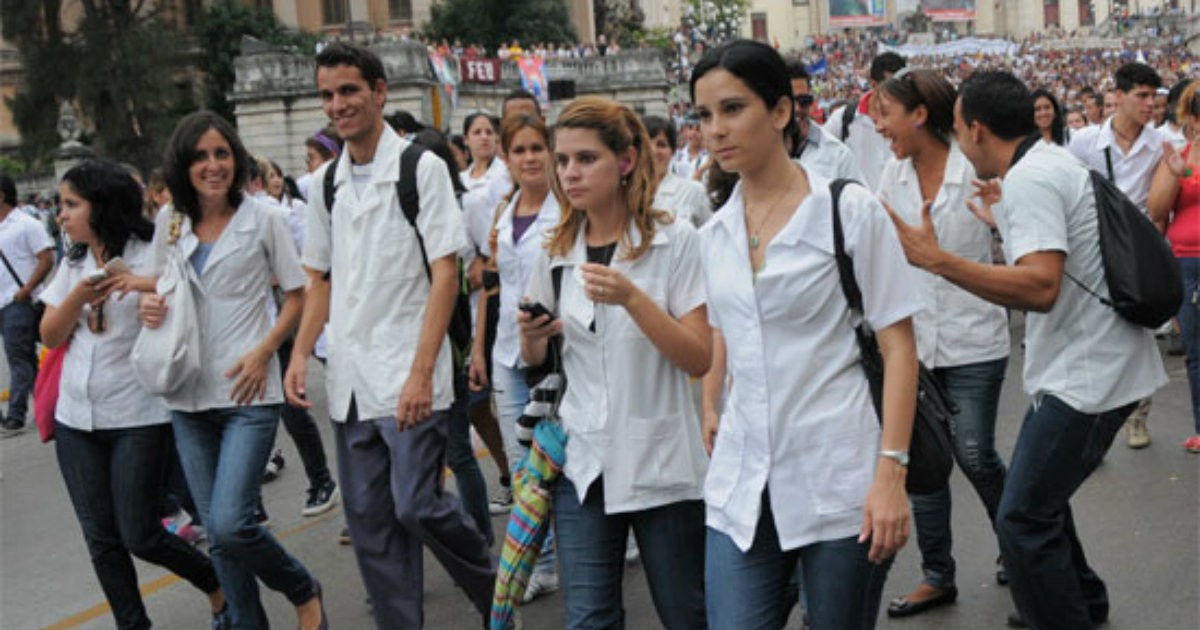
First-year medical students in Santiago de Cuba and Holguín have joined the growing wave of protests initiated by their peers in Pinar del Río and Granma. They are demanding either the cancellation or modification of final exams due to the severe logistical and electrical crisis currently plaguing Cuba.
Both student communities have submitted formal letters to their respective university councils, underscoring an ethical plea: "To highlight the objective limitations currently undermining our academic performance."
The comprehensive final exams are currently scheduled for June 29 through July 3.
Challenges Faced by Medical Students
Students from the University of Medical Sciences in Santiago de Cuba argue that the evidence is clear: "The vulnerability in preparation is not merely theoretical. The significant drop in grades from partial exams clearly indicates that students are not in a position to undertake a traditional comprehensive evaluation."
The letter also notes that the course has been conducted in a decentralized manner, exacerbating the challenges. Frequent power outages and transportation shortages have severely diminished both attendance and independent study hours.
Dire Conditions in Holguín
In Holguín, where residents have experienced as little as three hours of electricity per day, the message is even more emphatic: "The minimal conditions required to face a rigorous final exam are simply not present. The frequent power interruptions and the resulting lack of effective study time at home and in student residences make it unfair to assess our performance by the usual standards."
Students from the Mariana Grajales Coello University of Medical Sciences also raise issues of fairness, which the government has yet to address: "It is unjust that first-year students are the only ones facing final exams when everyone is enduring the same hardships."
Seeking Fair Solutions
Both groups are formally requesting two alternatives: either the partial exams already taken should serve as the final grade, or the exam content should be limited to what has been adequately covered in class.
The protests have sparked a heated debate on social media, with criticism directed at the students quickly countered. One medical student responded directly: "Try working a shift without electricity and supplies, and then we'll talk."
This same student rejected comparisons to previous generations, pinpointing the true issue: "It's not the rigor of the exams; it's the shortages and the country's situation."
He described a daily reality of power outages leaving ETECSA coverage unavailable from nine at night, students with visual impairments unable to use lamps, a lack of proper breakfast, and the absence of sphygmomanometers for third-year students.
His conclusion resonated with an entire generation's sentiment: "They call us the glass generation when, instead of living, we are merely surviving."
The Regime's Contradiction
The student demands highlight a contradiction the regime has yet to address: In May, the Ministry of Higher Education suspended university entrance exams for the 2026-2027 academic year, implicitly acknowledging the unfairness of evaluations amidst the electrical crisis. Yet, this rationale hasn't been extended to current students.
In the same month, sixth-year medical students in Santiago de Cuba had their hospital rotations suspended to fulfill mandatory military training as part of the so-called "Year of Defense Preparation," another regime intervention that has drawn criticism from the students themselves.
The underlying electrical crisis has led to a power generation deficit of between 2,040 and 2,215 MW during peak hours in June, with some areas enduring over 72 consecutive hours without electricity.
The regime under Miguel Díaz-Canel has been unable to reverse this dire situation, which now threatens to leave the island without well-trained doctors, further endangering an already collapsing healthcare system.
The Impact of Cuba's Electrical Crisis on Education
Why are medical students in Cuba protesting?
Medical students are protesting due to the severe conditions caused by the electrical and logistical crisis, which they argue make it unfair to conduct traditional final exams.
What alternatives are the students proposing for the final exams?
Students propose either using the grades from partial exams as the final results or reducing exam content to what has been effectively covered in class.
How has the electrical crisis affected students' daily lives?
The crisis has resulted in frequent power outages, leaving students without electricity to study, affecting attendance and independent study time, and causing a lack of essential study materials.