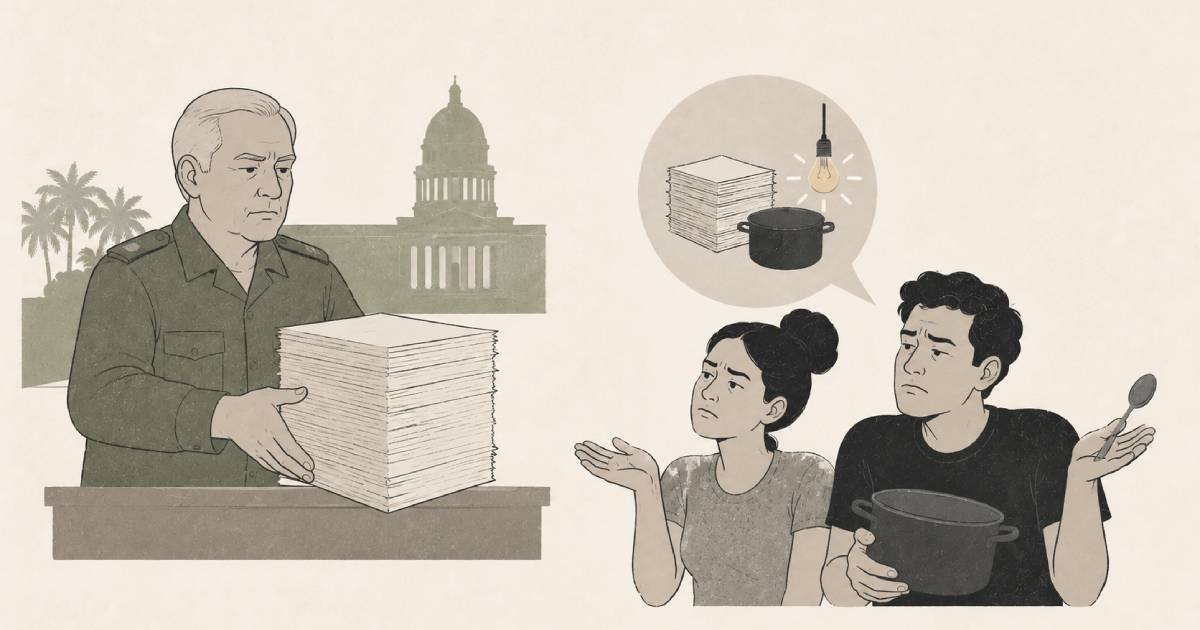
The Cuban government’s official release of 176 Economic and Social Transformations on Thursday sparked a flood of criticism across social media. Many citizens questioned the timing of the document's release amidst ongoing power outages, food shortages, a lack of medicines, and connectivity issues.
While the regime presented these measures as the outcome of consultations and discussions within the main political power structures, much of the public reaction focused not on the content, but on the harsh daily realities faced by millions of Cubans.
A particularly resonant comment captured the widespread frustration among users: "Download them and use them for food or light," one netizen quipped, highlighting the scarcity of food and frequent power cuts plaguing the nation.
Public Response and Connectivity Challenges
Irony and sarcasm colored much of the discourse. Several people pointed out their inability to access the document due to unreliable internet or non-functional download links. "I'll download them when ETECSA improves the internet," one person remarked, while others simply noted that the PDF wouldn't open.
Comparisons to past governmental initiatives were abundant, with many recalling previous efforts like the Currency Reorganization and Party Guidelines, which, according to them, failed to yield tangible results. Some users noted that while the new document contains broad proposals, it lacks concrete actions for immediate implementation. "I see many ideas but no concrete measures to implement them," another user expressed, reflecting the prevailing skepticism.
Immediate Needs vs. Long-Term Reforms
The most frequently voiced concerns were about issues directly impacting daily life. Many Cubans questioned whether any of the 176 transformations would address solutions for power outages, medicine shortages, food production, or the deteriorating healthcare system.
As the government circulated the document, several citizens used the occasion to highlight their ongoing struggles with over 30 hours without electricity, limited daily service, or continued lack of potable water across different areas of the country.
The official document outlines changes across virtually all sectors of the economy, from state enterprises, foreign investment, and the banking system to tax policy, tourism, commerce, and the phased removal of product subsidies in favor of targeted subsidies for individuals. It also aims to expand private sector participation in various economic activities and further partial dollarization of the economy.
Nevertheless, conversations on social media revealed that for many Cubans, immediate priorities remain far more pressing: access to electricity, water, affordable food, and medicines, rather than new packages of reforms whose effectiveness is yet to be proven.
Amidst sarcasm, fatigue, and criticism, the official announcement became a platform for hundreds of citizens to express the growing disconnect between government promises and the population's most urgent needs.
Cuban Economic Measures: Public Concerns and Questions
What are the 176 Economic and Social Transformations announced by the Cuban government?
The Cuban government announced 176 Economic and Social Transformations aiming to reform sectors such as state enterprises, foreign investment, taxation, tourism, and more, while also increasing private sector involvement and partial dollarization.
Why did the public respond negatively to the announcement?
The public's negative response was largely due to ongoing issues like power outages, food shortages, and lack of medicines, which the new measures failed to address directly. Many citizens expressed skepticism about the effectiveness and immediacy of these reforms.
Did the public have difficulty accessing the document outlining the measures?
Yes, many users reported difficulties accessing the document due to poor internet connectivity and non-functional download links, adding to their frustration and skepticism regarding the effectiveness of the measures.