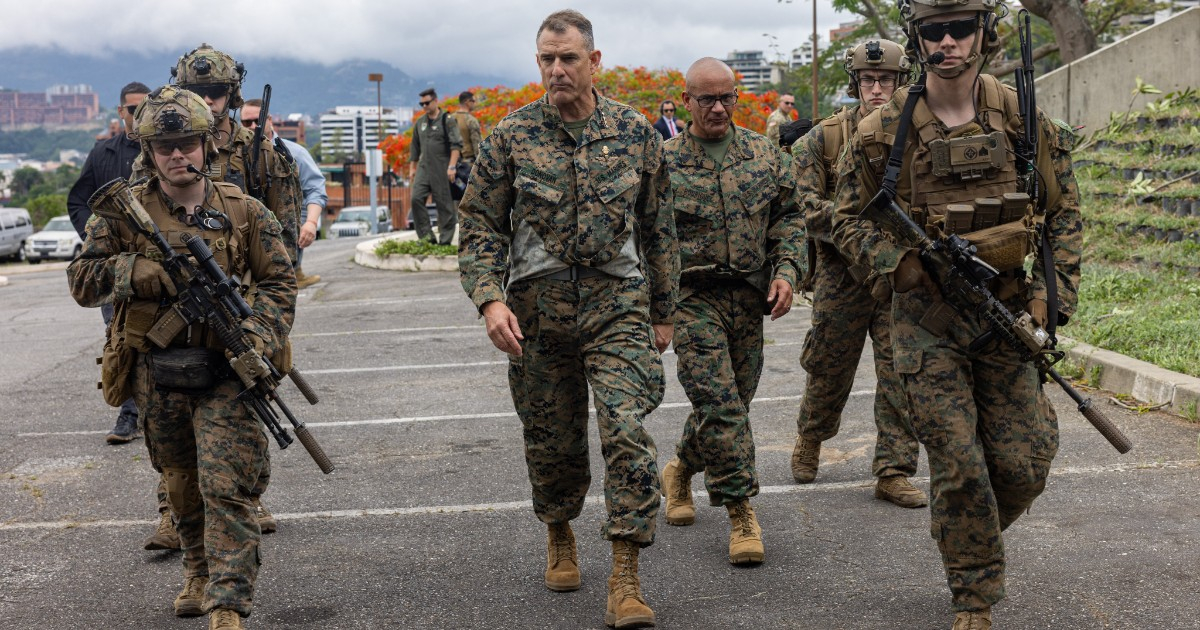
The United States Southern Command (SOUTHCOM) revealed on Thursday the deployment of joint military forces to support relief efforts in Venezuela following the catastrophic earthquakes that struck the northern region of the country on Wednesday.
Two powerful earthquakes, with magnitudes of 7.2 and 7.5, struck the states of Yaracuy and Carabobo just 39 seconds apart at 6:04 p.m. local time, approximately 100 miles west of Caracas.
The earthquake with a magnitude of 7.5 is recorded as the strongest in Venezuela since 1900, according to the U.S. Geological Survey (USGS).
In an official statement, SOUTHCOM noted it is acting "under the directive of the Department of Defense" and is working in collaboration with the State Department.
"Our joint forces are mobilizing swiftly to provide the unparalleled airlift, logistical, and rescue capabilities of the U.S. military to save lives and support the Venezuelan government during this crisis," the command stated.
SOUTHCOM also announced the establishment of an operational planning team with experts from the Office of Humanitarian Assistance, tasked with advising personnel and leadership on planning and mission decisions.
Furthermore, they have initiated close coordination with regional allies and partners who are committed to joining the international assistance effort.
President Donald Trump authorized a humanitarian aid package worth $150 million: $50 million allocated to organizations already operating in Venezuela—including Samaritan's Purse, Catholic Relief Services, and the World Food Program—and $100 million to the joint UN OCHA fund.
Trump stated on Truth Social that initial reports "are not good" and that the United States is "ready, willing, and able to assist" its "new and great friends" in Venezuela.
Secretary of State Marco Rubio contacted Delcy Rodríguez, the interim president of Venezuela, to coordinate the response and express solidarity. Rubio also announced the deployment of urban search and rescue teams from Fairfax, Virginia, and Los Angeles, California, consisting of firefighters, medical professionals, structural engineers, and search dogs, emphasizing that the critical window to find survivors under the rubble is 48 to 72 hours.
The official death toll by the end of Thursday was reported at 188, with 1,520 injured, 157 missing, and 200 trapped under debris, according to Jorge Rodríguez, president of the Venezuelan National Assembly.
La Guaira state is the most severely affected area, with massive building collapses in Catia La Mar and Los Corales, while at least two buildings in the Chacao municipality of Caracas have crumbled, and over 250 structures have been damaged.
The USGS issued a maximum-level Red Alert, with its PAGER probabilistic estimation system calculating between a 37% and 42% chance that the final death toll could range between 10,000 and 100,000 people, although this is an automatic projection, not an actual count.
Rodríguez's response marked an unprecedented diplomatic shift: she publicly thanked Trump and Rubio for their support, a gesture unimaginable under Nicolás Maduro's administration, which in 2019 rejected U.S. humanitarian aid as "crumbs of rotten and contaminated food."
In addition to the U.S., the international community responded swiftly: Spain deployed 54 military personnel from the Military Emergency Unit, the UN declared itself "fully mobilized," and chef José Andrés announced a donation of $1 million for relief efforts.
Key Questions About the U.S. Response to Venezuela's Earthquakes
What actions has the U.S. taken to assist Venezuela after the earthquakes?
The U.S. deployed joint military forces to provide relief, authorized $150 million in humanitarian aid, and coordinated with Venezuela's interim leadership. It also sent urban search and rescue teams to assist on the ground.
What is the significance of the earthquake in Venezuela?
The 7.5 magnitude earthquake was the strongest recorded in Venezuela since 1900, causing widespread destruction and a high number of casualties.