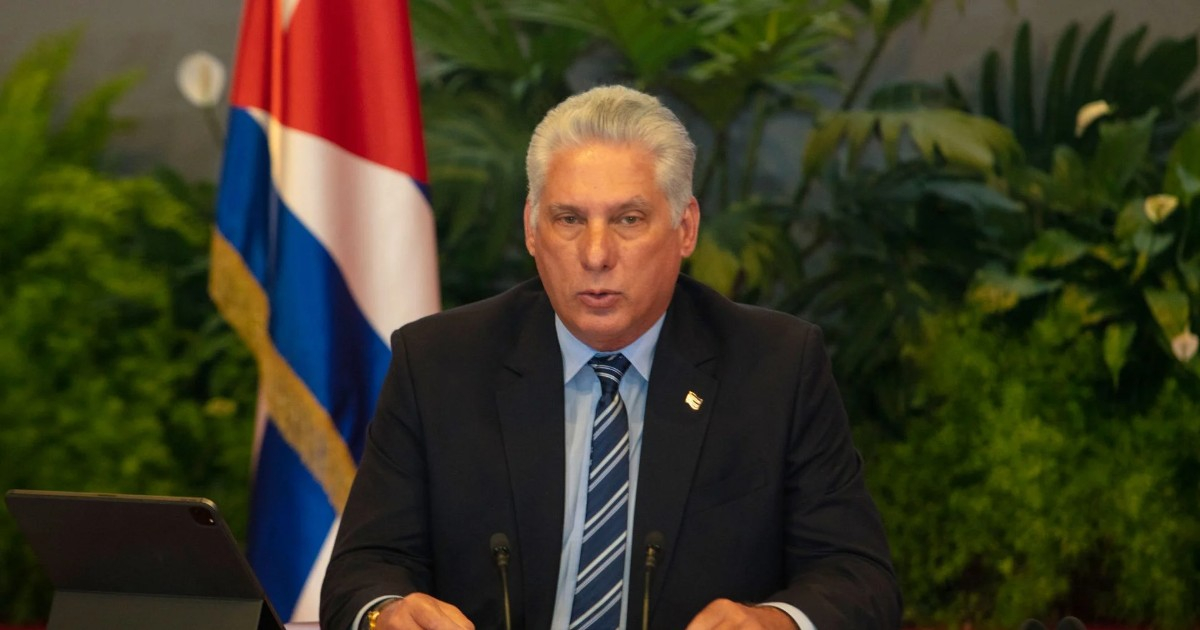
This Wednesday, Miguel Díaz-Canel took to social media to accuse Washington of waging a "relentless war" against Cuba, highlighting the regime's ability to endure despite sanctions. His comments coincided with another set of restrictive measures imposed by the Trump administration on the same day.
In his posts on X and Facebook, the Cuban leader asserted that "the U.S. aggression against Cuba is relentless and intensifies due to their frustration at not seeing us defeated."
Díaz-Canel characterized the U.S. actions as deliberate assaults on "income sources, financial access, fuel supplies, and technology transfers," aimed at "depriving the country of the ability to meet our people's fundamental needs."
He concluded his message with a defiant statement directed at Washington: "The U.S. government believes no country can operate and survive under such ruthless warfare. The impact is undeniably harsh, but our resilience and creativity astonish them."
These remarks come amidst the most intense pressure escalation on Cuba since the 1990s.
Since January 2026, the Trump administration has imposed over 240 sanctions on the island, supported by two executive orders: Order 14380, dated January 29, which established tariffs and secondary sanctions on those supplying oil to Cuba, and Order 14404, signed on May 1.
On June 4, the Treasury Department directly sanctioned Díaz-Canel himself, his wife Lis Cuesta Pedraza, his stepson Manuel Anido Cuesta, Raúl Castro, and his son Alejandro Castro Espín, in addition to five key Cuban entities, including the Ministry of the Revolutionary Armed Forces and the Committees for the Defense of the Revolution.
This Wednesday, the U.S. imposed yet another round of sanctions against five additional Cuban entities and an individual linked to the island, as reported by CNN en Español.
Reality on the Ground: A Dire Situation
Díaz-Canel's rhetoric of resilience sharply contrasts with the grim reality faced by the Cuban people. The island is enduring power outages lasting up to 22 hours daily, with an electricity generation shortfall exceeding 2,174 MW in May, when the regime confirmed that Cuba had exhausted its diesel and fuel oil reserves.
The United Nations declared the situation a humanitarian emergency in April 2026. Over 96,000 surgeries have been postponed, a million people rely on tanker trucks for water supply, and 33.9% of households experience persistent hunger.
Despite his public stance, Díaz-Canel's tone has not always been so combative. On March 29, during a Communist Party Plenum, he admitted that "resistance alone is not enough" and acknowledged "obstacles that do not originate from outside or the blockade."
On June 6, at the Karl Marx Theater during Raúl Castro's 95th birthday celebration, Díaz-Canel adopted a more belligerent tone, warning: "If the homeland is attacked, we will respond in legitimate defense. And if they attempt to enter... there will be determined and firm combat."
Understanding the Impact of U.S. Sanctions on Cuba
What are the primary objectives of U.S. sanctions against Cuba?
The main goals of U.S. sanctions are to exert economic pressure on the Cuban regime by targeting income sources, financial access, and essential supplies, thereby weakening the government's ability to sustain its operations and meet the population's needs.
How have the sanctions affected the daily lives of Cuban citizens?
Cuban citizens face severe hardships, including extended power outages, shortages of essential goods, and an increase in postponed medical procedures. Many families struggle with food insecurity and rely on external sources for basic necessities like water.
How has Díaz-Canel responded to the increasing pressure from the U.S.?
Díaz-Canel has publicly condemned the U.S. sanctions, emphasizing Cuba's capacity for resistance and adaptation. He has also acknowledged internal challenges and the need for solutions beyond mere endurance.