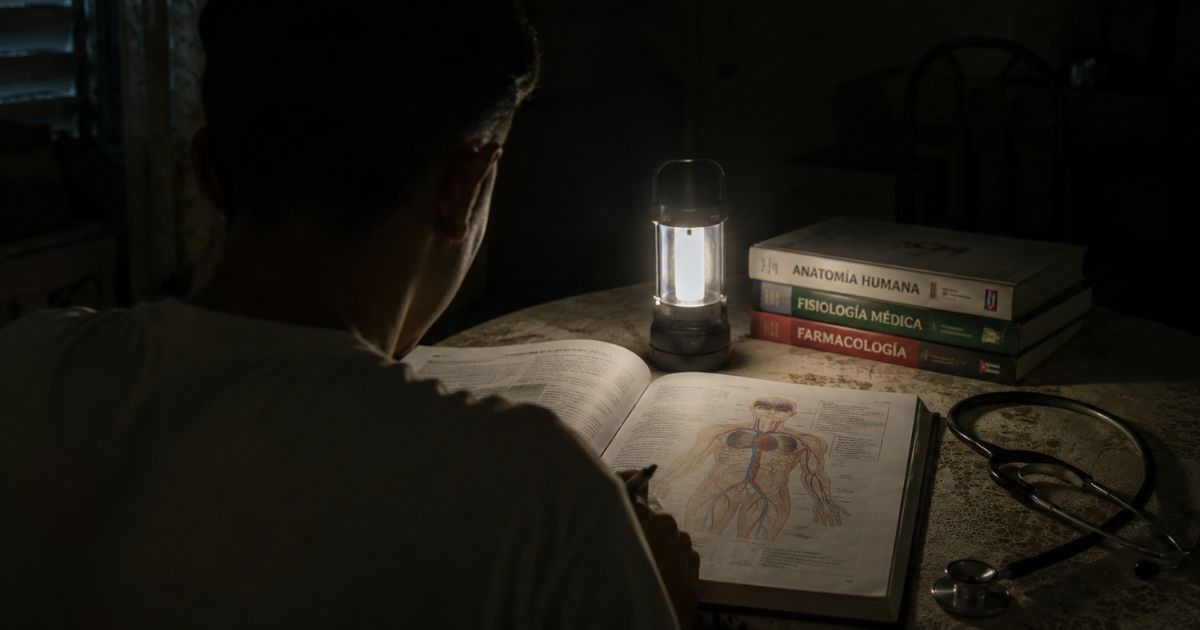
Medical students from the provinces of Pinar del Río and Granma have publicly demanded changes to their final exams, citing extended power outages and worsening educational conditions as reasons for their lack of preparedness.
Letters sent to CiberCuba have sparked a divided debate: while many students from other faculties express support, some criticize the complainants, arguing that power outages shouldn't excuse exam cancellations or poor performance.
Student Outcry from Pinar del Río
The first complaint comes from first-year students at the University of Medical Sciences "Ernesto Che Guevara" in Pinar del Río, who collectively signed a letter addressed to academic authorities.
They highlighted poor results in partial exams for the Nervous, Endocrine, and Reproductive Systems (SNER) and Nutrition and Metabolism subjects, which already demonstrate the accumulated damage.
"This lack of preparation isn't just an assumption; it's a proven fact," they wrote.
"If partial exams have already shown this deterioration due to constant interruptions, electrical outages, and lack of study time, a final comprehensive exam could be disastrous for most first-year students," they pointed out.
While acknowledging their professors' efforts, the students warned that "the harsh reality of the country surpasses any individual will."
Supported by a petition, they formally requested the elimination or significant reduction of final exam content and urged their peers in other provinces to join their call for action.
Manzanillo Students Speak Up
Another complaint emerged from Manzanillo, where third-year medical students at the Celia Sánchez Manduley Faculty shared the results of their second internal medicine test: a list dominated by failing grades, with not a single top score.
"We want to raise a complaint because we consider the situation an abuse," they wrote.
They attributed the poor results to two main factors: the frequent power outages in Granma, which often exceed 50 cumulative hours and hinder charging devices and accessing educational materials, and a professor who, they claim, gives exams with ambiguous questions and writing errors.
They also pointed out noticeable inequities: their peers from municipalities like Niquero, Pilón, Media Luna, Campechuela, Yara, and Bartolomé Masó, who take exams in different facilities, achieve significantly better results.
"We can't take it anymore. We feel voiceless and without real spaces to express our dissatisfaction," concluded the letter from Manzanillo.
Wider Educational Crisis
Both complaints arise during the worst electrical crisis in Cuba in decades, with a generation deficit peaking between 2,040 and 2,147 MW in June 2026, and some areas enduring over 72 continuous hours without power.
The impact on education had already led the Ministry of Higher Education to suspend university entrance exams for the 2026-2027 academic year, replacing them with accumulated academic indexes.
Last May, sixth-year medical students in Santiago de Cuba had their hospital rotations suspended to fulfill mandatory military training as part of the "Year of Defense Preparation."
Reactions to the letters from Pinar del Río and Granma reflect the social divide caused by the crisis: while some commend the students for speaking out, others argue that power outages shouldn't justify exam cancellations or poor performance.
The Pinar del Río students anticipated such criticism and responded in advance: "For a fair, empathetic education adapted to the reality we live in!"
Frequently Asked Questions About the Educational Crisis in Cuba
What are the main challenges faced by medical students in Cuba?
Medical students in Cuba are facing challenges such as prolonged power outages, deteriorating educational conditions, and inequitable testing environments, which hinder their ability to prepare adequately for exams.
How have power outages affected education in Cuba?
Prolonged power outages have severely disrupted the educational process in Cuba by preventing students from charging devices, accessing study materials, and maintaining a consistent study schedule, leading to widespread academic underperformance.
What actions are students taking in response to educational challenges in Cuba?
Students are voicing their concerns through public complaints, signing petitions to demand changes in exam formats, and urging peers from other provinces to join their calls for educational reform.