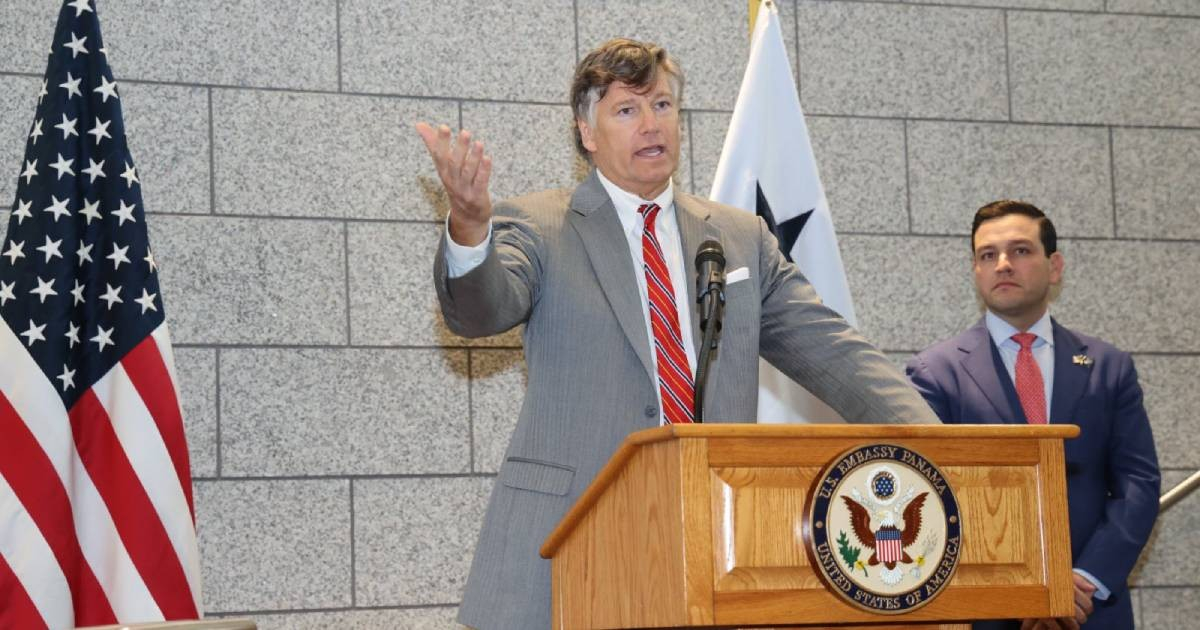
On Tuesday, U.S. Deputy Secretary of State Christopher Landau addressed the 56th General Assembly of the Organization of American States (OAS) in Panama City, calling for the Cuban government to implement urgent economic and political reforms. He described Cuba as a collapsing state that "has no other choice."
During his speech at the OAS plenary session, Landau stated unequivocally: "Cuba is a failed state, an ally of our adversaries, just 90 miles from the United States, with a long record of undermining democratic institutions and inciting civil unrest throughout our hemisphere."
Landau was straightforward about the future of the dictatorship: "The authoritarian, communist regime in Havana, which has retained power without elections for 67 years, is crumbling, and immediate economic and political reforms are necessary. They have no other choice."
He extended this demand to Nicaragua, asserting that "there should be zero tolerance for totalitarian regimes in our hemisphere."
Reforms and Reactions
This declaration follows the recent approval by Cuba's National Assembly of People's Power of a set of 176 economic measures, including private banking, partial dollarization, and opening to foreign investment. However, Washington dismissed these as "superficial smoke signals," arguing they offer no real political change.
On the same day, Secretary of State Marco Rubio announced new sanctions against five Cuban entities linked to the military conglomerate GAESA, including the International Financial Bank and Almacenes Universales S.A., as well as Annalie Lilliam Rueda Cardero, the wife of Alejandro Castro Espín. Rubio warned that "foreign banks and other companies providing services to these entities must immediately cease those activities."
International and Civil Society Responses
Coinciding with Landau's address, the OAS unanimously approved a declaration urging the restoration of democracy in Cuba, Nicaragua, and Venezuela and calling for the release of all political prisoners.
In a dialogue with civil society, activists Carolina Barrero and José Daniel Ferrer presented their case to the OAS, rejecting the regime's measures. Barrero stated that "the only path to a free Cuba is through civil and political liberties," dismissing the reform package as "a theater of illusions." Ferrer urged continental governments to demand an end to repression: "The tragedy faced by the Cuban people must end."
Context of Economic Hardships
The new sanctions align with Executive Order 14404, signed by Trump on May 1, 2026, which authorizes secondary sanctions against foreign financial institutions doing business with the Cuban regime. Since January, the Trump administration has imposed more than 240 sanctions against Cuba as part of its maximum pressure strategy.
The economic crisis on the island exacerbates the situation: daily power outages lasting up to 10 hours, severe shortages of food and medicine, and an estimated GDP contraction of 11% over the past five years set the stage for Washington's most forceful ultimatum to date.
Frequently Asked Questions About U.S. Sanctions on Cuba
What are the recent U.S. sanctions against Cuba?
The U.S. recently imposed sanctions on five Cuban entities affiliated with the military conglomerate GAESA and targeted individuals like Annalie Lilliam Rueda Cardero. These actions are part of a broader strategy to exert pressure on the Cuban regime.
Why is the U.S. demanding reforms from Cuba?
The U.S. views Cuba as a failing state with a history of undermining democratic institutions and inciting unrest. The demand for reforms aims to bring about economic and political changes necessary for stability and democracy.
How has the Cuban government responded to these demands?
Cuba's government recently passed a set of economic measures, but these have been dismissed by the U.S. as insufficient, lacking real political change.