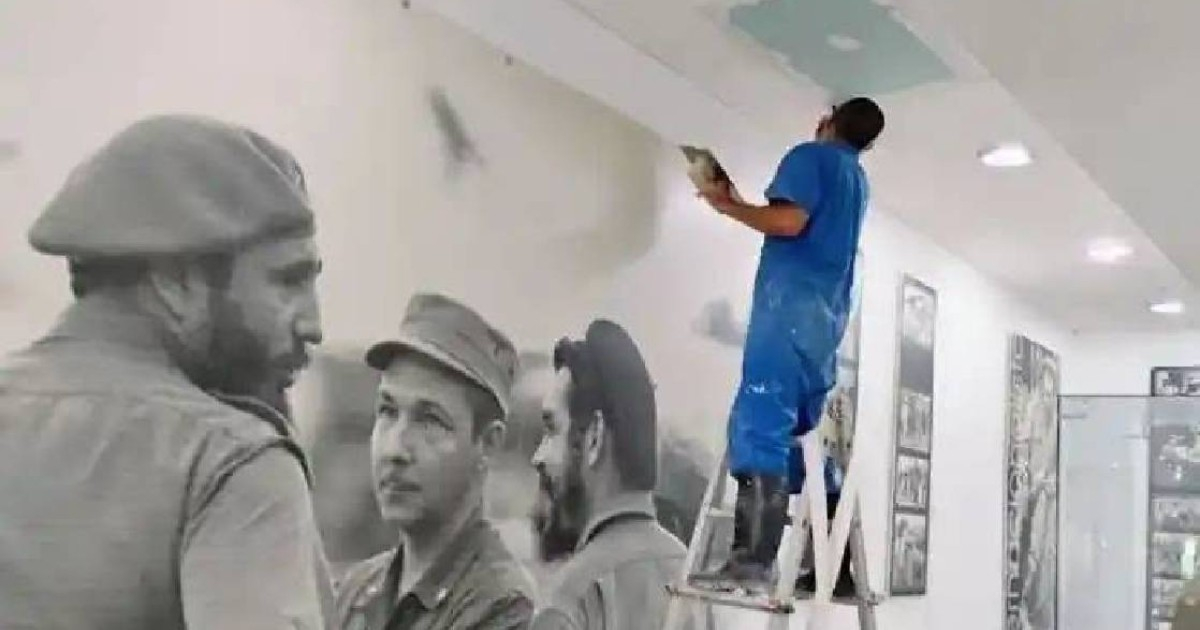
Amidst one of Cuba's most severe economic downturns in decades, the regime swiftly mobilized companies and organizations in Villa Clara on Wednesday to expedite the refurbishment of the Comandante Ernesto Che Guevara Sculptural Complex in Santa Clara. This site will serve as the resting place for Ramiro Valdés Menéndez, founder of the MININT and a key architect of Cuba's repressive state machinery.
State-run media outlets, Radio CMHW and Soy Villa Clara, reported that the refurbishments include comprehensive cleaning, landscaping enhancements, improved lighting, painting, restoration of damaged floors and roofs, museum waterproofing, and replacing all wooden fixtures in the Multipurpose Room with aluminum and glass.
A significant focus was placed on the Mausoleum for the Combatants of the Las Villas Front, where Valdés' remains will be interred. Reday René Armas Álvarez, director of the Complex, detailed ongoing efforts to clean and polish the marble and granite of each of the 220 niches, alongside the replenishment of some landscaping and the repainting and decoration of the trusses that provide access to the site.
The hydrosanitary network, furnishings, and protocol area also underwent comprehensive rehabilitation. Meanwhile, vegetation reminiscent of the Bolivian jungle was restored at the Memorial where Che Guevara's remains lie.
The stark contrast is hard to overlook: in a country where hospitals lack essential medications and power outages last for hours, a rapid beautification effort is underway to honor a man known by nicknames such as "the Dwarf," "Blood Puddle," and "the Butcher of Artemisa."
Valdés, who passed away on June 21 at the age of 94, founded the MININT in 1961 and was a proponent of the UMAP, forced labor camps where homosexuals, religious individuals, and dissidents were detained. As recently as August 2021, at the age of 89, he personally awarded MININT officers who suppressed the 11J protesters in Palma Soriano.
The regime declared an official period of mourning through Presidential Decree 1247 for June 23, with flags at half-staff on public buildings. On that day, 95-year-old Raúl Castro made a rare appearance at the MINFAR headquarters in Havana to lead the first honor guard for his comrade.
Cuban-American congress members María Elvira Salazar and Carlos A. Giménez expressed regret that Valdés died without facing justice for crimes against humanity. With his passing, the historical generation of the Revolution is now dwindled down to Raúl Castro and Guillermo García Frías.
The decision to use the Che Complex aligns with Valdés' wish to be buried near the guerrilla leader under whose command he fought as the second-in-command of Column No. 8 "Ciro Redondo" during the Battle of Santa Clara in December 1958.
The military honors and burial ceremony is scheduled to take place on Thursday morning.
Key Questions about the Refurbishment of the Che Guevara Complex
Why is the regime prioritizing the refurbishment of the Che Guevara Complex?
The regime is prioritizing the refurbishment to prepare for the burial of Ramiro Valdés Menéndez, a significant figure in Cuba's history, despite the country's ongoing economic challenges.
What specific updates are being made to the complex?
The updates include cleaning, landscaping, lighting improvements, painting, floor and roof repairs, waterproofing, and replacing wooden fixtures with aluminum and glass in the Multipurpose Room.
Who was Ramiro Valdés Menéndez?
Ramiro Valdés Menéndez was a founder of the MININT and a key figure in Cuba's repressive state apparatus. He was known for establishing forced labor camps and recently recognized officers who suppressed protests.