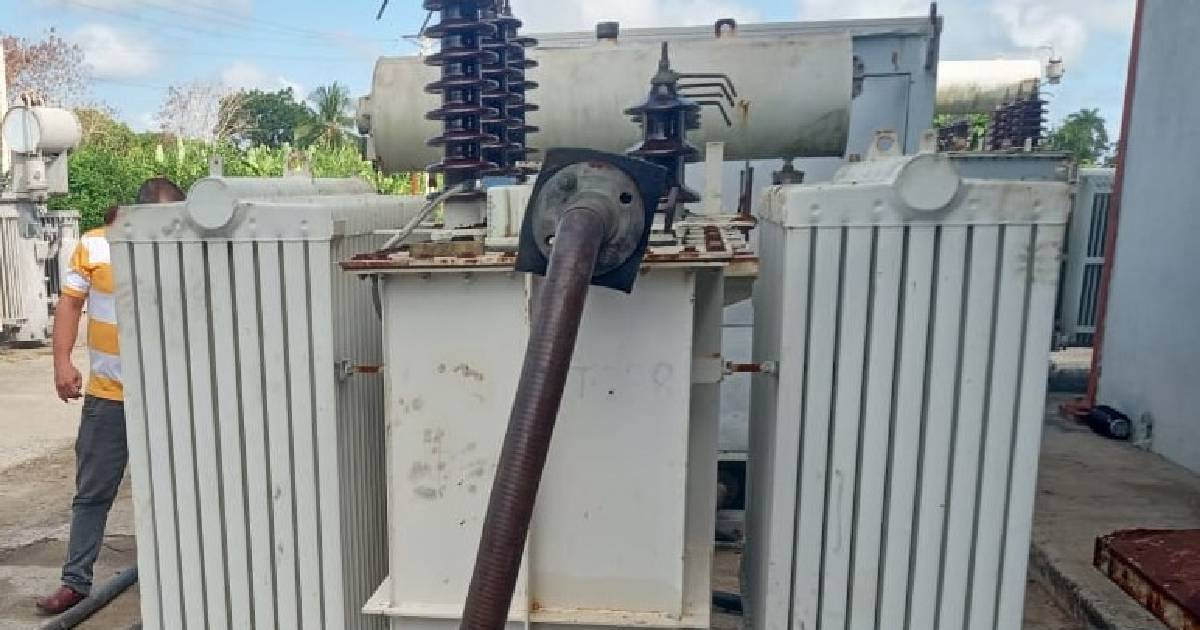
A tragic incident unfolded in the town of El Cobre, Santiago de Cuba, when an attempted theft of dielectric oil from an electrical transformer bank led to one individual being electrocuted and another apprehended on charges of sabotage. This information comes from an official statement released by the Provincial Prosecutor's Office on Wednesday.
The events transpired in the early hours of May 9, 2026, as three individuals approached a transformer bank situated next to a feed factory at kilometer 8 of the Central Highway. According to the prosecutor's report, one of the intruders climbed the utility pole, opened the transformers with a wrench, and began siphoning the dielectric oil using a hose, while the other two stood by, assisting in collecting the oil in containers.
During the theft, the electrical current was unexpectedly restored, resulting in the death of the person atop the pole. The case has been documented as Preliminary Phase File 65 of 2026, overseen by the Provincial Criminal Investigation and Operations Unit.
Charges and Legal Proceedings
The only individual captured is facing charges for sabotage, as outlined in Article 125.1 of the current Penal Code, and is currently under provincial arrest. The official note was released over 45 days after the incident, with no explanation for the delay, a typical occurrence in the "Cuban justice" system.
The theft of dielectric oil from transformers has become increasingly prevalent in Cuba, closely tied to the nation's energy crisis and fuel shortages. This oil, vital for cooling and insulating transformers, is sold on the black market as a substitute fuel for tractors and agricultural machinery, fetching between 500 and over 1,000 Cuban pesos per liter.
Impact on Infrastructure and Local Communities
Removing the oil renders the transformers permanently inoperative, leading to power outages that can last for days or even weeks. A single transformer can cost between 4 and 5 million dollars on the international market.
El Cobre, the site of the incident, is experiencing a severe electricity crisis in Santiago de Cuba, with the Loma del Burro circuit reported to have endured 22 days without power by June 2026. A local priest depicted his parishioners' plight as akin to being "buried alive, without light, without hopes, without dreams, and without any expectation."
Government Measures and Legal Ramifications
In response to the surge in transformer oil thefts, the Cuban regime has intensified penalties. Supreme People’s Court's Ruling 475/2025 mandates that such acts be classified as sabotage instead of ordinary theft, with sentences ranging from seven to 30 years of imprisonment, life sentences, or even the death penalty in severe cases.
Exemplary trials have increased in frequency: in Artemisa, an individual was sentenced to 12 years for stealing 70 liters of dielectric oil, and similar sentences have been issued in Ciego de Ávila for comparable offenses. Between January 2025 and March 2026, every individual charged with electrical sabotage in Cuba received sentences exceeding 10 years.
Understanding the Electrical Sabotage Crisis in Cuba
What led to the theft of dielectric oil in Cuba?
The theft of dielectric oil is largely driven by Cuba's ongoing energy crisis and severe fuel shortages, prompting individuals to resort to illegal means to obtain alternative fuel sources.
How does the Cuban government address transformer oil thefts?
The Cuban government has implemented harsher penalties for transformer oil thefts, reclassifying them as acts of sabotage with severe punishments, including lengthy prison terms, life sentences, or the death penalty in extreme cases.
What are the consequences of oil theft on Cuba's electrical infrastructure?
Oil theft can permanently damage transformers, leading to extended power outages that have significant impacts on local communities and the broader electrical grid.