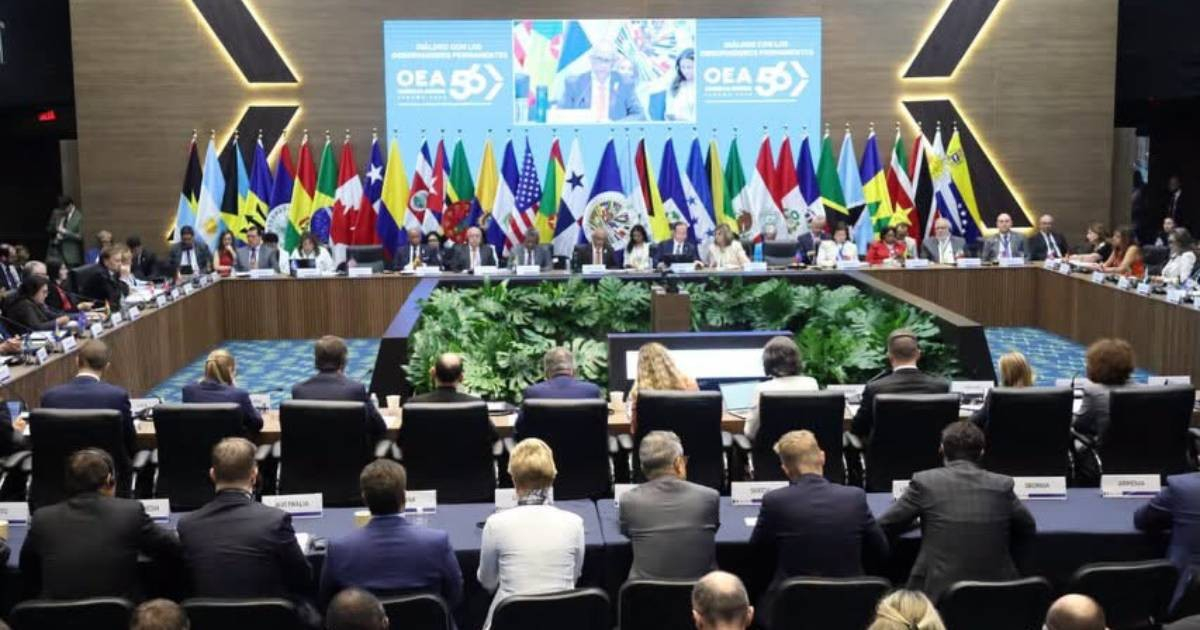
The Organization of American States (OAS) made a strong appeal on Tuesday for the reestablishment of democratic governance in Cuba, Nicaragua, and Venezuela. The OAS demanded the release of all political prisoners and emphasized the importance of respecting human rights in these nations during its 56th General Assembly held in Panama City.
With a declaration unanimously approved, the organization voiced its deep concern over the political climates in these countries, stressing the critical need to uphold the democratic principles and human rights that form the backbone of the inter-American system.
"Detaining individuals for political reasons contradicts the commitments made by states within the inter-American framework," the OAS declared, reminding that Cuba, Venezuela, and Nicaragua are geographically part of the hemispheric community.
The OAS was unequivocal in stating that "there is no room in the Americas for political persecution or imprisonment based on opinions or dissent," while urging the unconditional release of all who are incarcerated for political motives.
Protecting Democratic Systems
The declaration underscored the importance of maintaining democratic systems that allow citizens to express their will freely, engage in public life, and fully exercise their fundamental rights.
During the first plenary session of the Assembly, member states also passed a specific resolution on Nicaragua. They condemned the "widespread and systematic human rights violations and abuses" occurring in the country, warning that some of these actions could, prima facie, constitute crimes against humanity.
Human Rights in Nicaragua
The statement referenced the death of indigenous Miskito leader Brooklyn Rivera while in state custody on May 30, 2026, following over 32 months of arbitrary detention, despite precautionary measures from the Inter-American Commission on Human Rights and provisional measures ordered by the Inter-American Court.
Additionally, the OAS expressed "deep concern" over the institutional decline in Nicaragua, which it attributed to the erosion of the separation of powers and the progressive weakening of democratic order. The organization urged Daniel Ortega's government to respect freedom of expression and religion and to cease measures aimed at stripping nationals of their citizenship.
Open Dialogue and Support
Despite the criticisms, the OAS reiterated its willingness to keep channels of dialogue open and invited Nicaragua to rejoin the OAS, from which it officially withdrew in 2023.
The General Secretariat also expressed its readiness to support initiatives aimed at expanding democratic spaces, promoting political dialogue, assisting electoral processes, and rebuilding institutional trust in the region, while emphasizing that lasting solutions must be led by the national actors themselves.
The OAS's stance received backing from sectors of the Venezuelan opposition, who from Caracas supported the call for restoring democracy and freeing political prisoners in the three countries.
Voices from Cuba
The situation in Cuba was also a focal point of the Assembly's discussions. Activists Carolina Barrero and José Daniel Ferrer took part in Monday's dialogue with civil society, where they condemned the repression by the Cuban regime and called for greater international commitment to a democratic transition on the island.
Barrero criticized the 176 economic measures announced by the Cuban government on June 18, describing them as a "theater of illusions" that, in her view, do not address the fundamental freedoms lacking for the population.
Meanwhile, Ferrer, leader of the Patriotic Union of Cuba (UNPACU), declared to the continental representatives that "the tragedy faced by the Cuban people must end" and urged regional governments to demand an end to repression and support a democratic transition in the country.
FAQs on Democracy and Human Rights in Latin America
What actions did the OAS demand for Cuba, Nicaragua, and Venezuela?
The OAS called for the restoration of democratic governance, the release of political prisoners, and the respect for human rights in Cuba, Nicaragua, and Venezuela.
What specific concerns did the OAS have about Nicaragua?
The OAS expressed concern over widespread human rights violations and the erosion of democratic institutions, attributing these issues to the government's elimination of the separation of powers.
How did Cuban activists contribute to the OAS Assembly?
Cuban activists Carolina Barrero and José Daniel Ferrer participated in the dialogue with civil society, denouncing repression in Cuba and urging international support for a democratic transition.