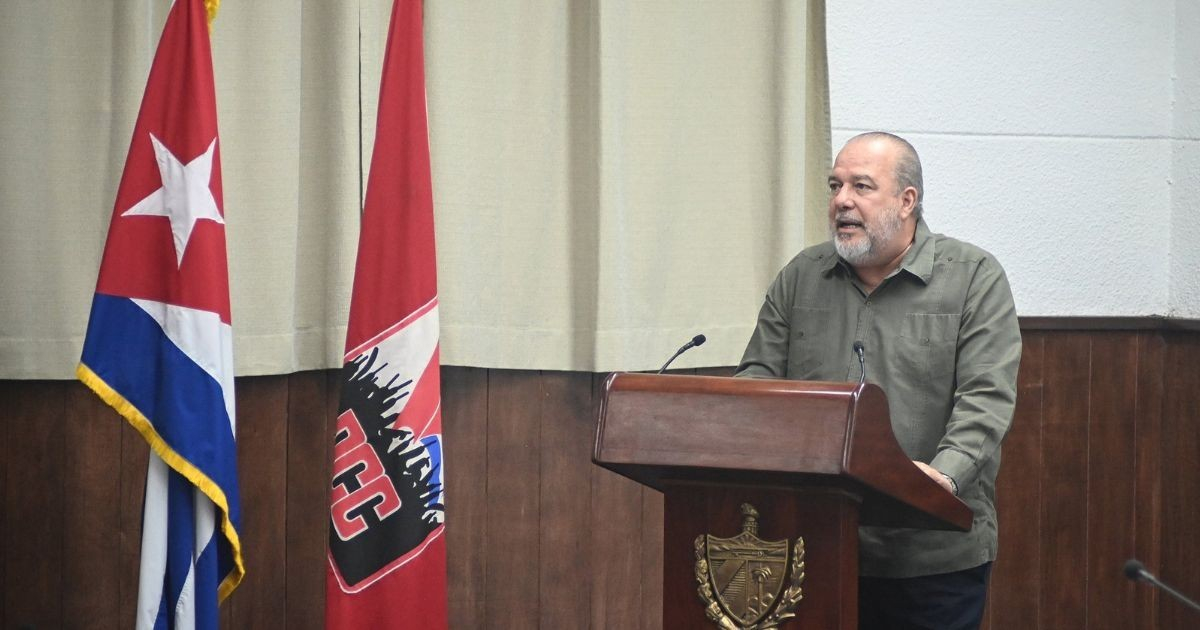
On Wednesday, Cuba's Council of Ministers convened to evaluate a series of 176 recently approved economic and social reforms, pledging to release all details in full once internal reviews are completed.
The announcement came via Prime Minister Manuel Marrero Cruz on his account on X, and was soon corroborated by the state-run newspaper Granma.
"Today, the Council of Ministers will examine the newly approved economic and social transformations, which have been enhanced with insights from the Political Bureau, as well as discussions held during the Communist Party Plenum and the National Assembly," stated Marrero Cruz.
In a subsequent post less than an hour later, the Prime Minister assured that the measures would be disclosed in their entirety, describing them as "a bold and sovereign response stemming from the ongoing process of updating and perfecting the Cuban Economic Model, initiated in 2011 and intensified since 2021."
Roberto Morales Ojeda, Secretary of Organization of the PCC Central Committee, echoed the official narrative on X, asserting that the reforms "are being implemented by the Council of Ministers" and linking them to Fidel Castro's legacy.
This reform package, encompassing 176 measures across 23 strategic areas, was presented by Marrero Cruz to the Extraordinary Plenum of the PCC Central Committee on June 17 and subsequently ratified by the National Assembly.
Key Measures in the Reform Package
The proposed measures include the introduction of private banks, private currency exchange houses, the buying and selling of state-owned company shares by private and foreign individuals, partial dollarization, a reduction of ministries from 27 to between 20 and 21, the elimination of salary caps, and a tax reform introducing a gradual VAT.
Even Miguel Díaz-Canel acknowledged during the Plenum's closing that "creative resistance is no longer sufficient" and that "it's no longer enough to explain the crisis; it must be changed," an unusual admission of the regime's longstanding economic mismanagement.
Public Skepticism and International Reaction
However, the promise of transparency is met with deep skepticism. The Cuban populace reacted to the reform announcements with protests in Santiago de Cuba, Santa Clara, and Havana, while the phrase "same dog, different collar" dominated social media.
This distrust is historically justified: in 2016, the government itself admitted to fulfilling only 21% of the economic guidelines promised in 2011.
Internationally, the response has been lukewarm. On June 19, the U.S. Department of State dismissed the 176 measures as "superficial smoke signals," and just four days later, the Trump administration imposed new sanctions on five Cuban entities linked to the military conglomerate GAESA, including the International Financial Bank and RAFIN S.A.
Secretary of State Marco Rubio warned that "foreign banks and other businesses providing services to these entities must immediately freeze those activities," underscoring that Washington does not perceive these reforms as a genuine shift in direction.
All this unfolds against a backdrop of an economy in freefall: the CEPAL projects a contraction of the Cuban GDP by 6.5% for 2026, marking the worst in Latin America, with a cumulative decline exceeding 23% since 2019. The new reforms will necessitate changes to over 148 legal provisions, a process the regime has yet to clearly outline.
FAQs on Cuba's Economic Reforms
What are the main components of Cuba's new reform package?
The reform package includes the establishment of private banks, private currency exchange houses, the sale of shares in state-owned enterprises to private and foreign investors, partial dollarization, the reduction of ministries, the removal of salary caps, and a tax reform introducing VAT gradually.
How has the international community responded to these reforms?
The international reaction has been largely skeptical. The U.S. Department of State termed the reforms as superficial, and additional sanctions were imposed by the Trump administration on Cuban entities linked to GAESA.
Why is there skepticism around the Cuban government's promises of transparency?
The skepticism stems from historical precedents where the Cuban government failed to deliver on promised economic guidelines, fulfilling only 21% of them since 2011.