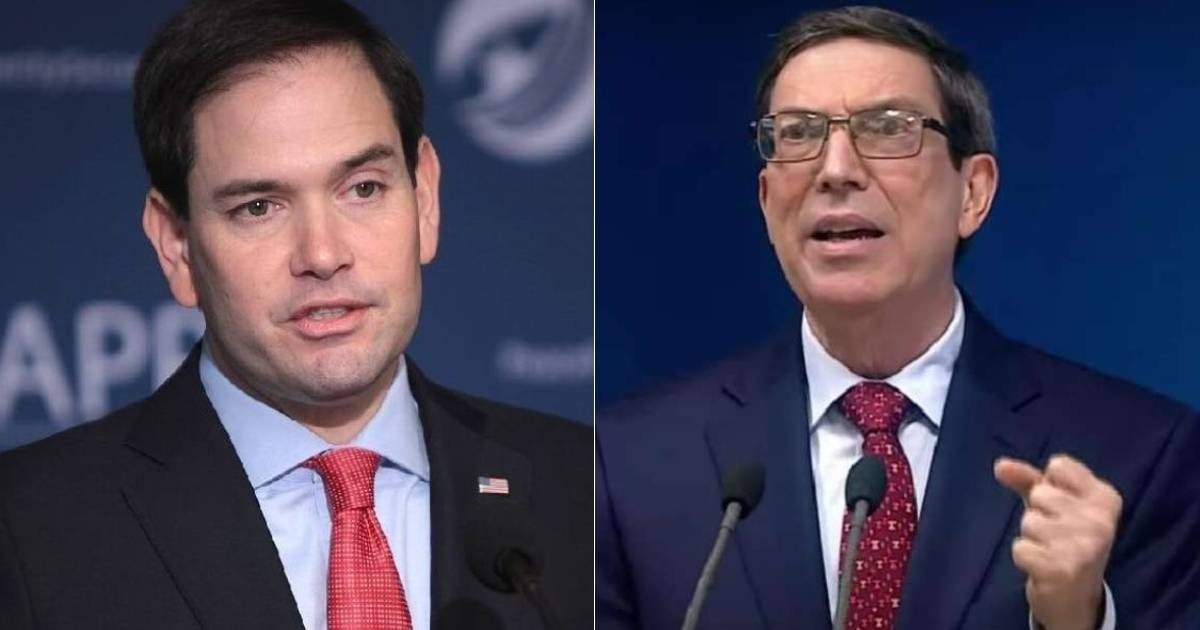
Cuban Foreign Minister Bruno Rodríguez Parrilla expressed strong disapproval on Tuesday through a fiery post on X, reacting to new sanctions announced by U.S. Secretary of State Marco Rubio targeting entities linked to the Cuban military conglomerate GAESA. Rodríguez labeled Rubio as "dishonest and deceitful," accusing Washington of further tightening the grip on Cuba’s economy.
In his post, Rodríguez asserted that Cuba has shown itself to be "stronger, more capable, and effective" than Rubio anticipated, in the face of what he termed as “ruthless aggression and collective punishment against the people and their living conditions.” He concluded his message with a direct rebuke of the U.S. diplomat: "What this individual promotes from the world's greatest power is a crime," accompanied by the hashtag #CubaStandsFirm.
Details of the Sanctions
The sanctions that provoked Rodríguez’s response were revealed by Rubio on his X account, targeting five Cuban entities and one individual under Executive Order 14404, signed by President Trump on May 1, 2026.
The sanctioned entities include Almacenes Universales S.A. (AUSA), RAFIN S.A., the Banco Financiero Internacional S.A. (BFI), GeoMinera S.A., and the Empresa Siderúrgica José Martí (Antillana de Acero), Cuba’s largest producer of crude steel, recently modernized with Russian cooperation.
Additionally, Annalie Lilliam Rueda Cardero, wife of Alejandro Castro Espín, former chief of Cuban intelligence services and son of Raúl Castro, was designated. She was previously sanctioned on June 4 along with Díaz-Canel and Lis Cuesta Peraza.
GAESA's Role and Impact
Rubio characterized GAESA as "the main channel for the regime's elites to appropriate the island's scarce resources, diverting them towards repression, anti-American subversion, and espionage instead of schools, power plants, and the basic needs of the Cuban people."
The Secretary of State also warned that any person or entity providing services to those sanctioned risks facing secondary sanctions, urging foreign banks and companies to immediately cease activities with these entities.
Rodríguez's Ongoing Verbal Campaign
Rodríguez’s response is part of a systematic verbal offensive against Rubio, intensifying with each new wave of sanctions. On May 7, he described the initial designations against GAESA as a "collective punishment with genocidal intent"; on June 2, he defended the military conglomerate as a "proven efficient" structure; and on June 5, he accused Rubio of "chronic lying."
This communication strategy by the regime seeks to portray the sanctions as imperial aggression against the Cuban people, diverting attention from GAESA's central role in the island’s economic crisis. The military conglomerate controls about 40% of Cuba's GDP and 95% of the country's foreign currency transactions, with assets estimated at over $17.9 billion.
Since January 2026, the Trump administration has imposed over 240 sanctions on Cuba, including a petroleum blockade that reduced fuel imports by 80% to 90%, causing blackouts of up to 24 hours daily across much of Cuba.
According to the official statement from the State Department, the sanctions announced on June 23 represent the fourth major wave of designations in less than two months, with the stated goal "not to punish, but to achieve a positive change in behavior."
Understanding the Impact of U.S. Sanctions on Cuba
What entities were targeted by the latest U.S. sanctions against Cuba?
The entities targeted include Almacenes Universales S.A. (AUSA), RAFIN S.A., Banco Financiero Internacional S.A. (BFI), GeoMinera S.A., and Empresa Siderúrgica José Martí (Antillana de Acero), along with Annalie Lilliam Rueda Cardero.
Why is GAESA significant in the context of these sanctions?
GAESA is significant because it is seen as the primary vehicle through which Cuba's regime diverts resources away from the people and towards activities such as repression and espionage.
How has the Cuban government responded to the sanctions?
The Cuban government, through Foreign Minister Bruno Rodríguez, has denounced the sanctions as aggressive and unjust, claiming they are part of a larger imperial strategy against the Cuban people.
What is the intended goal of the U.S. sanctions according to the State Department?
The State Department states that the intention of the sanctions is to encourage a positive change in behavior, not to punish Cuba.