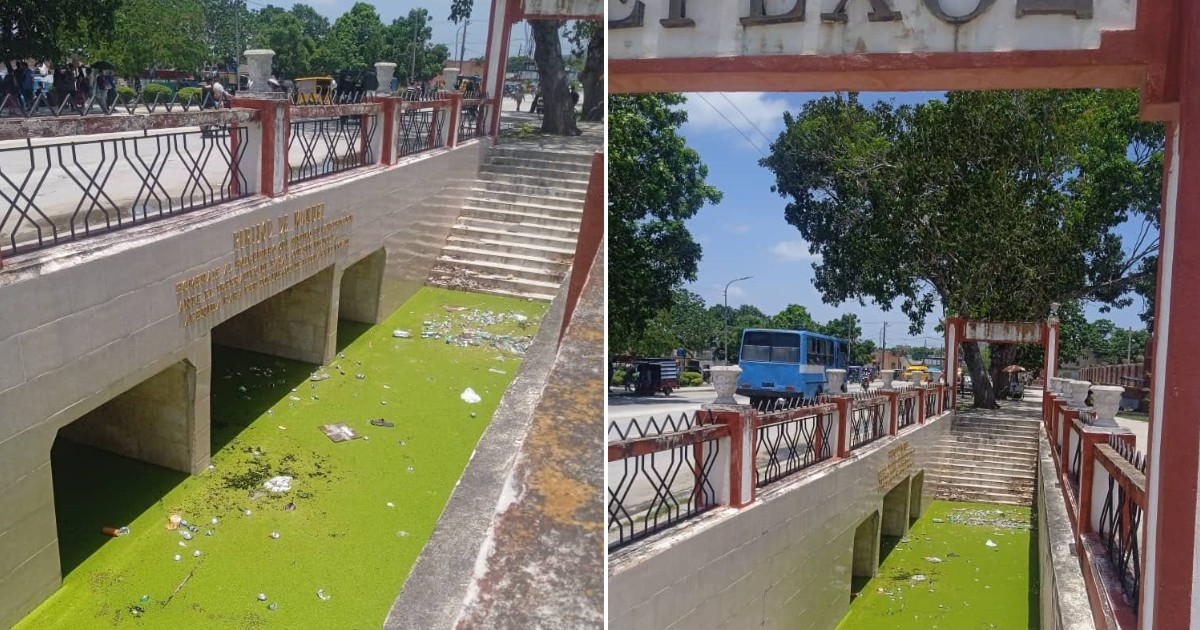
A recent post on the Holguín Memories Facebook page, titled "Total Abandonment," has brought back memories of the once-iconic Pirijod de Manuel pedestrian underpass in Holguín. Today, it lies neglected, submerged in water, overrun with green algae, and has become an open-air dumping ground.
Constructed in the late 1970s beneath Avenida de los Libertadores, this underpass is named after the Russian word "Переход" (Perekhod), meaning pedestrian crossing, which locals phonetically adapted to "Pirijod." Popular lore attributes its creation to a resident named Manuel, who championed the idea to provide safe passage across the avenue to the stadium area, and thus it was affectionately named after him.
A Once Vital Passage Now in Ruin
For years, the underpass served a significant role, featuring a café inside—fondly remembered as "Doña Yuya's"—and a small shop. It was a daily route for students attending the Fajardo Hospital or the Pedagogical Institute.
Despite its initial utility, the structure had underlying issues from the start. "The tunnel's drainage system was flawed from its inauguration. I remember going to the stadium with my father in the '80s and there was always standing water," recounted a commenter. Another added that the water stems from the groundwater and it "could have been fixed by sealing it, but for the government, it's easier to let it become a breeding ground for disease."
Community Frustration and Institutional Contradictions
Presently, the underpass is utterly unusable: stagnant water covered in algae, bottles, cans, and accumulated solid waste. Locals describe it as a mosquito haven, makeshift public restroom, and an epidemic hotspot, especially in a city already battling dengue and chikungunya outbreaks tied to stagnant water.
The post sparked a wave of reactions blending nostalgia, outrage, and dark humor. "I remember as a child passing through there, the café sold bottled soda and other items, it was very clean then, over forty years ago, such a shame," shared one user. Another noted the institutional hypocrisy: "Hygiene and Epidemiology easily fines any Holguín resident for a messy yard. Now, I wonder who will be fined for this filth, who's accountable, because this is the State's responsibility, not the people's."
Many commentators emphasized that the decay is not new. "It's been like this for 15 years or more," one wrote. Another was more blunt: "We've reached a point of no return. Cuba belongs to no one. The people are exhausted, drowning in neglect and apathy."
A Broader Reflection of Urban Decay
The Pirijod de Manuel is not an isolated case. Holguín, once famed as "Cuba's cleanest city," is littered with abandoned infrastructures: the Ateneo Deportivo, the Ismaelillo Theater, sculptures along the pedestrian boulevard, and the Holguín-Gibara railway station. In May 2026, the Communal Services Company acknowledged shortages of trucks, fuel, and personnel as factors in the urban collapse.
The Cyrillic sign "ПЕРЕХОД," painted in red and white over the entrance arch, remains preserved. The Russian term and the underpass's design echo the massive pedestrian underpasses that pepper the urban landscape of Moscow and other former Soviet cities.
Beyond the nostalgia it evokes among generations of Holguín residents, the current state of the Pirijod de Manuel has become, for many, a symbol of Cuba's broader decay. Once a unique and functional structure, it now stands flooded, abandoned, and without prospects for recovery, reflecting the cumulative deterioration of infrastructure, public services, and urban spaces across much of the nation.
Understanding the Decline of Cuba's Infrastructure
What is the current state of the Pirijod de Manuel underpass?
The underpass is currently in a state of complete neglect, with stagnant water, algae, and accumulated waste making it unusable. It is also described as a mosquito breeding ground and an unsanitary public area.
Why was the Pirijod de Manuel originally constructed?
The underpass was built to provide a safe pedestrian crossing under Avenida de los Libertadores, facilitating access to the stadium area. It was promoted by a local resident named Manuel and became known by his name.
What are the broader implications of this neglect?
The state of the Pirijod de Manuel is indicative of widespread infrastructural decay in Holguín and across Cuba, highlighting issues such as inadequate maintenance and governmental neglect.