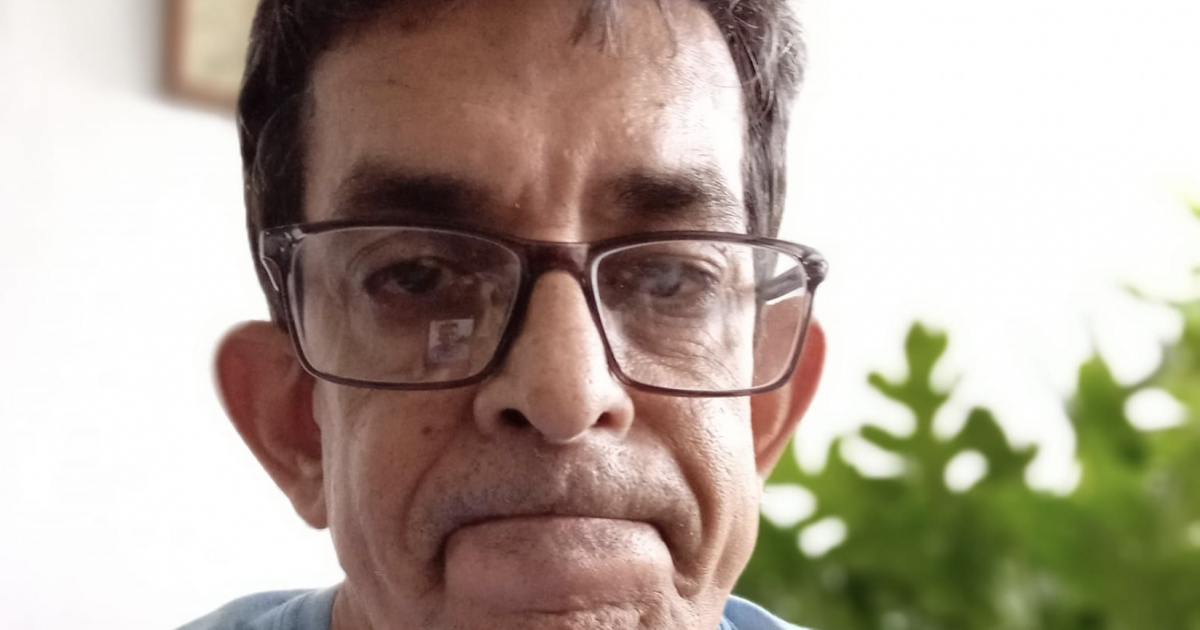
On Tuesday, comedian Ulises Toirac shared his thoughts on Facebook regarding the 176 economic measures recently approved by the Cuban regime.
"The crux of the issue with these measures isn't the measures themselves. It's encouraging that by adopting them and labeling past approaches as 'obstacles', there's an acknowledgment of the historic failure in economic policy," he remarked, pointing to the systemic investor distrust in a regime that historically has not respected or returned foreign capital.
According to Toirac, the real problem lies not in the capitalist-style measures, but rather in the credibility of those enacting them. "No one wants to invest in a system that has never returned investments transparently and is guided more by a political party than by a government or its constitution," he stated.
The comedian also highlighted the contradiction in the official narrative: a plan that includes private banking, trading of state-owned company shares, and partial dollarization, framed as a way to "save socialism." He humorously summarized it: "It's like saying to fix a leaky roof, you should tear it down, claiming it'll save the house."
However, Toirac acknowledged that Cuba possesses real assets to attract investment. He mentioned the nation's strategic cobalt reserves—essential for battery and tech industries, ranking fifth or sixth globally—and the Port of Mariel, strategically positioned near the Panama Canal, making it a key logistical hub between Asia, the Americas, Europe, and Africa. He also noted the potential in sugar cane fields and tourism.
"We're not as insignificant as some may think," he wrote, adding the critical "but": these assets mean little without a legal framework that shields investors from arbitrary actions.
Toirac's central question was how to foster trust when the same entity advocating for change has a historical track record of doing the opposite. "How can anyone believe that a regime that has consistently acted a certain way for years will suddenly change? Who ensures that once stable, it won't revert to its old ways, like in the Wild West?" he asked.
Toirac believes the solution isn't just a change in leadership, but rather the establishment of institutions that prevent those in power from manipulating rules. "A political and legal framework is essential to ensure that if someone tries to cheat the system, they can't easily do so," he warned.
This post is the latest in a series of reflections by Toirac on recent reforms. On June 19, he called for an "exclusion clause" to prevent Communist Party officials, military, and Interior Ministry officers from participating in the new economic framework, warning of the risk of a Soviet-style oligarchy. He later suggested that the government is merely "buying time" as power outages worsen and protests increase.
The context of these reflections is one of extreme tension: the Electrical Union reports deficits exceeding 2,000 MW during peak evening hours, with power cuts lasting more than 24 hours in Havana. Meanwhile, the Cuban Conflict Observatory recorded 1,311 protests in May 2026 alone.
Cuba also carries a documented history of defaults: it suspended debt service with the Paris Club in 1987 and has an external debt exceeding $29.5 billion, a daunting figure for any potential investor.
Understanding Cuba's Economic Challenges
What are the key concerns about Cuba's new economic measures?
The main concern is not the measures themselves, which are capitalist in nature, but the credibility of the Cuban government, which has a history of not returning investments and lacking transparency.
Why is there skepticism about investing in Cuba?
Investors are skeptical because the Cuban regime has historically failed to return investments and operates under a political party rather than a stable legal system.
What assets does Cuba have to attract investors?
Cuba has significant assets like cobalt reserves, the strategically located Port of Mariel, fertile sugar cane fields, and potential in tourism.