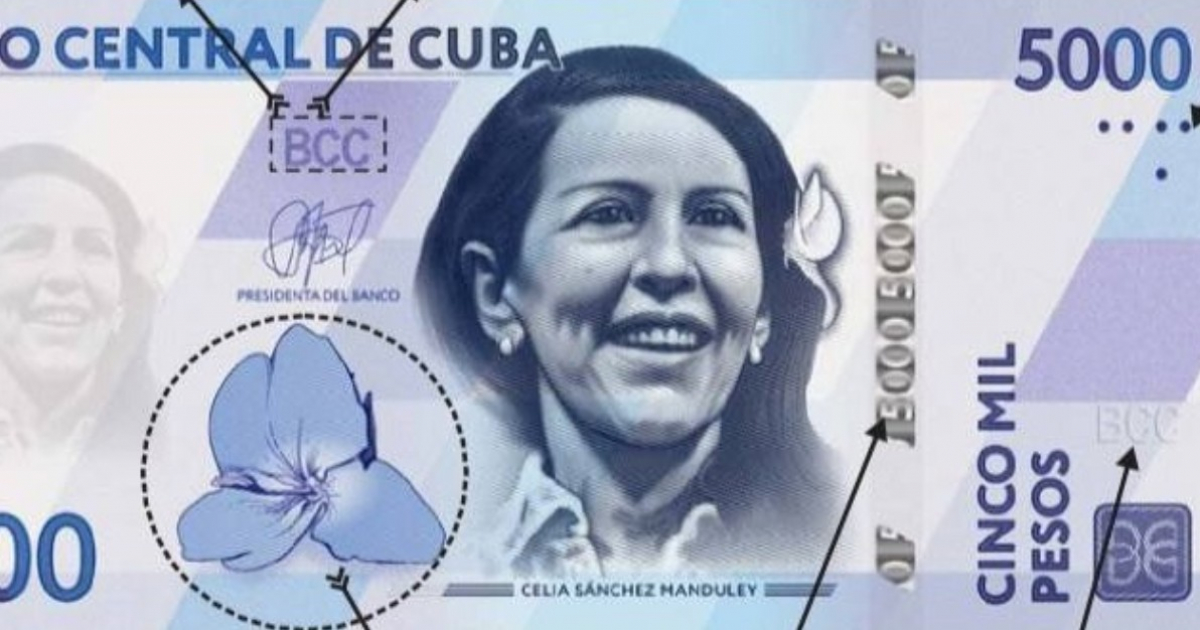
It has been three months since the Central Bank of Cuba (BCC) introduced the 5,000 Cuban pesos (CUP) bills, the highest denomination in the country's monetary history. Yet, for many Cubans, these bills remain elusive and have not made their way into the everyday cash transactions, as reported by elToque this Monday.
The BCC unveiled these new bills on April 1, 2026, amidst rising inflation and a banking system plagued by serious inefficiencies. The introduction was intended to ease the handling of large sums of cash and to counteract the persistent increase in prices.
Challenges in Distribution and Public Perception
Despite their intended benefits, the distribution of these bills has been so sparse that for most Cubans, they are almost a mythical concept. "I've only seen them in pictures," says Alicia, an educator from the Diez de Octubre municipality in Havana.
This sentiment is widespread: while the bills exist, they rarely appear in the hands of everyday citizens. Those who do acquire one often either spend it quickly or hold onto it tightly. Roberto, a construction worker in Havana, chose the former path: "I got rid of it right away. It felt risky to have that much money in one bill," he admitted.
Fears and Strategic Uses
The fear of theft, loss, or counterfeiting often drives these decisions. On the other hand, some individuals reserve the bills for particular transactions in the informal market. Dennis, an artist from Centro Habana, acknowledges the scarcity of these bills but prefers to keep them when he can. "I save them to buy dollars," he explains.
An anonymous business owner commented that "the large bills make it easier to conduct under-the-table transactions," such as purchasing gasoline outside official channels.
Economic Disparities Highlighted
The gap between the bill's nominal value and the real incomes of Cubans is stark. The minimum wage remained at 2,100 CUP for years until the National Assembly raised it to 3,210 CUP on June 18, with the increase effective from July and payable in August. This new minimum wage still falls short of the value of just one of these new bills.
Meanwhile, the informal market saw the dollar reach 695 CUP on Sunday, with the euro climbing to 800 CUP, both hitting record highs.
Issues with Smaller Denominations
The introduction of high-denomination bills also creates challenges on the lower end of the currency scale. Mabel, a young woman from Mayabeque, reports that some cafes have stopped accepting five, ten, twenty, or fifty peso bills. "What can I do? They don't accept transfers either," she laments.
Economist Pavel Vidal, a PhD in Economic Sciences and former analyst at the BCC, describes the issuance as a "necessary and overdue" measure. "When a country experiences years of high inflation, existing denominations become inadequate," he explains.
Vidal argues that the new bills do not exacerbate inflation—"it’s not a solution to the inflation problem, but it also doesn't worsen it"—and speculates that the delayed issuance might have been due to the mistaken belief that limiting the number of bills could curb inflation.
The new bills also mark a milestone: for the first time, Cuban paper currency features female figures. The 2,000 CUP bill shows the portrait of Mariana Grajales, and the 5,000 CUP bill features Celia Sánchez.
On the streets, however, some describe these bills as "odd" or say they "look like euros," perceptions that distance them from daily life.
"Without sufficient printing, the positive effects won't be realized or will be negligible," Vidal warns, summarizing the risk that this measure might remain merely symbolic—quite literally, just paper.
Understanding Cuba's Monetary Challenges
Why are the 5,000 CUP bills not widely circulated?
The distribution of the 5,000 CUP bills has been limited, making them scarce in everyday transactions for most Cubans.
What is the impact of the new bills on inflation?
According to economist Pavel Vidal, the new bills do not aggravate inflation, although they are not a solution to the inflationary problem either.
How have the new bills affected smaller denominations?
The introduction of high-denomination bills has led some businesses to stop accepting smaller bills, creating challenges for everyday transactions.