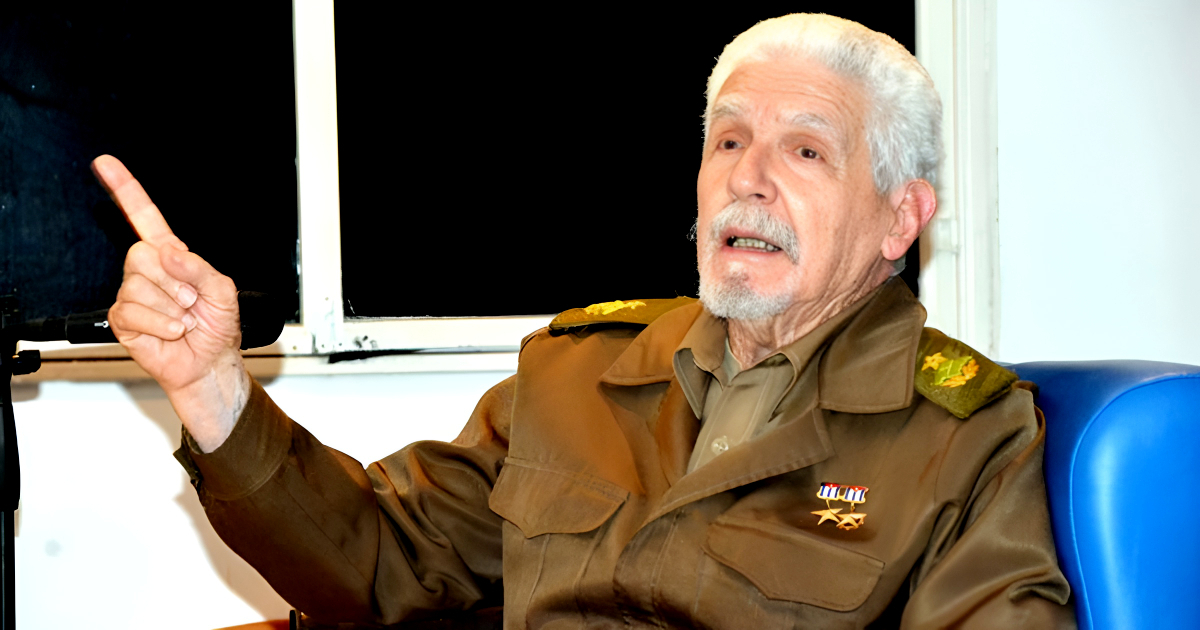
On Monday, the Cuban regime revealed plans for posthumous ceremonies to honor Ramiro Valdés Menéndez, who passed away on Sunday at the age of 94. Valdés, a cornerstone of the country's oppressive machinery, will be remembered in simultaneous ceremonies set for this Tuesday in Havana and each provincial capital.
According to the official announcement in the state-run newspaper Granma, the tribute in Havana is scheduled to commence at 10:00 a.m. at the headquarters of the Ministry of the Revolutionary Armed Forces, where Valdés's remains will be on display.
At the same time, tributes will also take place in all provincial capitals and the Special Municipality of Isla de la Juventud.
The regime has declared an official mourning period through Presidential Decree 1247, signed by Miguel Díaz-Canel. This decree mandates that the Cuban flag be flown at half-mast on public buildings and military institutions throughout Tuesday, from 6:00 a.m. until midnight.
The decree, published in the Official Gazette, describes Valdés as a "hero of the Republic of Cuba and of Labor" and assigns the enforcement of this decree to the ministers of the Revolutionary Armed Forces, the Interior, and Foreign Relations.
Valdés's remains will be transported to Santa Clara for burial on Thursday, June 25, with military honors at the Mausoleum of the Las Villas Front, within the Ernesto Che Guevara Sculptural Complex.
The official statement notes that the chosen burial site respects Valdés's "last wish to rest alongside his comrades-in-arms and near the Heroic Guerrilla," referring to Che Guevara, under whose command Valdés fought as the second-in-command of the No. 8 "Ciro Redondo" invading column during the Battle of Santa Clara in 1958.
Valdés served as the first head of the Ministry of the Interior (MININT), established in 1961, and was the architect of Cuba's state security apparatus. He founded both the Department of State Security and the General Intelligence Directorate, structures that have upheld the regime's political repression for over six decades.
His legacy is polarizing. The regime regards him as a revolutionary hero, while opponents, exiles, and Cuban-American lawmakers view him as responsible for decades of surveillance and crimes against the Cuban people, earning him nicknames like "Blood Puddle" and "The Butcher of Artemisa."
Cuban-American representative María Elvira Salazar responded harshly to his death, stating, "Another one dies without facing earthly justice for all the harm he caused."
Similarly, Representative Carlos A. Giménez expressed regret that Valdés died "without ever having to face justice for the countless crimes against humanity, tortures, and atrocities he committed against the Cuban people."
Valdés had been away from public life for months. His last verifiable appearance was in September 2025 at the inauguration of a solar park in Sancti Spíritus, and he was notably absent from the MININT's 65th-anniversary event on June 6, 2026, where Díaz-Canel honored him in absentia.
Following his death, Raúl Castro, aged 95, remains the sole surviving member of the original core of the Castro regime with active political influence.
Understanding the Legacy of Ramiro Valdés
Who was Ramiro Valdés?
Ramiro Valdés was a key figure in the Cuban regime, known for his role in establishing the state's security apparatus. He was a revolutionary hero for the government but considered a repressive figure by opponents.
What were the official plans for his posthumous tribute?
The Cuban regime planned simultaneous ceremonies in Havana and provincial capitals, with a formal tribute at the Ministry of the Revolutionary Armed Forces and an official mourning period declared through a presidential decree.
How is Valdés's legacy perceived differently?
The regime views Valdés as a revolutionary icon, while critics and exiles see him as responsible for decades of political oppression, earning him derogatory nicknames.