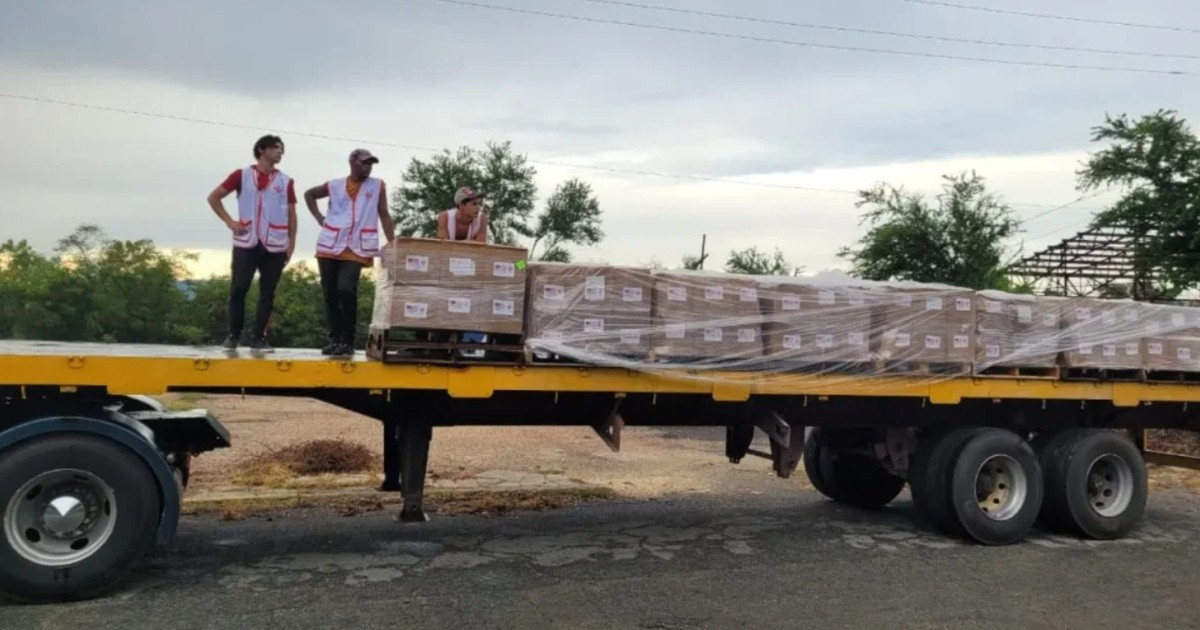
Months following the devastation caused by Hurricane Melissa in eastern Cuba, humanitarian aid from the United States is reaching even the most remote areas of the island. Due to a persistent fuel shortage that hinders other forms of transportation, the assistance is delivered via ox-drawn carts. This unique delivery method was highlighted in a report by AFP, broadcasted by France24, from the small village of Hongolosongo in Santiago de Cuba province.
With a population of just 130, Hongolosongo is near El Cobre and serves as a distribution point for Caritas Cuba, the Catholic NGO that mediates between Washington and those affected by the hurricane. The U.S. chose to route all its assistance through this organization and other independent NGOs, deliberately avoiding direct dealings with the regime.
The aid packages distributed by Caritas include essentials like rice, beans, oil, canned goods, hygiene products, and chlorine tablets to purify water. In Hongolosongo, less than half the homes are connected to the electrical grid, and only a few have access to running water, with many families still struggling to repair their roofs eight months after the cyclone struck.
Teodardo Debardet, one of the aid recipients, returns to his wooden home on a modified bicycle that acts as his wheelchair. Having lost both legs in a work accident and with only two fingers on each hand due to illness, he lost his roof and bathroom when Melissa hit the area with winds of 195 km/h in October 2025. "I'm very thankful," he states.
Challenges in Delivering Aid
Katia Simón, the Caritas coordinator in El Cobre, describes the logistical hurdles her team faces in reaching these isolated communities: "It's a bit challenging because we have to find transportation, source fuel, and see who can get us there." When gasoline and diesel are scarce, which happens frequently, the load is transported by ox cart.
Despite these obstacles, the aid is welcomed with relief. "We welcome this help from wherever it comes... if it's from the people of the United States, that's fine," says 63-year-old Osmany Vedey. Caritas complements each delivery with medical consultations, haircuts, and recreational activities for children.
Since the U.S. initially allocated $3 million following Melissa's impact, the aid has expanded to a total of $9 million, with Caritas having utilized 82% of it by May 8, 2026, benefiting around 8,800 families across five eastern provinces.
Future Aid and Political Tensions
In May 2026, the U.S. Department of State offered an additional $100 million for Cuba: $60 million channeled through the Catholic Church and $40 million through other independent NGOs. The regime claimed to be "examining" the offer without confirming acceptance, with Foreign Minister Bruno Rodríguez even denying having formally received the proposal, dismissing it as a "fable."
Díaz-Canel has repeatedly argued that lifting the U.S. embargo, in place since 1962, would be "easier and more effective" than any humanitarian aid delivery. However, last May, he tentatively agreed to accept aid, citing fuel, food, and medicine as priorities.
Understanding U.S. Humanitarian Aid to Cuba
How is the U.S. aid delivered to remote areas in Cuba?
Due to chronic fuel shortages, U.S. aid is delivered to remote Cuban areas using ox-drawn carts, ensuring that even the most isolated communities receive support.
What does the aid from the U.S. include?
The aid packages include rice, beans, oil, canned goods, hygiene products, and chlorine tablets for water purification, addressing essential needs in affected communities.
Why does the U.S. use NGOs to distribute aid in Cuba?
The U.S. opts to channel aid through NGOs like Caritas to avoid direct interaction with the Cuban regime, ensuring that aid reaches those in need without political interference.
What are the challenges faced in delivering aid to Cuba?
Delivering aid is challenging due to logistical issues, such as finding transportation and fuel. When these resources are limited, aid is transported by ox carts.