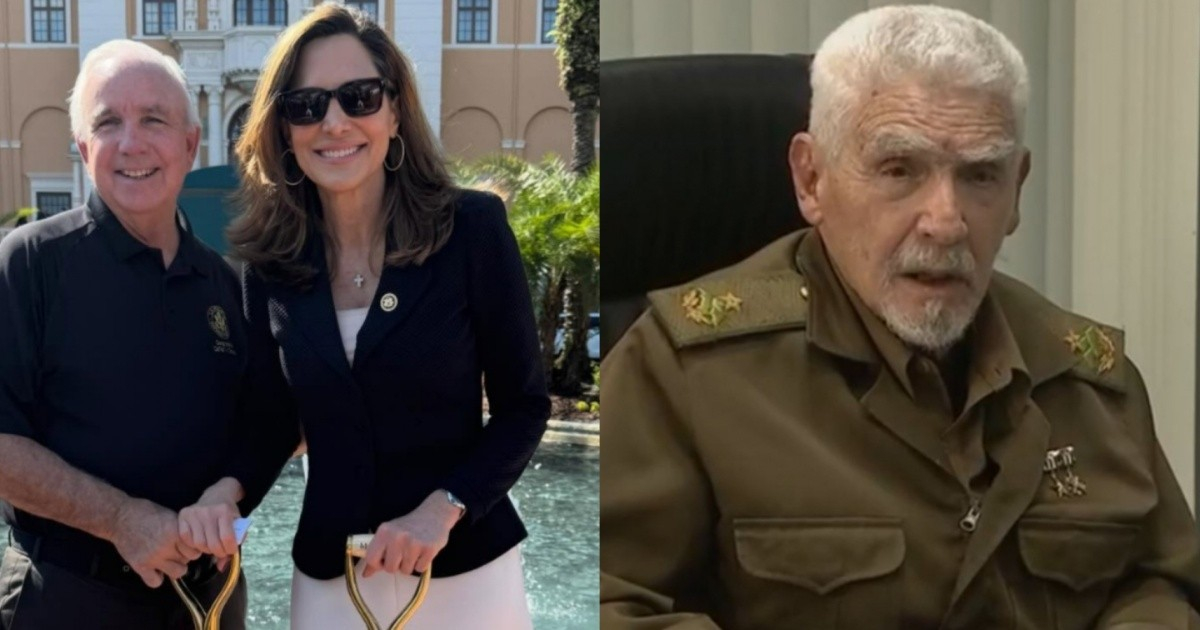
The passing of Ramiro Valdés Menéndez, a key architect of Cuba's Ministry of the Interior, sparked swift reactions from Cuban-American lawmakers María Elvira Salazar and Carlos A. Giménez. Both emphasized that this notorious enforcer of the regime left this world without being held accountable for his actions.
Valdés, who was 94 at the time of his death, received confirmation of his passing from President Miguel Díaz-Canel. This news surfaced shortly after months of silence from the regime about his whereabouts, with his last verified public appearance in September 2025.
María Elvira Salazar, representing Florida's 27th district, was among the first to speak out. On her X account, she dubbed Valdés "Pool of Blood" and didn't hold back: "Another one gone who never faced earthly justice for his deeds. I'm sure he's now in hell with Fidel and all the tyrants who drove the Cuban people to misery, death, and exile."
The congresswoman further stated that in a free Cuba, Valdés's legacy would be remembered as one of "repression, blood, and suffering," urging that the pain inflicted on the Cuban people never be forgotten.
Shortly after, Carlos A. Giménez, born in Cuba and representing Florida's 28th district, issued his own strong statement: "It's a pity that Ramiro Valdés died without ever facing justice for the countless human rights abuses, tortures, and atrocities he committed against the Cuban people."
Both Republican lawmakers serve districts in South Florida with significant Cuban-American populations and have consistently opposed the Havana regime throughout their tenures.
Valdés played a pivotal role in Cuba's repressive machinery from the early days of the dictatorship. He established the Ministry of the Interior on June 6, 1961, leading it in separate terms and forging the state's intelligence and security structure to suppress and incarcerate dissidents and opponents for decades.
Born on March 11, 1932, in Artemisa, Valdés was part of the attack on the Moncada Barracks in 1953, the Granma expedition in 1956, and Che Guevara's column during the revolutionary war. Since 1976, he held the honorary title of Commander of the Revolution, one of the last surviving members of that foundational generation of Castroism.
His removal from the position of Minister of the Interior in December 1985, orchestrated by Raúl Castro, did not mark the end of his influence. He remained involved in governmental affairs, overseeing the energy sector in his later years of public activity.
The passing of historic figures from the Castro era without facing legal proceedings for human rights violations is a recurring issue highlighted by the Cuban exile community and their representatives in Washington, who have closely monitored the regime's silence regarding Valdés in recent months.
Cuban Regime and Accountability: Key Questions
Who was Ramiro Valdés Menéndez?
Ramiro Valdés Menéndez was a founding figure of Cuba's Ministry of the Interior, known for his role in establishing the state's repressive apparatus. He was involved in significant revolutionary events and held the honorary title of Commander of the Revolution.
What was the reaction of Cuban-American lawmakers to his death?
Cuban-American lawmakers María Elvira Salazar and Carlos A. Giménez expressed disappointment that Valdés died without facing justice for his actions, condemning his legacy of repression and human rights abuses.
Why is Valdés’s death significant to the Cuban exile community?
Valdés’s death is significant because it highlights a pattern of historical figures from the Castro era dying without facing charges for human rights violations, a point of contention for the Cuban exile community and their advocates in the U.S.