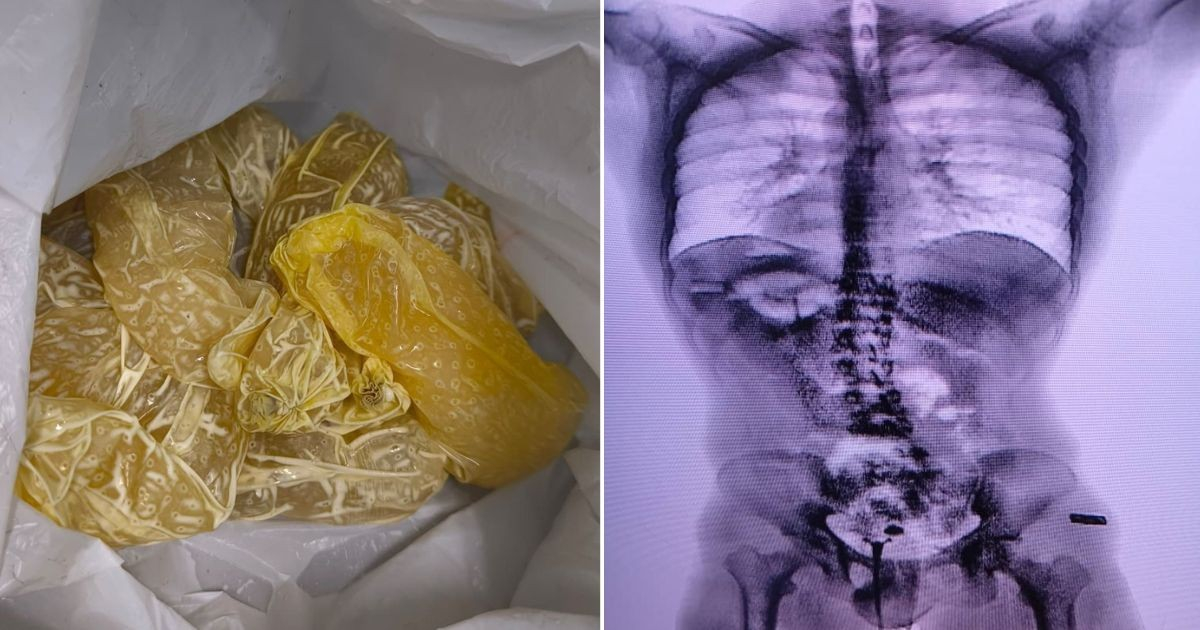
On Saturday, Cuban Customs authorities at Havana's José Martí International Airport intercepted a traveler arriving from Panama with 25 drug capsules concealed within his body.
This incident was disclosed on X by Wiliam Pérez González, the Colonel and First Deputy Chief of the Cuban Customs, who praised the "efficiency of the risk analysis and management efforts executed by Cuban Customs and the anti-drug agency."
Accompanying the announcement were images depicting the yellow latex capsules that had been extracted from the traveler's body, alongside an abdominal X-ray showcasing the foreign objects within.
The official report did not clarify the type of narcotics contained within the capsules nor the nationality of the apprehended individual.
The method, commonly referred to as "body packing" or human couriering, involves swallowing latex-wrapped capsules filled with narcotics to smuggle them undetected through customs. Detection typically involves abdominal X-rays.
This case adds to a series of similar interceptions at the same airport in recent months. On May 3, 2026, Pérez González himself announced the arrest of a passenger with 48 ingested cocaine capsules at José Martí.
In August 2025, a Colombian woman was detained with 23 cocaine capsules in her stomach at the same location, and in July of that year, at least two additional incidents of passengers carrying hidden drugs were reported.
Similarly, in November 2025, authorities apprehended a passenger bound for Panama carrying marijuana and hashish, indicating that the drug trafficking route between these countries operates bidirectionally.
The connection with Panama is significant, as the country is known as a major drug trafficking corridor in the region, having seized 43 tons of narcotics thus far in 2026.
In 2024, Cuban authorities seized a total of 1,051 kilograms of drugs, predominantly cocaine, marijuana, methamphetamine, and cannabinoids, according to data released in early 2025.
Back in December 2018, Cuban authorities dismantled four networks catering to Mexican drug traffickers using mules on the island, with payments reaching up to $75,000 per traveler, highlighting the economic scale of this illicit trade.
Understanding Drug Smuggling in Cuba
What is body packing in drug smuggling?
Body packing is a smuggling technique where individuals swallow drug-filled capsules, usually wrapped in latex, to transport them covertly across borders.
Why is Panama significant in drug trafficking?
Panama is a major drug trafficking corridor in the region, known for facilitating the movement of narcotics, with 43 tons seized in 2026 alone.
How do Cuban authorities detect drug capsules inside the body?
Cuban authorities typically use abdominal X-rays to detect drug capsules concealed inside the body.
How much drugs were seized by Cuba in 2024?
In 2024, Cuban authorities seized a total of 1,051 kilograms of drugs, including cocaine, marijuana, methamphetamine, and cannabinoids.