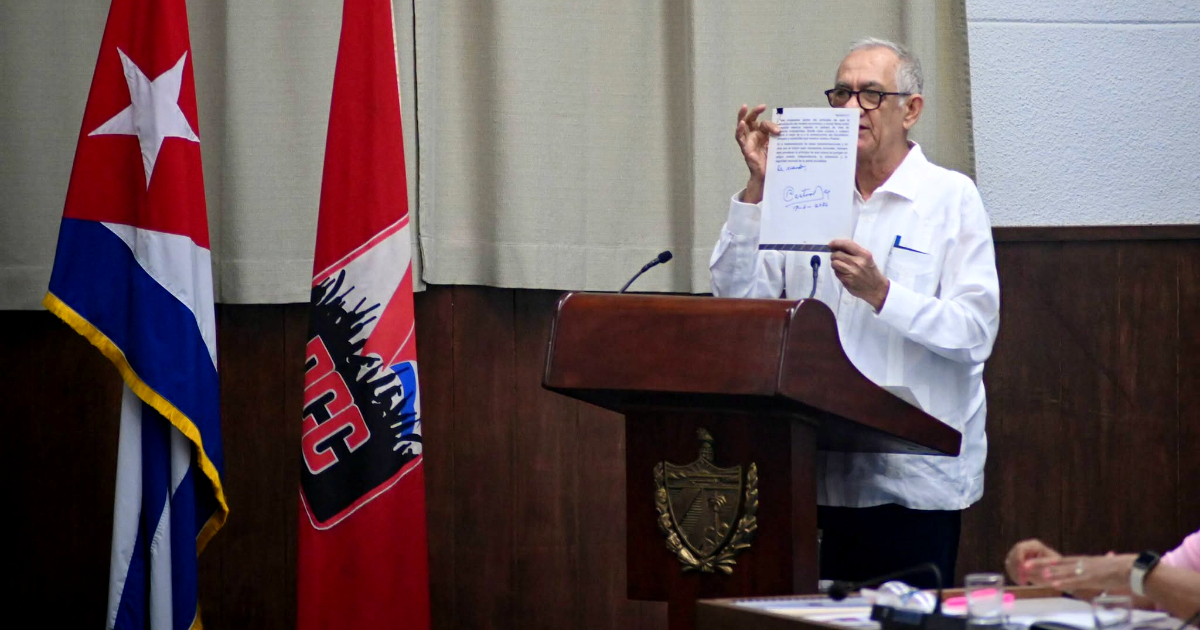
"We are not abandoning socialism."
Miguel Díaz-Canel reiterated this twice at the National Assembly of People's Power, shortly after the regime sanctioned a series of economic reforms featuring measures that clash with traditional Cuban socialist ideals.
Among the 176 recently approved measures are the introduction of private banking, private currency exchange, foreign investment in the non-state sector, relaxation of micro, small and medium-sized enterprises (MSMEs), removal of general price caps, and the transformation of state enterprises into joint-stock companies.
Díaz-Canel's repeated assurance was not mere rhetoric. He was not solely discussing an economic overhaul; he was attempting to safeguard the political legitimacy of a system that for decades had anchored its authority on the irrevocable nature of socialism.
The issue lies in how the regime itself has turned that principle into a straitjacket.
The Constitution as a Fortress
The 2019 Cuban Constitution was not crafted to encourage political diversity or democratic review of the country's model. It was engineered to cement "continuity."
This document asserts that Cuba is a socialist state governed by law and social justice, but it also declares the socialist system as irrevocable.
Moreover, it designates the Communist Party of Cuba (PCC) as the "superior leading political force of society and the State," thereby constitutionalizing the PCC's political monopoly and ruling out any genuine competition for power.
This isn't just a legal technicality. The constitutional setup serves a clear political function: preventing the model from being replaced through a conventional democratic process.
The so-called "Cuban revolution" has insulated itself. Socialism, therefore, has not remained a debatable political option but has become a permanent state condition. Similarly, the Communist Party has been elevated from being one party among many to a constitutionally superior entity.
In essence, the Castro regime has enshrined its ideology as the supreme law.
The Paradox of the Revolution
For decades, this constitutional safeguard was touted as a historical guarantee.
The argument was straightforward: The Revolution had to be preserved from both internal and external foes; socialism was an inalienable achievement; the Communist Party represented the continuity of the process initiated in 1959.
The 2019 Constitution took this logic to its ultimate extent. It not only shielded the regime from political alternation but also made any substantial model change a constitutional dilemma.
This was exactly the aim: to prevent a transition. To ensure that a citizen majority, a legitimacy crisis, or a generational shift could not pave the way for another political and economic system.
However, now this constitutional wall is also beginning to work against the regime's own needs.
Shooting Themselves in the Foot
The paradox is clear. The power that entrenched socialism as irreversible now faces an economy that seemingly compels it to implement mechanisms associated with market economies.
The government needs to attract capital, loosen regulations, expand the private sector, allow non-state financial institutions, and encourage business forms that for decades were regarded with suspicion by revolutionary orthodoxy.
Yet, admitting this as a shift towards capitalism is impossible. Ideological, political, and constitutional reasons prohibit such an admission.
Openly acknowledging a model transition would challenge the very legality core that the regime devised for its perpetuation. Hence, Díaz-Canel's refrain: "We are not abandoning socialism."
This phrase functions less as an economic reality description and more as a political containment operation.
The Contradictions of Language
Over the years, the regime has developed a lexicon tailored to manage this contradiction.
It avoids mentioning transition, opting for "updating." It doesn't refer to capitalism but to "perfecting socialism." It doesn't talk about the market but about "Cuban-style socialism." It doesn't discuss abandoning a model but rather studying "socialist construction experiences in other countries."
Referring to these experiences is not coincidental.
For years, China and Vietnam have served as examples of single-party regimes that incorporated extensive market mechanisms without formally renouncing communist political control.
This seems to be Havana's aspiration: to adopt capitalist economic tools without acknowledging a break from socialism, preserving power monopoly and presenting the change as an internal evolution of the same system.
However, as these reforms expand, the meaning of socialism stretches. Eventually, the inevitable question arises: How much can a system change before the name it retains no longer describes its actual nature?
The Question of Legitimacy
Díaz-Canel's insistence reveals an underlying concern. The regime needs not only for the reforms to succeed but for them not to dismantle the narrative that justified its rule for 67 years.
For decades, the Castro regime demanded sacrifices in socialism's name. It restricted economic freedoms for socialism, excluded political competition in socialism's name, condemned the market, private enterprise, and wealth accumulation in socialism's name. In socialism's name, it repressed, imprisoned, stigmatized, and divided the Cuban people.
Now, amid a deep economic crisis, it resorts to practices and language long associated with its ideological adversary. The contradiction is too vast to be resolved with a single phrase.
That's why it's repeated. "We are not abandoning socialism."
The repetition attempts to close a rift that the official discourse itself has opened.
Beyond Economics: A Deeper Issue
The fundamental question is not whether Cuba will continue to be called socialist.
As long as the Constitution maintains the Communist Party's political monopoly and the irreversibility of the system, the regime is compelled to present itself this way.
The real question is different.
What legitimacy does a power retain that for decades declared a model as non-negotiable, sacrificed generations in its name, and now needs to incorporate elements it once deemed incompatible with its principles?
The Castro regime crafted a Constitution to prevent the country from escaping its foundational narrative. But the economic crisis now forces it to bend that narrative until it becomes nearly unrecognizable.
This is the trap. Irreversible socialism was designed as a permanence guarantee. Today, it begins to turn into a problem for those needing change without admitting they are changing.
Understanding Cuba's Political Landscape
Why is the Cuban Constitution seen as a barrier to change?
The 2019 Cuban Constitution was crafted to ensure continuity of the socialist regime, declaring the system irrevocable and solidifying the Communist Party's political monopoly, thus hindering any potential for democratic transition or substantial change.
How does the regime justify economic reforms without admitting a shift towards capitalism?
The regime employs a language of "updating" and "perfecting socialism" to introduce economic reforms. By referencing experiences from countries like China and Vietnam, it aims to adopt capitalist tools while maintaining a facade of socialism and political control.
What is the main contradiction facing the Cuban regime?
The contradiction lies in the regime's need to implement market-oriented reforms to address economic issues while simultaneously upholding socialism as an irreversible state principle, creating a conflict between ideological integrity and practical necessity.