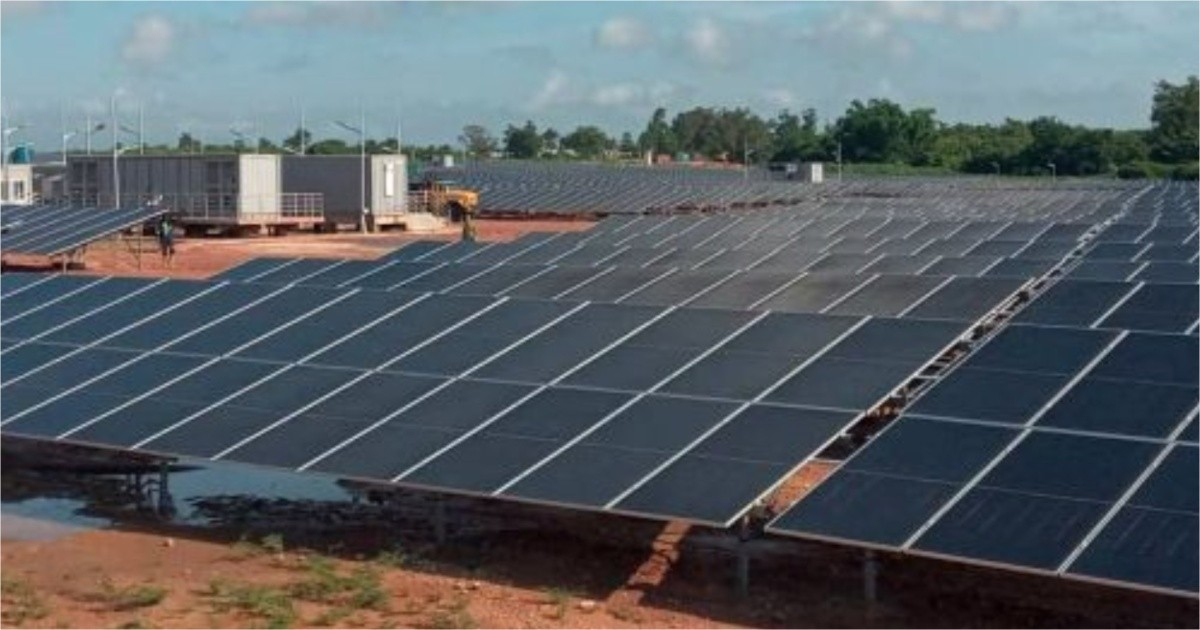
This past Saturday, the Cuban regime announced the connection of a third solar park in Pinar del Río to the National Electric System. This facility, located near Puerta de Golpe in Consolación del Sur, boasts a capacity of 21.8 megawatts. However, instead of celebrating, Cubans took to social media with their usual sarcastic remarks in response to such announcements.
One Facebook user quipped, "Pinar del Río will never experience blackouts again," capturing the irony of an unchanged reality. Another user joked, "I heard they installed the panels incorrectly, so instead of the sun giving us energy, it’s actually receiving it, ha, ha, ha." A simple yet telling comment read, "Submarine current."
Public Skepticism and Irony
Questions filled with skepticism also emerged: "Are you sure this is Pinar del Río?" And some comments mixed humor with critique: "And who actually has access to these panels?"
The stark disparity between official announcements and everyday reality was evident on the same Saturday when the Electric Union predicted a nationwide power deficit of 1,935 megawatts, as reported by state-run Cubadebate.
Challenges Amidst Economic Struggles
The official media portrayed the project as an achievement "despite the economic blockade," blaming the U.S. embargo for construction delays. Yosleiby Izquierdo Sánchez, a lead specialist in renewable sources at the Pinar del Río Electric Company, acknowledged to Granma that managing the limited fuel supply was one of the main challenges. The park, still in its initial phase with technical support from China, contributed 106 megawatt-hours to the grid on its first day.
This new installation features 42,588 bifacial photovoltaic panels—an upgrade over the province's previous two parks—alongside seven inverters and two direct interconnection lines to the national system. "We're already supplying the national grid, but we're still making necessary adjustments, which is typical at this stage," Izquierdo Sánchez explained.
Expansion Without Storage Solutions
This third solar park marks rapid growth in Vueltabajo. Before 2025, the province had eight small installations with a combined capacity of just 18.5 megawatts. Over the past 14 months, approximately 70 additional megawatts have been added, including the first large park at La Barbarita in April 2025, the second at La Lucila in November, and a five-megawatt donation from China at La Ceniza.
Yet, the core issue remains unresolved: none of these parks feature battery storage systems, meaning their output is restricted to daylight hours, failing to alleviate the more severe nighttime blackouts. In June, Cuba faced deficits of up to 2,134 megawatts, with availability hovering around 1,016 megawatts against a demand of roughly 3,050 megawatts.
The pattern of disappointment repeats with each solar park inauguration. Prior to the unveiling of a solar park in Artemisa in November 2025, Cubans were already remarking, "Every time they announce a solar park opening, the blackouts increase." This Saturday, the scenario played out once more, as predictably as the power outages.
Understanding Cuba's Energy Challenges
Why are Cubans skeptical about new solar parks?
Cubans are skeptical because previous solar park inaugurations have not resolved the ongoing issues of blackouts, particularly at night due to the lack of battery storage systems.
What are the main challenges in Cuba's energy sector?
Cuba's energy sector faces challenges such as insufficient fuel supply, lack of storage solutions for solar energy, and infrastructure issues, compounded by the U.S. embargo.
How much energy do the new solar parks contribute?
The new solar parks in Pinar del Río are contributing additional capacity, but without storage solutions, the energy is only available during daylight and does not mitigate nighttime blackouts.