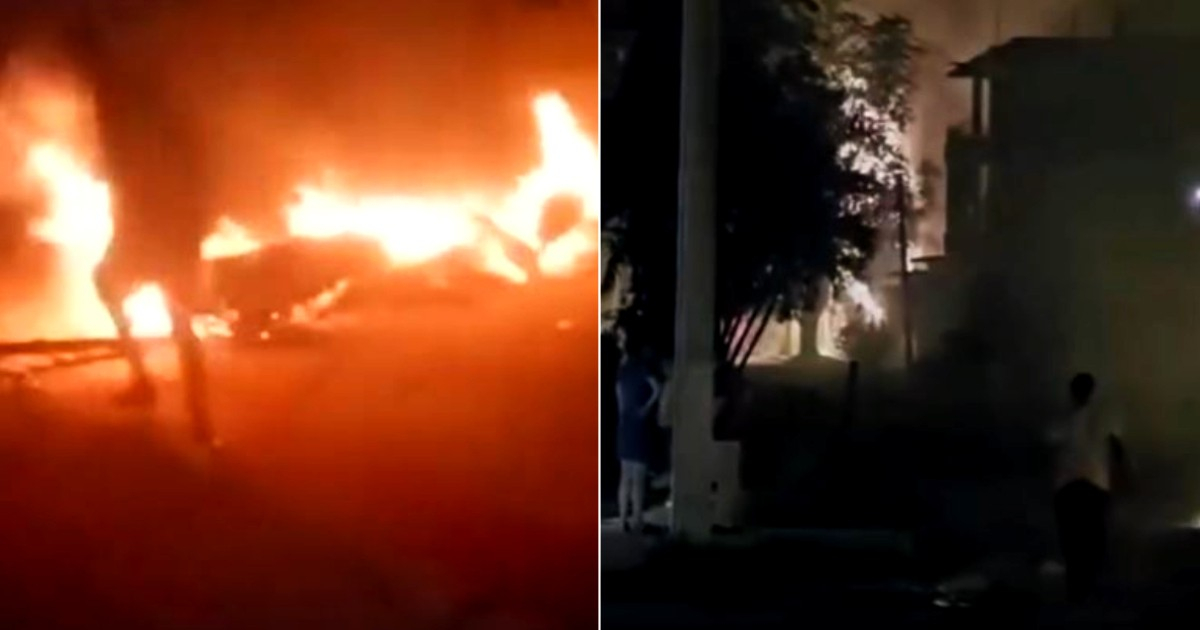
In Cuba, fire has emerged as a new form of protest.
What initially began as nighttime banging of pots and pans in opposition to power outages has evolved into a more extreme form of resistance. Cubans are now setting fire to accumulated trash in the streets, burning tires, and lighting bonfires at street corners, transforming the darkness of blackouts into beacons of defiance.
On Saturday, reports surfaced of pots and pans being banged alongside tire fires in the neighborhoods of San Miguel del Padrón and La Güinera in Havana. This marked the latest in a series of protests that the independent outlet Árbol Invertido described on social media as "the language of protests in Cuba."
"Fire has become the language of protests in Cuba," the outlet stated, "a new means for Cubans to signal their distress amid unbearable nights and power cuts. From the depths of a nation mired in poverty, these luminous signals broadcast a clear and loud message: a yearning for freedom and rejection of the communist regime."
The timeline of fiery protests spans the entire island and extends over several months. Between March 7 and 10, residents of Marianao burned trash to light their way during nighttime demonstrations. Simultaneously, they sang the national anthem.
On March 15, protestors set garbage ablaze in the Micro 9 neighborhood of Santiago de Cuba. The following day, residents of Centro Habana ignited trash near the Ministry of Energy amid an ongoing electricity crisis.
In April, these fires became more frequent. On April 9, burning trash on San Nicolás Street scorched the main door of the Church of San Judas Tadeo and San Nicolás de Bari. On April 23, the same pile of trash was once more set alight, and firefighters failed to respond; the next day, the Escolapios Fathers issued an urgent statement warning that the church was at risk of burning for a third time.
An incident on April 28 was particularly telling: residents of the Reina neighborhood deliberately set fire to trash to force the arrival of fire trucks and utilize their water, at a time when over 200,000 Havanans lacked access to drinking water.
The night of May 13 was the most intense since the events of July 11, 2021. Residents of Santos Suárez reported that "fires were set at every corner," with bonfires, pot banging, and internet outages affecting at least ten Havana municipalities while the power generation deficit reached 2,113 MW.
On June 8, flames erupted near Infanta and San Lázaro in Centro Habana. On Friday, the streets of Santos Suárez once again blazed with burning trash during fresh protests over blackouts.
Fire holds a dual significance in this context. It is a visible act of political defiance but also a desperate response to a public health collapse: overflowing trash heaps are widespread across Cuba, posing a real epidemic threat.
In 2025, the island experienced one of the worst dengue and chikungunya outbreaks on record, resulting in 65 deaths and 81,909 infections, according to the Pan American Health Organization, with over half of the deceased being minors.
Authorities officially acknowledged the epidemic in November 2025, and by February 2026, chikungunya transmission remained active.
The Cuban Conflict Observatory recorded 1,311 protests, complaints, and critical expressions in May 2026, the highest monthly figure on record, preceded by 1,133 in April. On Saturday, the Electric Union reported an availability of just 1,016 MW against a demand of 2,650 MW, with 1,620 MW affected.
For the regime, these luminous signals in the darkness of blackouts represent a new and troubling form of challenge: as incendiary as the cries of "Freedom" and "Down with the Dictatorship" that accompany them, and much harder to ignore.
Understanding the Escalating Protests in Cuba
What sparked the recent escalation of protests in Cuba?
The escalation began with nighttime protests against power outages, which evolved into more intense acts of resistance, including setting fires to trash and tires as a visible expression of defiance against the communist regime.
How has the use of fire in protests impacted the situation in Cuba?
The use of fire has served as both a political act of defiance and a response to public health concerns, highlighting the desperation and frustration of citizens dealing with overflowing trash and the risk of epidemics.
What are the broader implications of these protests for the Cuban regime?
The protests represent a significant challenge to the regime, as they are difficult to ignore and highlight the widespread discontent and calls for freedom among the Cuban population.