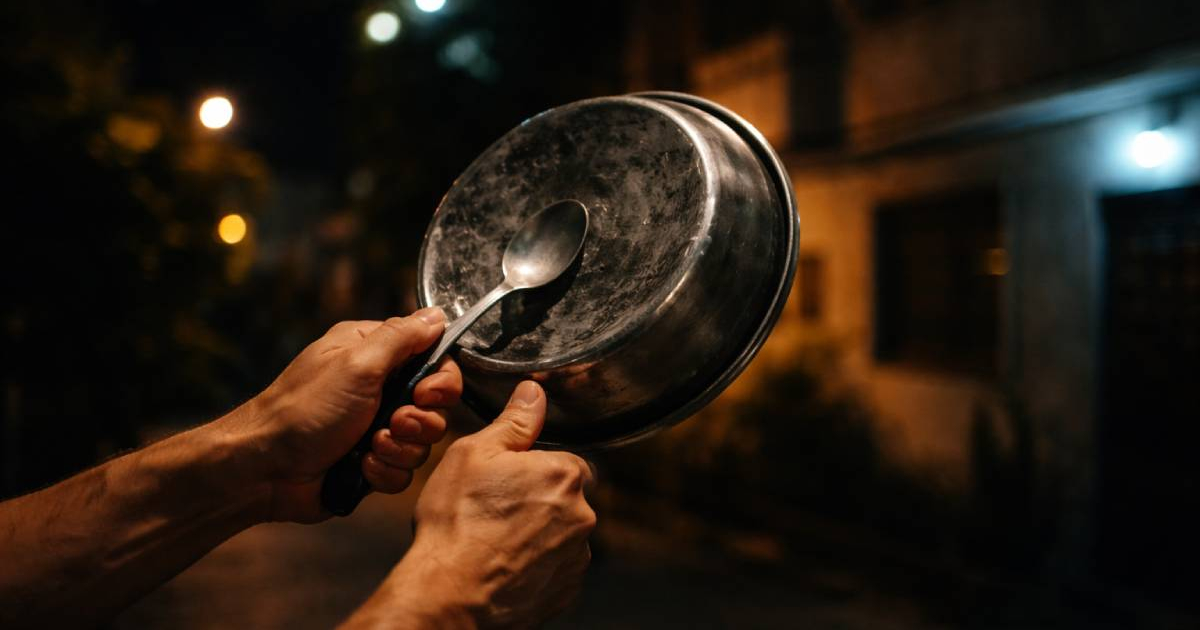
On Friday night, the residents of Avenida Carlos III in Central Havana staged a pot-banging protest to voice their frustration over the relentless power outages that have been suffocating the Cuban capital. This demonstration was captured in a video shared by independent journalist Yosmany Mayeta Labrada on his Facebook page.
The footage, enveloped in darkness, reveals figures of people on the streets while the clanging of pots and pans echoes—a form of protest that has spread through various Havana neighborhoods and other Cuban provinces throughout June 2026.
This protest in Carlos III was not an isolated incident. Similar gatherings were reported at the intersections of Escobar and San Leopoldo in Central Havana, and pot-banging protests were also recorded near the Communist Party headquarters in Santiago de Cuba.
Energy Crisis Sparks Outrage
In the Havana municipality of Santos Suárez, tensions flared as residents took to the streets to extend their protest against the ongoing electrical crisis.
The immediate cause of this outrage is an unprecedented energy crisis: power cuts in Havana have lasted between 12 and 22 hours daily, with some neighborhoods experiencing blackouts for up to 31 consecutive hours.
The situation deteriorated further after the shutdown of the Antonio Guiteras Thermoelectric Plant. In Santiago de Cuba, the Electric Company reorganized the outages into nine blocks, leaving each area with just one or two hours of electricity per day.
Chants of Dissent and Government Response
Protesters have been chanting slogans such as "water and electricity" and "down with the dictatorship," while the regime has responded with a heavy police presence, including the deployment of the so-called black berets, and arrests reported since at least March 6, 2026.
This wave of protests began in early June. On June 2, pot-banging demonstrations were reported in several Havana municipalities, and the following day, coinciding with Raúl Castro's birthday, pots were heard in Monte and Águila, Holguín, and Villa Clara.
On June 17, pot-banging, street blockades, and garbage burning marked the night in several capital neighborhoods, as documented by El Toque. By June 18, a Havana neighborhood erupted in protest after enduring 36 hours without electricity, and fresh pot-banging demonstrations shook Santiago de Cuba.
Unprecedented Protests Since July 2021
Journalist Mario J. Pentón noted on Facebook that "between June 18 and 19, multiple spontaneous protests were recorded in various parts" of the country, highlighting the scale of the events unfolding in Cuba this week.
Independent media outlets agree that this surge represents the largest wave of popular protests in Cuba since July 11, 2021, when thousands of Cubans took to the streets in dozens of cities, and the regime responded with a massive crackdown resulting in hundreds of political prisoners.
Understanding the Recent Protests in Cuba
What triggered the pot-banging protests in Havana?
The protests were triggered by prolonged power outages in Havana, with some areas experiencing blackouts for up to 31 consecutive hours.
How has the Cuban government responded to the protests?
The government has responded by deploying police forces, including the so-called black berets, and making arrests since at least March 6, 2026.
What is the current state of the energy crisis in Cuba?
The energy crisis in Cuba has led to daily power cuts lasting between 12 and 22 hours, with some areas experiencing up to 31 hours of continuous outages.