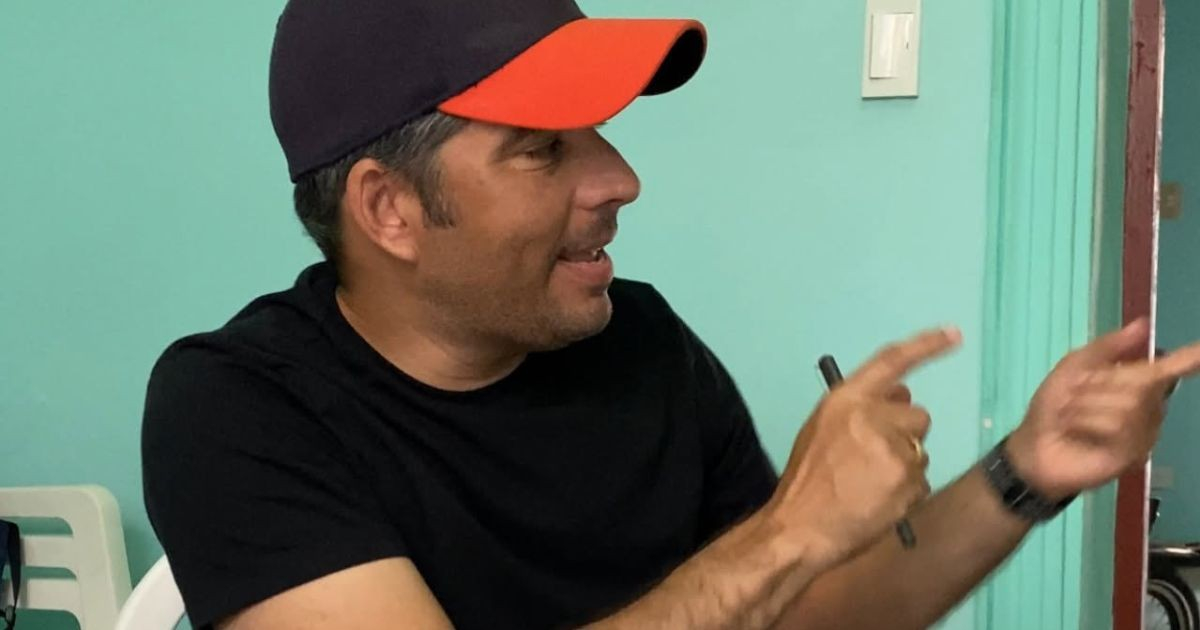
The renowned Cuban actor and comedian Luis Silva, famous for his character Pánfilo, delivered a strong rebuke to the Cuban regime on Thursday through his social media platforms. His remarks came in response to the announcement of a new economic reform package by Miguel Díaz-Canel's government.
Silva took to his verified social media accounts to express his disbelief at the news that Díaz-Canel acknowledged past mistakes and pledged to "remove restrictions" to boost the island's economy, describing the situation as both "unbelievable and amusing."
In a story post, Silva commented, "It's unbelievable and amusing that every time they attempt supposed changes, they have to REMOVE RESTRICTIONS," before delivering a bold statement in capital letters against a red background: "YOU HAVE BEEN THE TRUE BARRIER TO THE PROSPERITY OF CUBANS!"
Decades of Self-Imposed Restrictions
Silva's main argument targets the long-standing self-imposed restrictions by the regime itself. "If since the 1990s they had allowed people to prosper and grow without limits, obstacles, or bans, today the people would live better," he asserted.
The comedian's post followed the presentation of a comprehensive package of 176 economic measures by Prime Minister Manuel Marrero Cruz to the National Assembly. The government has described these measures as the most significant structural reform attempt since the Special Period of the 1990s.
Key Reforms and Internal Admissions
The announced reforms include opening up to private banking, the buying and selling of state enterprise shares, partial dollarization, increased autonomy for small and medium private enterprises, the removal of price caps, and expanded access to foreign investment, grouped under 23 key areas.
Díaz-Canel admitted to lawmakers that "there are obstacles that don't come from outside or the embargo," acknowledging that part of the crisis originates internally. He added, "The mistake wasn't in proposing them, but in postponing them," referring to long-discussed reforms that have yet to materialize.
This admission underscores Silva's long-standing argument, which he has been vocal about on his social media platforms, where he boasts a following of over 2.6 million on Facebook and receives tens of thousands of interactions with each post.
Silva's Continued Criticism of the Regime
Silva is no stranger to confronting the regime with such critiques. In March 2021, he condemned the "internal blockade" created by Cuban regulations, pointing to Cuban Customs as the real obstacle for citizens. In August 2022, he demanded a total economic opening from the government, urging them to "fully open the valve" instead of doing it "bit by bit." In October 2024, he called for resignations over the energy crisis following a massive blackout on the island.
Economic Crisis and Future Concerns
The backdrop to this latest criticism is a Cuba in economic freefall. The Economic Commission for Latin America and the Caribbean (ECLAC) projects a GDP contraction of -6.5% for 2026, while The Economist Intelligence Unit estimates -7.2%, and economist Pedro Monreal warns of a scenario of up to -15%. The country endures blackouts lasting between 20 and 25 hours daily in several areas, with generation deficits exceeding 2,000 megawatts, alongside widespread shortages of food and medicine.
In this context, analysts caution that the 176 measures could replicate the Soviet-style privatization model of the 1990s, benefiting the ruling elite with inside information rather than the Cuban people.
Understanding Cuba's Economic Challenges
What are the main economic reforms announced by the Cuban government?
The Cuban government announced reforms including the introduction of private banking, buying and selling of state enterprise shares, partial dollarization, greater autonomy for small and medium private enterprises, removal of price caps, and expanded access to foreign investment.
What is Luis Silva's main argument against the Cuban regime?
Luis Silva argues that the Cuban regime has been the true obstacle to the prosperity of Cubans due to decades of self-imposed restrictions and prohibitions that have limited economic growth and development.
How has the Cuban economy been affected in recent years?
The Cuban economy has been severely affected, with projected GDP contractions and widespread shortages of food and medicine. The country also faces significant energy deficits, leading to prolonged daily blackouts in various regions.