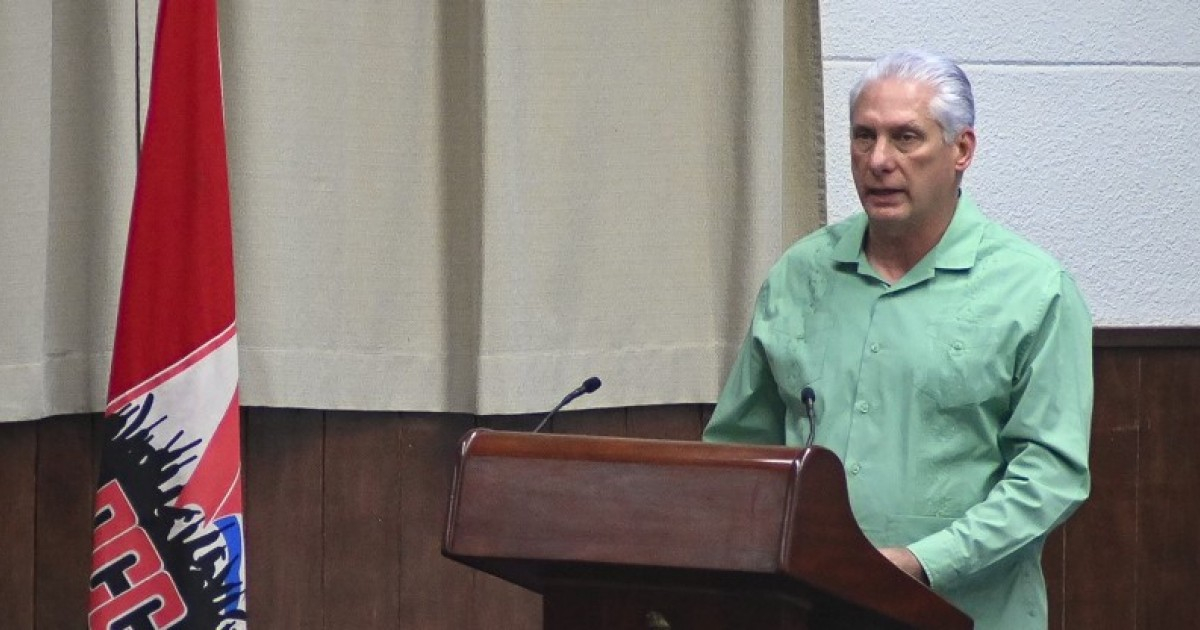
Miguel Díaz-Canel has underscored the critical nature of food production in Cuba, labeling it as a "national security issue." In a decisive move, he has mandated the elimination of idle lands and announced the extension of agricultural usufruct to private producers, cooperatives, small and medium-sized enterprises (SMEs), and associative forms during an Extraordinary Plenary Session of the Central Committee of the Communist Party.
"Every plot overtaken by marabú, which should be producing food, must be addressed: either it starts producing or it is given to someone willing to do so," he stated emphatically.
The leader made it clear that state ownership of the land remains non-negotiable: "This land will continue to belong to the people, and if it does not produce, if it does not serve the country, if it fails to fulfill its social function, it must be transferred to those who can make it productive."
The announcement also includes a specific promise for farmers: direct access to foreign currency through sales to the tourism sector or the exchange market, along with the ability to directly import seeds, fertilizers, parts, and equipment.
"Cuban farmers cannot be expected to produce more food with fewer tools and prices that don't cover their costs," he asserted.
This speech was part of a package of 176 measures organized into 23 strategic axes, which the National Assembly confirmed on Thursday during an extraordinary session. These measures were derived from the evaluation of 390 proposals. The process was fast-tracked: Díaz-Canel outlined the main objectives on June 12, the Communist Party approved them on Wednesday, and the Assembly ratified them the following day.
Díaz-Canel was compelled to acknowledge that the crisis also has internal origins: "There are obstacles that do not come from outside or from blockades. There is sluggishness, bureaucracy, and regulations that hinder those who want to produce, as well as decisions we have postponed. What depends on us, we must change, and we must change it now."
Alarming Agricultural Decline in Cuba
The scale of the agricultural collapse surrounding these announcements is dire. Between 2018 and 2023, pork production plummeted by 95%, rice by 87%, beans by 70%, and milk by 58%.
The marabú—a symbol of Cuba's neglected countryside—now spans between 1.1 and 1.7 million hectares of what were once productive lands. In 2021, the state itself admitted that 49% of Cuba's 6.4 million hectares of agricultural land remained uncultivated, while the nation imports between 70% and 80% of its food.
As of April, 96.91% of the Cuban population lacked adequate access to food, as reported by the Food Monitor Program, with 33.9% of households indicating that at least one member had gone to bed hungry in the previous 30 days.
Challenges and Reforms in Land Usufruct
This is not the first time usufruct has been addressed. Since 2008, when the regime enacted Decree-Law 259, more than 2.1 million hectares have been granted in usufruct with disappointing outcomes: by 2015, contracts for 43,000 usufructuaries were revoked for improper land use.
Economist Pedro Monreal described the reforms as "belated pragmatism" and cautioned that Cuba "has missed the reform trains of China and Vietnam."
The regime is now preparing new Agricultural and Forestry Land Legislation, aiming to extend usufruct terms to 25 years or more, expand land limits up to 268 hectares, and include private SMEs as beneficiaries, according to details of the upcoming agricultural legislation.
Raúl Castro, who participated via videoconference in the Extraordinary Plenary and signed the proposal document, issued a warning that echoes the accumulated skepticism: "As important as the approval of these transformations is their proper and timely implementation."
Understanding the Agricultural Reforms in Cuba
What is the main objective of Díaz-Canel's recent agricultural reforms?
The primary aim is to eradicate idle lands and enhance food production by expanding agricultural usufruct to private producers, cooperatives, and SMEs.
How does the Cuban government plan to support farmers under the new measures?
The government promises farmers access to foreign currency via sales to the tourism sector or exchange market and the ability to import necessary agricultural inputs directly.
What challenges have previous land usufruct initiatives in Cuba faced?
Past initiatives have faced disappointing results, with many contracts being canceled due to improper land use, highlighting the need for effective implementation and support.