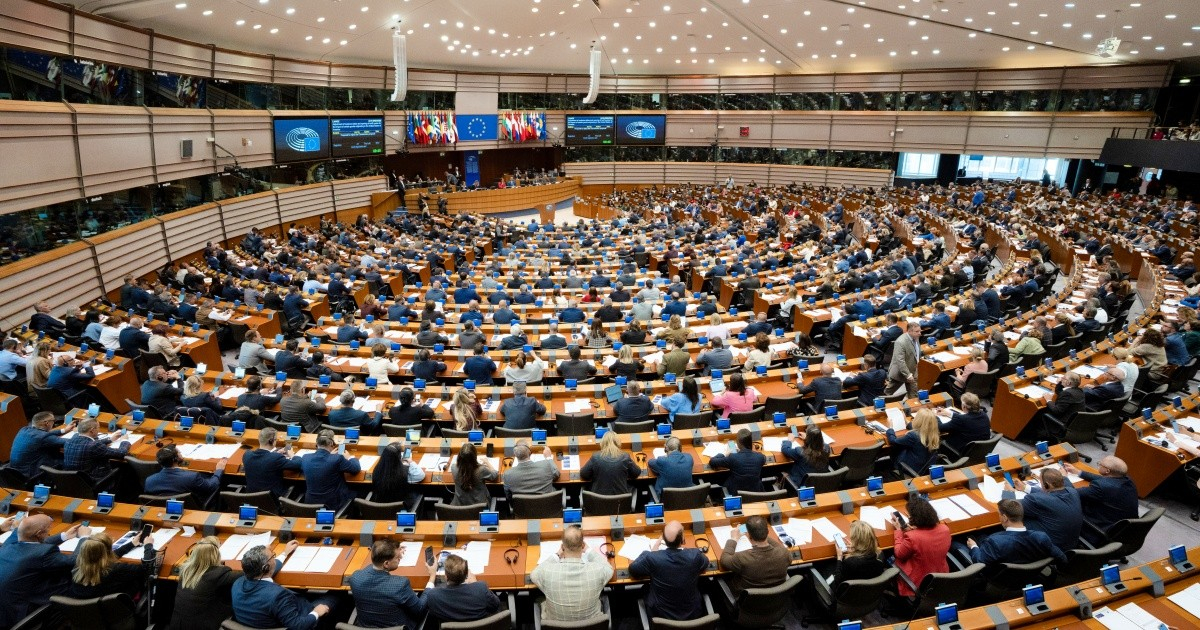
The Cuban government raised its rhetoric on Friday in response to the European Parliament's resolution calling for sanctions against Miguel Díaz-Canel and GAESA, and advocating for the termination of the Political Dialogue and Cooperation Agreement (PDCA) between Cuba and the European Union.
Although Havana issued an official statement mere hours after the vote through its Embassy in Belgium and to the European Union, it wasn't until Friday morning that Foreign Minister Bruno Rodríguez Parrilla personally addressed the matter. He denounced the resolution, accusing conservative European factions of aligning with U.S. policies against the island.
This sequence of events drew significant attention. Initially, the regime's reaction was restricted to a diplomatic note from Brussels, while Cuba's top officials remained silent on what was one of the strongest resolutions against Cuba by the European Parliament in decades.
The controversy also coincided with the presentation of 176 economic measures to the National Assembly by Prime Minister Manuel Marrero Cruz, which dominated official media coverage.
Initial Response from Cuban Diplomacy
The first communication from the Cuban regime came from Brussels, where the Cuban Embassy to Belgium and the EU issued a statement titled "European Parliament: From Arrogance to Indignity." This document dismissed the resolution adopted in Strasbourg as “another exercise in political manipulation, double standards, and subordination to the most extreme and hostile U.S. political agendas against the island.”
The Cuban diplomatic mission directly accused European conservative groups of spearheading a campaign against Havana, claiming the European Parliament's actions align with Washington's interests. It stated, "The indignity of the European Parliament, dominated by right-wing political groups, is well-known."
Furthermore, the note attempted to discredit the European lawmakers, alleging that those purporting to defend human rights are the same who, according to the Cuban version, "have approved and celebrated with racist and xenophobic slogans, the expulsion of migrant families, including children, and have instituted a European ICE emulating Trump's policies."
Legal Arguments and Accusations
One of the central arguments in Cuba's response was legal. The embassy emphasized that the European Parliament lacks the authority to decide on the PDCA between Cuba and the EU. "The PDCA is not a commercial agreement. It is a comprehensive and bilateral political agreement covering areas of political dialogue and cooperation, safeguarding relations between Cuba and the EU and its Member States, based on principles of sovereign equality, reciprocity, and mutual respect," the statement asserted.
It further accused particular European political sectors of acting under Washington's influence, suggesting the resolution supports economic pressure policies against the Island. "It is particularly alarming that European political sectors end up subordinating the EU's sovereign interests to Washington's aggressive agenda and the campaigns driven by extremist anti-Cuban groups," it declared.
The statement concluded by expressing gratitude to the regime's international allies, assuring that "Cuba is not alone" against the isolation efforts promoted by its adversaries.
Bruno Rodríguez Breaks Silence and Criticizes the EU Parliament
Hours after the initial diplomatic response, Foreign Minister Bruno Rodríguez took to social media to personally weigh in on the issue. In a more direct and political message, the Foreign Minister accused European conservative sectors of adopting the narrative pushed by the United States to justify sanctions against Cuba.
"Right-wing political forces in the European Parliament prefer to align with the deceitful American narrative designed to justify the energy blockade, extreme economic warfare, and military threat by the U.S. government against the Cuban people," he tweeted.
Rodríguez also criticized the MEPs for not defending European interests against the extraterritorial measures imposed by Washington, highlighting that this stance contradicts EU legislation, specifically Regulation (EC) 2271/96, established to protect European companies and citizens from the extraterritorial application of certain third-country laws.
In one of his strongest remarks, Rodríguez linked the stance of these European political groups with the situation in the Middle East. "It doesn’t surprise us. We’ve witnessed the silence and complicity of these same groups in the face of the Israeli genocide in Gaza," he stated.
Despite the criticisms, Cuba's top diplomat made it clear that Havana will not abandon the institutional framework currently governing its relations with Brussels. "Cuba will continue to support the implementation of the PDCA with the European Union, a mechanism that allows addressing common interests and differences on the basis of equality, reciprocity, and mutual respect," he concluded.
The Resolution That Triggered Cuba's Reaction
The resolution approved by the European Parliament on Thursday was backed by 283 MEPs, with 199 voting against and 85 abstaining. It represents one of the European Parliament's sternest statements on the Cuban situation in recent years. Among other points, it warns that the Island is "on the verge of becoming a failed state" and notes that 89% of Cuban families live in extreme poverty.
The resolution also references data from Prisoners Defenders, which recorded 1,281 political prisoners in Cuba as of late May 2026, including minors.
The MEPs urged the EU Council to consider individual sanctions against Miguel Díaz-Canel and other regime officials, particularly those linked to GAESA, the military-run conglomerate that controls a significant portion of Cuba's economy.
Additionally, the European Parliament renewed its call for the suspension of the PDCA between Cuba and the EU, the principal framework currently regulating bilateral relations.
This initiative comes just two weeks after the U.S. Office of Foreign Assets Control (OFAC) directly sanctioned Díaz-Canel for the first time. Before the vote, Spanish MEP Hermann Tertsch, a key proponent of the resolution, summed up the proposal's spirit with a blunt statement: "The time for warnings and threats is over. It's time to act."
The Cuban response clearly indicates that the government perceives the resolution as a new political offensive driven by Washington and supported by European conservative sectors. However, the text adopted in Strasbourg reflects a growing deterioration in the perception of Cuba's political, economic, and human rights situation within European institutions, which have traditionally favored dialogue with Havana over sanctions.
Understanding the European Parliament's Resolution on Cuba
What prompted the European Parliament to call for sanctions on Cuba?
The European Parliament's resolution was prompted by concerns over Cuba's political situation, human rights issues, and economic conditions, warning that the Island is on the brink of becoming a failed state.
How did the Cuban government respond to the European Parliament's decision?
The Cuban government responded by issuing a statement through its Embassy in Belgium, accusing European conservative groups of aligning with U.S. interests and dismissing the resolution as political manipulation.
What is the Political Dialogue and Cooperation Agreement (PDCA)?
The PDCA is a comprehensive political agreement between Cuba and the EU that facilitates political dialogue and cooperation, based on principles of sovereign equality, reciprocity, and mutual respect.