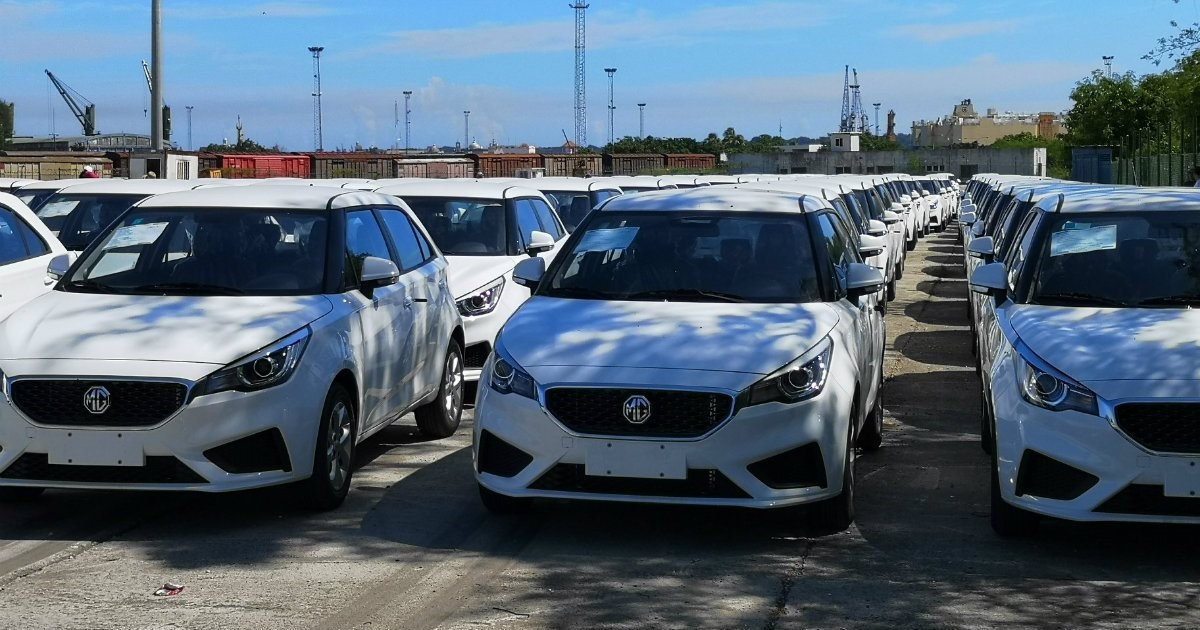
The Cuban government declared on Thursday the removal of limitations on vehicle purchases for both individuals and businesses. This is one of 176 economic reform proposals presented to the Third Extraordinary Session of the National Assembly of People's Power (ANPP), as reported by the official Granma newspaper.
This new measure eradicates restrictions on vehicle imports, offering tariff priority to electric models, particularly those capable of being charged with solar energy.
The announcement is part of a broader reform package introduced by Prime Minister Manuel Marrero Cruz to the deputies gathered at the Havana Convention Palace, with virtual participation from across the country, including army general Raúl Castro Ruz.
Marrero Cruz characterized the current period as "the most complex context the country has faced since the Special Period" and framed the reforms under the principle of "doing what is necessary to preserve what is essential."
The document outlines 176 transformation proposals across 23 key areas, originating from 390 initiatives received, of which the government approved 66.7%. Additionally, the Political Bureau added 69 further recommendations.
The reform package was publicly announced by Miguel Díaz-Canel on June 12, endorsed by the Central Committee of the Communist Party of Cuba (PCC) on June 17, and presented to the ANPP for discussion and approval on Thursday.
Expansion of Economic Autonomy
Among the changes in the first key area is the enhancement of state-owned enterprises' autonomy to operate equally with other economic players, the decentralization of pricing for wholesale and retail markets, and the removal of significant limits on small and medium-sized enterprises (SMEs).
Additionally, the proposal suggests abolishing the wage scale in state enterprises and establishing a minimum wage that considers inflation levels, with amounts negotiated between companies and workers with union involvement.
The government has also authorized private banking for the first time in decades and announced the opening to investment from Cubans living abroad, all within the same reform package.
Historical Context of Vehicle Market Restrictions
Cuba's history of vehicle market restrictions is long-standing. In 2011, the government permitted the buying and selling of used cars between private parties, and in December 2013, it abolished the state permit required to purchase new vehicles. This measure took effect in January 2014, although prohibitive prices kept the market out of reach for most Cubans.
The regime blames the current crisis on intensified U.S. sanctions since January 2025, which, according to Marrero Cruz, have disrupted fuel supplies and foreign currency income.
However, the structural decline of the Cuban economy is a result of decades of centralized management under the dictatorship, which the government itself admits has not been reversed since the achievements of the VI Congress of the PCC began to fade in mid-2019.
An Ambitious Reform Effort
This Thursday's package represents the most ambitious reform attempt since the "updating of the economic model" initiated in 2011. It also includes a reduction of the state apparatus from 27 to between 20 and 21 ministries, among them the creation of a Ministry of Interior and Transportation.
"These actions do not represent a concession, but rather the sovereign adaptation of development tools to the specific circumstances of the country," Marrero Cruz asserted before the Assembly.
FAQs on Cuba's Recent Economic Reforms
What are the key changes in Cuba's vehicle purchase policy?
Cuba has lifted restrictions on vehicle purchases for individuals and businesses, allowing for the importation of vehicles, with tariff preferences for electric cars, especially those using solar energy.
How does the reform package affect state-owned enterprises?
The reforms enhance the autonomy of state-owned enterprises, allowing them to operate on equal terms with other economic players, and include the decentralization of pricing and the removal of limits on small and medium-sized enterprises.
Why is the Cuban government implementing these reforms now?
The government is implementing these reforms in response to the complex economic challenges facing the country, aiming to preserve essential elements while adapting to current circumstances.