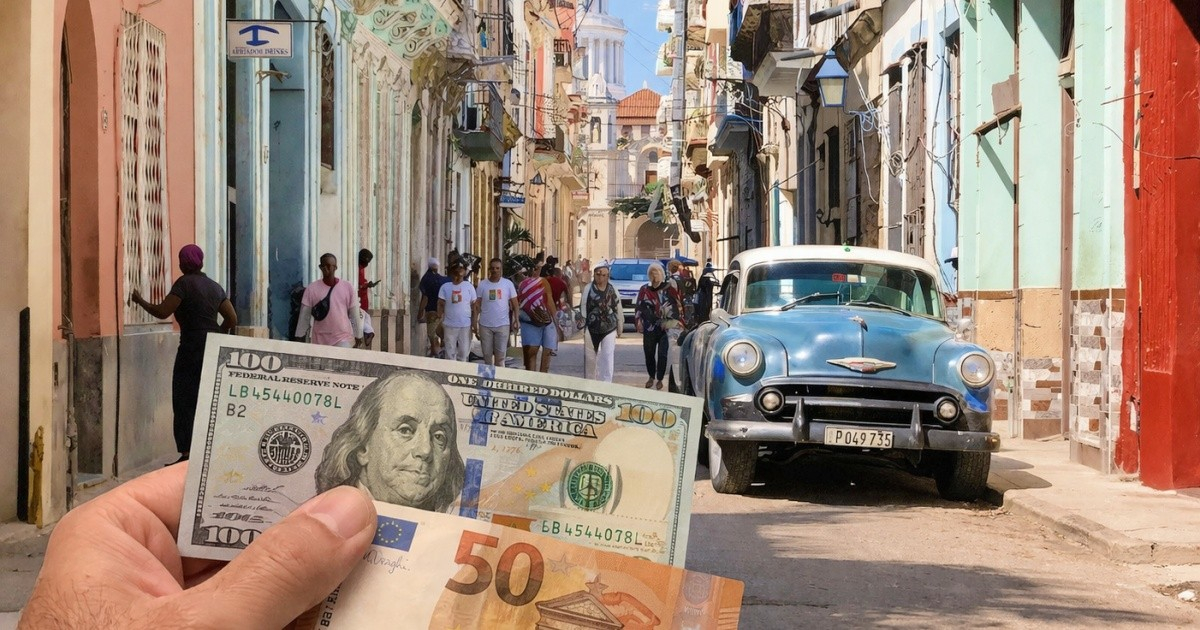
The informal currency market in Cuba continues its upward trend this Thursday: the U.S. dollar climbs by five pesos, reaching 685 Cuban pesos (CUP), while the euro rises by ten pesos to 775 CUP, as reported by elTOQUE's daily update on the Cuban informal market. Meanwhile, the Freely Convertible Currency (MLC) remains unchanged at 500 CUP for the second consecutive day.
Unprecedented Currency Surge
June's dramatic rise in currency values has caught many by surprise. The dollar began the month at 585 CUP, and in just 18 days, it has soared by 100 pesos, which is an increase of over 17%. Initially, the elTOQUE's Observatory of Currency and Finance (OMFi) predicted a maximum of 650 CUP by the end of June; however, this limit was surpassed on the 12th, a full 18 days ahead of schedule.
On Wednesday, the dollar was valued at 680 CUP and the euro at 765 CUP, marking historical highs at that time. This Thursday, both currencies continue to rise, indicating that the brief pause on Tuesday, June 16 — the first in 20 continuous days of increases — was merely a temporary break.
Informal Market Transactions
Private transactions reflect the current volatility with wide-ranging offers. The euro trades between 760 and 815 CUP; the dollar, between 610 and 750 CUP; and the MLC, from 420 to 570 CUP.
The gap between these rates and the official Cuban Central Bank (BCC) rates widens daily. The BCC sets the dollar at 555 CUP and the euro at 644.77 CUP for today, meaning that buying dollars informally costs 130 pesos more than the state rate. This discrepancy makes imported goods more expensive and exacerbates inequality between those with access to foreign currency and those reliant on the peso.
Free-Falling Cuban Peso
The accumulated depreciation of the Cuban peso is staggering. Back in 2020, the dollar was valued at roughly 42 CUP on the informal market; today it stands at 685 CUP, signifying a loss of more than 95% of the peso's value over six years. The average annual depreciation from January to April 2026 was 45%, more than double that of 2025.
Economist Elías Amor has warned that the dollar could approach 1,000 pesos if macroeconomic imbalances persist. "The problem is that needs can be met with foreign currency, and people will pay whatever it takes for it," he noted. He also stressed, "No foreign currency will enter Cuba in the coming months."
Structural Crisis Behind the Numbers
The currency surge is a symptom of deeper, interrelated issues. Tourism, Cuba's main source of foreign currency, has plummeted: from January to May 2026, only 359,491 international visitors arrived, a 58.4% drop compared to the same period in 2025, with hotel occupancy at 12.9% in the first quarter. Energy crises with prolonged blackouts, fiscal deficits, and unbacked monetary issuance complete the picture.
The impact on the population is severe and immediate. The average state salary stands at approximately 6,930 CUP monthly, while the basic cost of living is estimated around 96,000 CUP per month. Official annual inflation reached 15.89% in May 2026, though independent estimates place it closer to 70% per year.
Even Cuba's Vice President Salvador Valdés Mesa admitted in May that living on 6,000 CUP is impossible due to high prices, highlighting the regime's failure to manage the crisis.
The OMFi cautioned that "greater economic isolation could lead to more restrictions on foreign currency entry, reduced availability of imported goods, and further inflationary pressure," a scenario that, given Thursday's data, appears to be unfolding precisely.
Understanding Cuba's Currency Crisis
Why are the dollar and euro increasing in value in Cuba?
The surge in value is due to economic instability, including a drop in tourism, energy crises, and a lack of foreign currency entering the country, which increases demand.
What impact does the currency increase have on Cuban citizens?
The increase makes imported goods more expensive, heightens economic inequality, and further strains the average Cuban's ability to afford basic living costs.
Could the dollar reach 1,000 CUP?
Economists warn that if current macroeconomic imbalances persist, the dollar could approach 1,000 CUP, exacerbating the economic crisis.