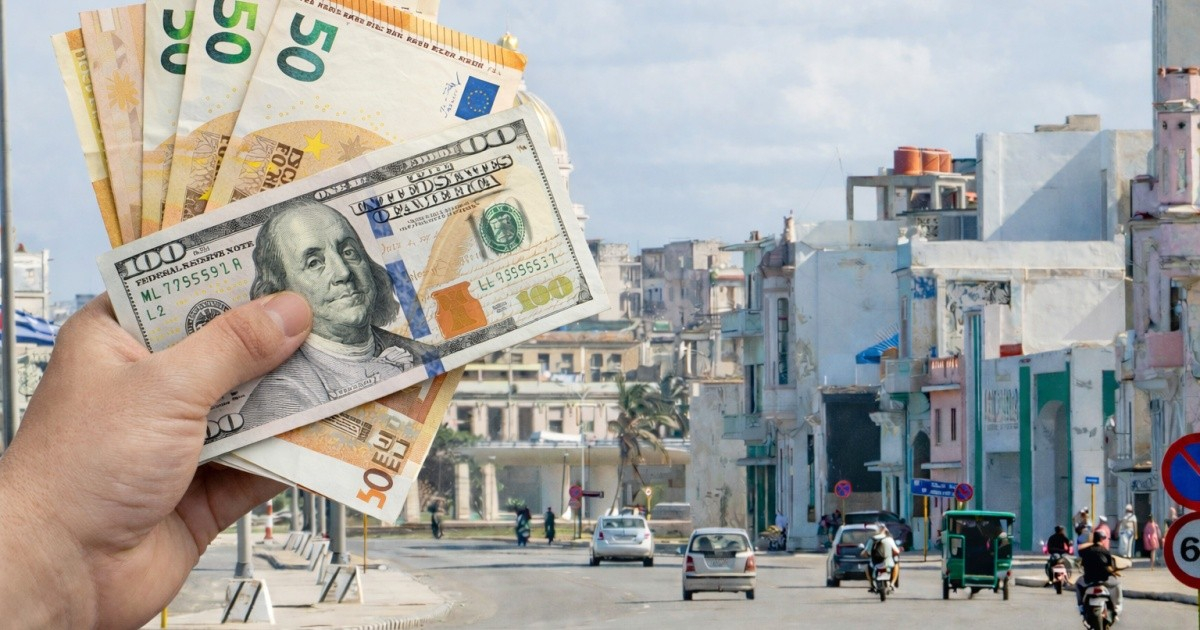
The US dollar reached a staggering 685 Cuban pesos on Thursday in the informal market, according to real-time data from elTOQUE updated at 11:17 am. This happened while the Communist Party of Cuba held a special plenary session to announce reforms, which were met with mockery and skepticism by the Cuban people.
The exchange rate represents a five-peso increase from Wednesday's close when the dollar was valued at 680 CUP, following two consecutive days of rising rates.
Since closing May at 580 CUP, the Cuban peso has depreciated by 105 pesos against the dollar, marking a sharp 18.1% decline in just 18 days of June.
Euro's Decline and Market Disparity
The euro is also experiencing a decrease, trading at 785 CUP on Thursday, which is nine pesos more than the previous day. It has seen a monthly drop of 125 pesos—18.9%—since it closed May at 660 CUP.
The gap between the informal and official markets is increasingly alarming. The Central Bank of Cuba sets the dollar at approximately 558 CUP, which is over 127 pesos less than what is paid on the streets by any Cuban.
Economic Reforms Amid Inflation
Experts from elTOQUE's Monetary and Financial Observatory warn that internal inflationary pressures and the shortage of foreign currency in formal channels continue to drive the surge in the parallel market, with no signs of reversing in the near term.
This economic turmoil unfolds as the regime conducts meetings and announces transformations.
Communist Party's Economic and Social Reforms
On Wednesday, the Central Committee of the PCC convened in an extraordinary plenary session led by Miguel Díaz-Canel to approve a package of over 20 economic and social reforms. Raúl Castro participated via videoconference, endorsing the measures with his signature, according to government reports.
Roberto Morales Ojeda, a member of the Political Bureau, opened the session with a statement encapsulating the session's intent: "The economic and social transformations we analyze here are to preserve the Revolution and its achievements."
Prime Minister Manuel Marrero presented the proposals structured around six pillars: economic management, municipal autonomy, corporate autonomy, agricultural recovery, foreign trade, and foreign investment.
Included in the reforms are reducing the number of ministries from 27 to 21, granting more wage autonomy to state enterprises, opening investment opportunities for Cubans living abroad, and gradually replacing universal subsidies with targeted aid.
Marrero Cruz emphasized that the reforms "acknowledge market mechanisms as tools for efficient resource allocation," but clarified that they "can only be driven by our own efforts," dismissing any external support.
Public Reaction and Economic Projections
The public's response was immediate and overwhelmingly skeptical. Cubans took to social media to voice their doubts: "Same dog with different collars," one user commented. Others dubbed it "Reordering 3.0," referring to the failed monetary reordering of 2021 that spiked inflation. "This is a series with several seasons, and no one knows which is the last," summarized another commentator.
Economist Pedro Monreal offered a more technical yet equally harsh assessment: without access to energy, foreign currency, technology, or external demand, the reforms are "unlikely" to be effective.
The context speaks volumes: the plenary session occurred as pot-banging protests rocked Santiago de Cuba, Santa Clara, and Havana amid blackouts lasting up to 22 hours daily. Meanwhile, a Reuters ticker in the session room announced that the United States would block two tankers carrying Russian fuel destined for Cuba.
This Thursday, the National Assembly convenes in an extraordinary session at 2:00 pm to formally approve the "Economic and Social Transformation Proposals," as per the notice published in the Official Gazette.
The Economic Commission for Latin America and the Caribbean (ECLAC) projects a 6.5% decline in Cuba's GDP by 2026, which would make the island the worst-performing economy in Latin America for the second year in a row.
Understanding Cuba's Economic Challenges
Why is the Cuban peso depreciating so rapidly?
The Cuban peso is depreciating due to internal inflationary pressures and a severe shortage of foreign currency in formal channels, leading to a surge in the parallel market.
What are the main components of the new economic reforms in Cuba?
The reforms focus on economic management, municipal and corporate autonomy, agricultural recovery, foreign trade, and investment. They include reducing ministries, increasing wage autonomy, and targeting subsidies more effectively.
How has the public reacted to these reforms?
The Cuban public has reacted with skepticism, viewing the reforms as inadequate and similar to previous unsuccessful attempts, leading to widespread doubt about their potential effectiveness.