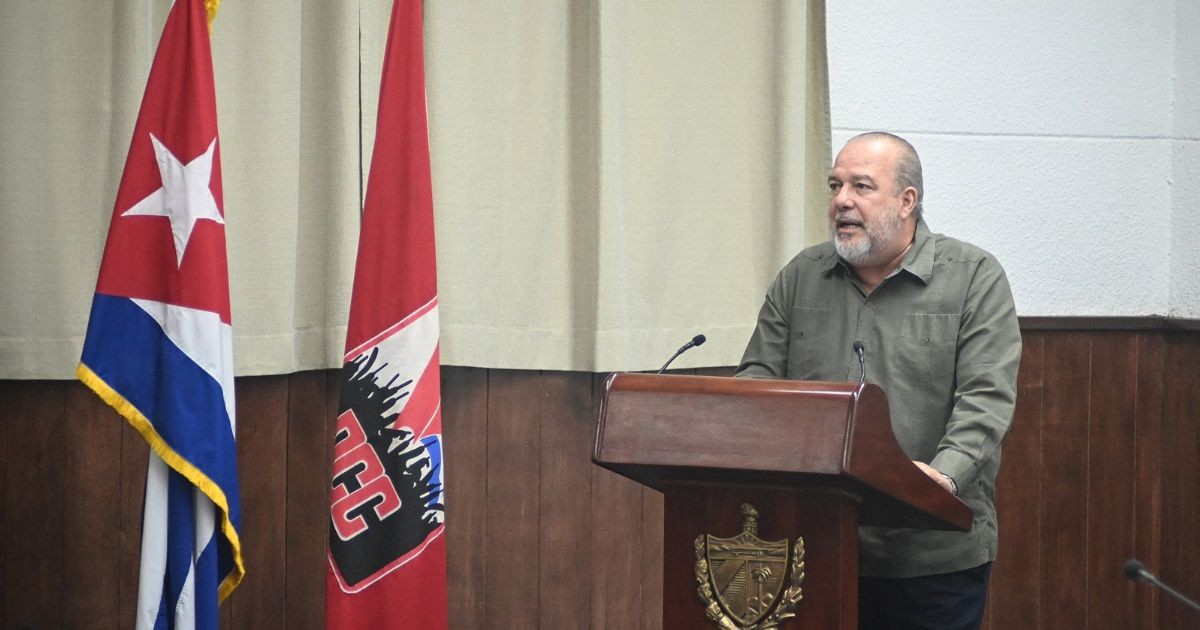
The Communist Party of Cuba (PCC) held an Extraordinary Plenary Session of its Central Committee on Wednesday to assess a series of economic and social transformations amid significant official media silence and during one of the most severe crises the island has faced in decades.
With Miguel Díaz-Canel at the helm, the meeting commenced with a presentation by Prime Minister Manuel Marrero Cruz. He portrayed the proposed changes not as a structural reform but rather as an enhancement of the existing model: "The proposed economic and social transformations will impact the improvement of the Cuban economic management system."
Marrero also stressed that the process "can only be propelled by our own efforts," dismissing any expectations of external assistance to pull the country out of its collapse.
According to a report by pro-government journalist Lázaro Manuel Alonso, the communist plenary is discussing "crucial issues regarding the management of the economy, state enterprises, opportunities for non-state economic actors, Cubans with capital to invest, whether they live inside or outside the country, agricultural management, energy, and banking transformation."
Roberto Morales Ojeda, the Central Committee's Secretary of Organization, established the political boundary of the measures before they were debated: their goal is "to preserve the Revolution and its main achievements."
During the session, it was also reaffirmed that the initiatives "do not signify a deviation from the socialist project; they are an expression of the inherent logic of development during the historical period of its construction, guided by the ideas of Fidel and Raúl."
The sole acknowledgment that bordered on reformist language came from Marrero himself, who conceded that the proposals "include a recognition of market mechanisms as tools for efficient resource allocation," though he was quick to clarify that this "does not imply in any way a renunciation of the State's social responsibility."
Key Focus Areas of the Transformations
The measures are structured around six core areas: economic management system, municipal autonomy, enterprise autonomy, agricultural recovery, foreign trade and investment, and social policy.
Among the specific points are allowing municipalities to import and export without intermediaries, granting state enterprises more latitude to set wages and retain foreign currency, and permitting Cuban expatriates to invest on equal terms. A proposal also includes reducing the number of ministries from 27 to between 20 and 21.
The package was first announced by Díaz-Canel on June 12 during a press briefing, and the regime swiftly moved forward with institutional validation: the PCC Plenary on Wednesday and an extraordinary session of the National Assembly scheduled for Thursday.
Dire Economic Landscape
The backdrop is bleak. The Economic Commission for Latin America and the Caribbean (ECLAC) forecasts a 6.5% decline in Cuba's GDP in 2026, following a 3.8% contraction in 2025, which would mark Cuba as the worst-performing economy in Latin America for the second consecutive year.
Economist Pedro Monreal warns of a potential drop of at least 15% if inflation, foreign currency shortages, and the energy crisis persist. Record electrical deficits exceeding 2,000 MW were recorded in May, with 51% of the country simultaneously without power.
This is not the first instance of Marrero announcing changes without substantive reforms: in October 2025, he relaunched a program to "correct distortions," and in January 2026, he spoke of a "war economy," urging people "not to fear change."
In every case, the official rhetoric has maintained that the adjustments are to "perfect" socialism, not abandon it.
Cuban Economic Challenges and Reforms
What are the main areas targeted by Cuba's proposed transformations?
The proposed transformations focus on six key areas: economic management system, municipal autonomy, enterprise autonomy, agricultural recovery, foreign trade and investment, and social policy.
What is the economic forecast for Cuba in the coming years?
The Economic Commission for Latin America and the Caribbean (ECLAC) projects a 6.5% decline in Cuba's GDP in 2026, following a 3.8% contraction in 2025, indicating severe economic challenges ahead.
How does the Cuban government plan to implement these changes?
The Cuban government plans to implement these changes through institutional validation, beginning with the PCC Plenary and followed by an extraordinary session of the National Assembly.