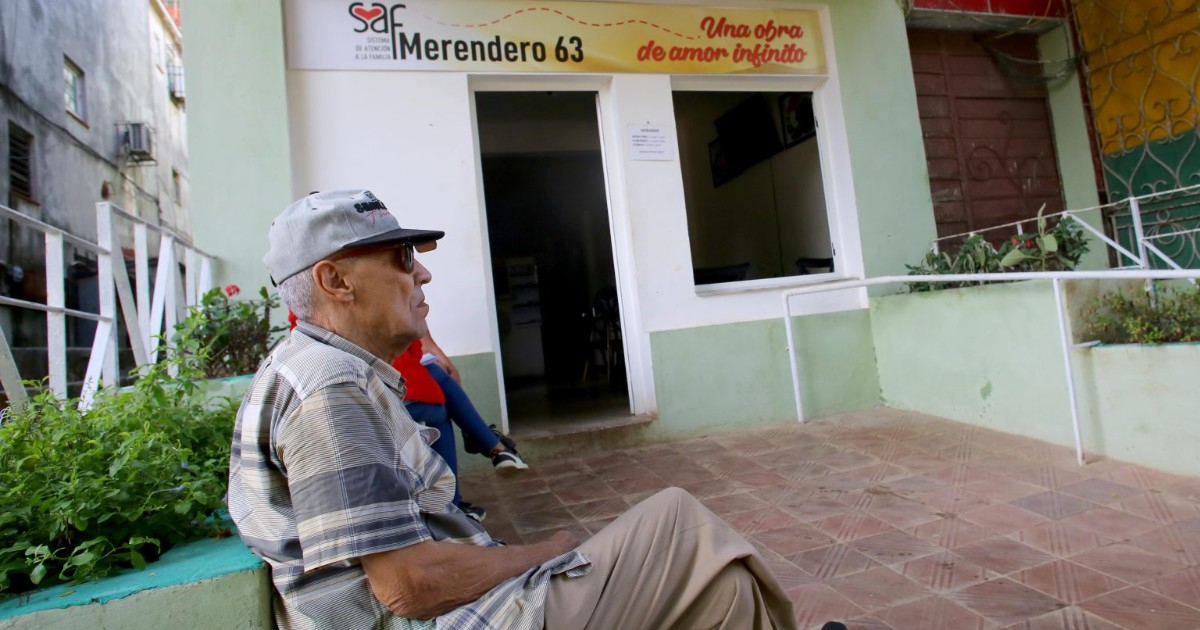
A makeshift stove made from an old tire, burning wood in a hallway, and smoke saturating clothing, walls, and lungs: this has been the reality for five months at SAF 0204 Villanueva in the Boyeros district of Havana. It is one of over 1,400 community kitchens the Cuban regime operates to feed its most vulnerable elderly citizens.
According to a report by the state-run Cubadebate, liquefied gas supply ceased five months ago, forcing cooks to improvise to maintain daily service.
The report, released Tuesday by the state media, attempts to highlight the "resilience" of the Family Attention System (SAF). However, it instead illustrates the extreme hardship faced by tens of thousands of older Cubans, abandoned by a government that can no longer provide even a gas stove.
SAF 0204 Villanueva serves 129 diners. Bárbara Mediaceja Hernández, head of the Boyeros Commerce Branch, admitted that local private businesses stopped collaborating since December 2025.
"Not here. They helped until last December. But then they didn't want to anymore. They say too many inspectors come, and they get fined a lot. I understand them, but the truth is they don't help," she confessed.
At SAF "El Río" in the Plaza de la Revolución district, the situation is similar. Four workers—administrator, kitchen assistant, cook, and custodian—manage a service that this month serves 84 seniors, providing three daily meals: breakfast, lunch, and dinner.
"We work from Monday to Sunday without a break," stated Liliam de la Rosa Domínguez, the administrator.
To fill the gaps left by the state, "El Río" relies on donations from the World Food Program—rice, oil, and peas—support from ETECSA Norte as a "sponsor" company, and bread donated twice a week by a private small business at no cost.
"The bread is free. Although we're currently affected by the flour shortage, they continue to receive their bread," Liliam remarked.
This survival scenario is set against the backdrop of a demographic and social crisis with no visible solution. Cuba is the most aged country in Latin America: by the end of 2024, 25.7% of its population was aged 60 or older, with peaks of 29.1% in Villa Clara and 28.1% in Havana. Mass emigration reduced the population to 9.74 million in 2025, over 10% less than in 2020, leaving thousands of elderly without family support.
Despite the regime increasing pensions to a minimum of 3,056 pesos in September 2025, they are a mockery amidst rampant inflation: a carton of 30 eggs costs around 3,000 pesos, equivalent to an entire monthly pension.
According to a November 2025 survey, 99% of Cuban retirees cannot meet their basic needs for food, housing, and medication.
Even Cubadebate, inadvertently, summarized the tragedy: "For them, SAF is often all they have. It's the only hot meal of the day. It's the only helping hand the State extends to them."
This Wednesday, Cubans on social media criticized the official media for presenting the system with "inflated information" and accused the regime of whitewashing a reality that their own photos—the wood-burning stove, the smoke, the blackened walls—exposed.
Cuban Elderly Crisis: Key Questions
Why have the community kitchens in Cuba stopped receiving gas?
The supply of liquefied gas to community kitchens ceased five months ago, forcing them to operate using makeshift methods to continue providing meals.
What role do private businesses play in supporting Cuban community kitchens?
Private businesses in Cuba had been supporting community kitchens, but many stopped due to increased inspections and fines, leaving these kitchens to rely more on donations and limited state support.
How has emigration affected the elderly population in Cuba?
Mass emigration has significantly reduced Cuba's population, leaving many elderly without family support as younger generations leave the island in search of better opportunities.