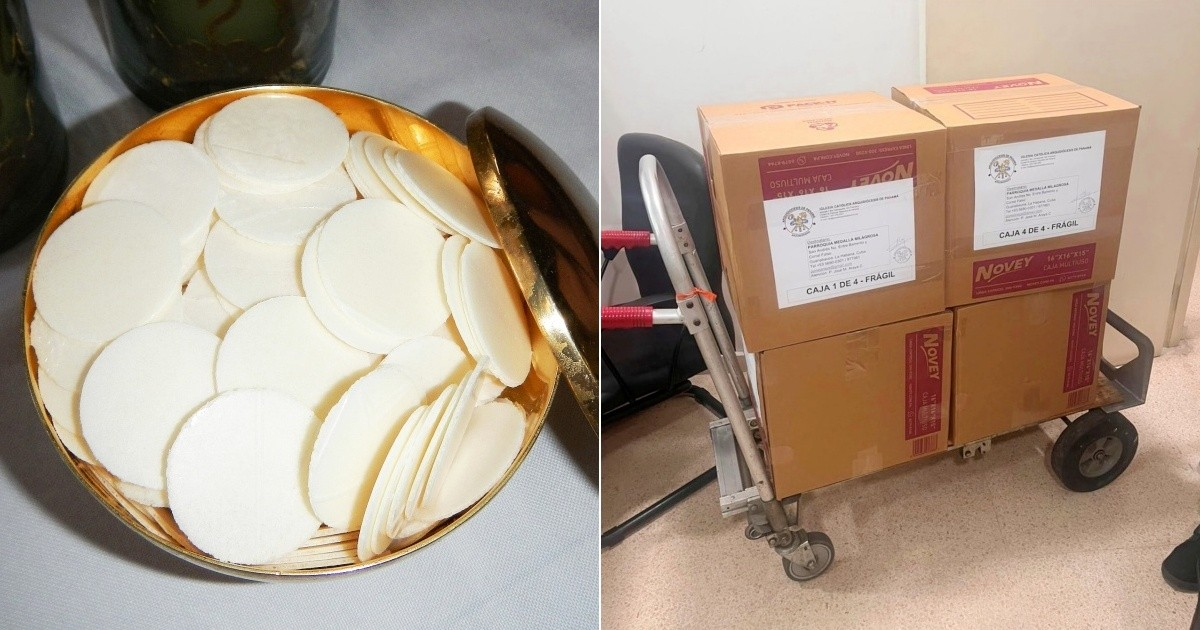
The Archdiocese of Panama dispatched 35,000 communion wafers to Cuba this Tuesday to support the celebration of the Eucharist in Catholic communities on the island. These communities are struggling to secure this essential liturgical element, according to an official statement signed by Archbishop José Domingo Ulloa Mendieta and published on the archdiocese's institutional account.
Crafted by the Sisters of the Monastery of the Visitation of Panama, the wafers were vacuum-sealed to maintain their quality during transit and were transported free of charge by COPA Airlines to Cuba.
The shipment, consisting of four boxes labeled as fragile, was addressed to the Medalla Milagrosa Parish in Guanabacoa, Havana, under the care of Father José M. Araya.
A Gesture Born from Scarcity
This initiative emerged from an unprecedented situation: the Discalced Carmelite nuns of the Monastery of Santa Teresa and San José in El Vedado, Havana, the sole supplier of wafers for all Catholic churches in Cuba, announced on June 4th the suspension of their production due to a lack of electricity.
"We inform you that due to the lack of power, it is impossible for us to produce the wafers," the nuns stated in a message circulated among Cuban clergy.
The manufacturing process requires an industrial mixer and a mechanical press. With only two hours of electricity per day, production has become unfeasible. "The remaining stock will be rationed to ensure it lasts a bit for everyone," the Carmelites added.
Dominican priest George Payano, 35, clarified to AFP last Monday: "The Carmelite sisters produce the wafers for all of Cuba. They need time and need to operate the machinery, the press for this... Two hours of electricity are extremely limited."
An anonymous priest confirmed that wafer collection in Havana had already been reduced to a third of the usual amount. This is the second time in less than five years that the monastery has halted production: in November 2022, the cause was a lack of flour; now it is a structural electricity crisis.
Revealing Cuba's Crisis Through Wafer Rationing
The fact that a sister church must airlift consecrated bread so that Cuban Catholics can celebrate Mass is a striking symbol of how deeply the crisis has permeated every aspect of life on the island, even the most intimate: faith.
On Tuesday, the Union Eléctrica reported an availability of just 995 MW against a demand of 2,620 MW, with a projected deficit of up to 2,085 MW during peak hours. Power cuts reach as long as 20 to 24 hours daily in some areas. The record deficit was 2,174 MW on May 14th.
The energy crisis, exacerbated by decades of poor management by the regime and the lack of regular oil shipments since January 2026, has led to a humanitarian emergency documented by the UN: more than 100,000 postponed surgeries—including 11,000 involving minors—32,000 pregnant women at risk, and nearly half a million students with reduced school hours.
The psychological impact is also severe: a study published in May showed that 55.4% of surveyed Cuban adults suffered from extremely severe depression.
State-run media Cubadebate reported yesterday on the wafer shortage, attributing it to a "petroleum blockade" imposed by Washington, in an attempt to shift the blame from the dictatorship's role in the collapse of the electrical system.
Seventy-year-old parishioner Mariela Shuman summed up the feelings of many Cubans to AFP: "You know that those who cannot take communion do so spiritually, let’s hope it doesn't come to that."
Panama's Response
In light of this situation, the Archdiocese of Panama chose to take concrete action.
In its statement, the institution led by Archbishop Ulloa Mendieta emphasized the significance of the gesture:
"The Eucharist is the sacrament of unity. Around the same Bread of Life, we recognize ourselves as brothers and members of one Body. Therefore, when a community lacks what is necessary to celebrate this mystery, we feel the evangelical duty to reach out and accompany them."
On its social media, the archdiocese added: "More than material aid, this shipment is a sign of communion, hope, and unity among sister Churches, reminding us that faith unites us beyond any distance."
The Cuban Catholic Church is also in a diplomatically delicate position: Washington has designated it as the primary channel for distributing humanitarian aid—including a $100 million offer in 2026—without regime intermediation, which strains its relationship with Havana authorities.
The Panamanian statement concludes with a call to keep "the prayers alive for the Cuban people, for their pastors and faithful, so that, strengthened by God's grace, they continue to proclaim the Gospel and celebrate the mysteries of our faith with joy."
Understanding the Impact of Cuba's Wafer Shortage
Why did Panama send communion wafers to Cuba?
Panama sent communion wafers to Cuba due to a shortage caused by electricity issues that halted local production by the Carmelite nuns, the only suppliers on the island.
How has the energy crisis in Cuba affected daily life?
The energy crisis has led to severe power outages, affecting everything from surgical procedures to education, and has contributed to significant psychological distress among the population.
What is the significance of the Eucharist shipment from Panama?
The shipment symbolizes solidarity and unity among the Catholic Churches and highlights the extent of the crisis in Cuba, affecting even spiritual practices.