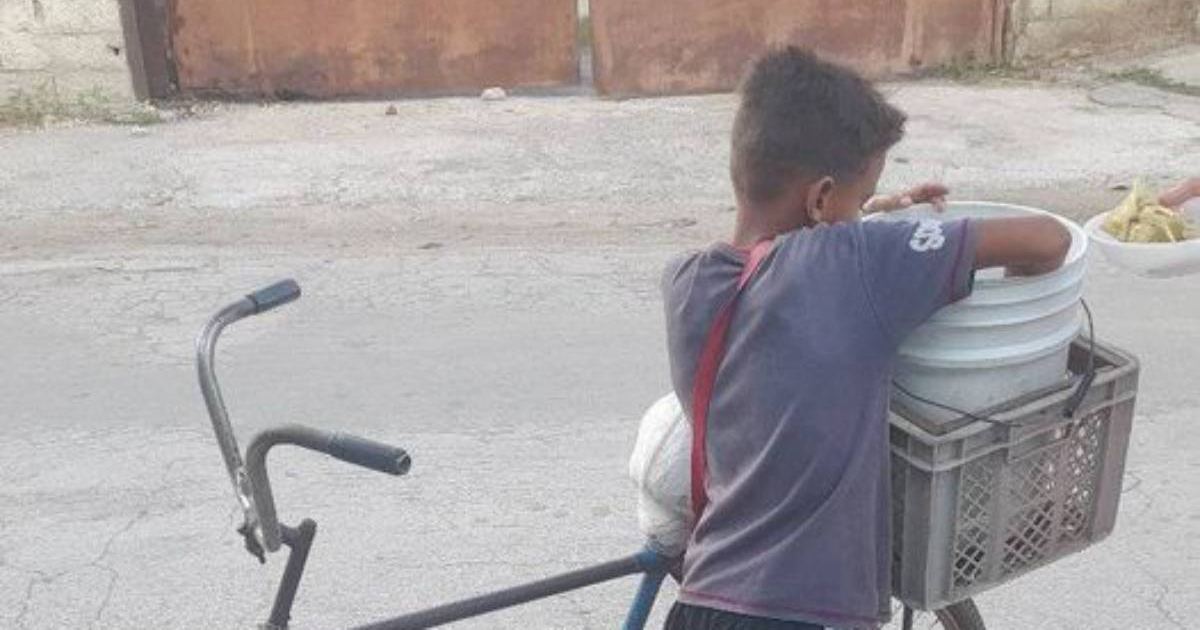
On June 12, the World Day Against Child Labor, the Cuban Young Communist League (UJC) posted a message on Facebook claiming that "thanks to the Revolution, child labor is not a reality in our country," while pointing out that "in other countries, millions of children continue to be exploited."
The post, which featured an image of a young boy carrying a bundle of plants, triggered a wave of outraged responses from Cubans who countered the official narrative with firsthand accounts of what they witness daily in their communities.
"In Cuba, there are children begging for money or washing car windshields at traffic lights. They sell bread, small packets of drinks, offer to take out neighbors' trash for some change, and many skip school after a hot night without electricity and with only a piece of bread for dinner," wrote user Yordy Cha Cal.
Iran Capote encapsulated the widespread sentiment: "One has to be either incredibly naive or completely disconnected from the country's reality. Walk the streets and you'll see children begging for money or selling goods to support their families."
Indira Rionda was more blunt: "Thousands of children are working and collecting raw materials in garbage dumps. Childhood is engulfed in cruel poverty."
Several individuals also recalled the notorious "schools in the countryside" program, a government initiative that sent secondary and pre-university students to work in agricultural fields for weeks at a time.
"And what about the secondary school children sent to the countryside for 45 days, picking coffee, potatoes, raw materials, and the pre-university students forced to work in the fields every day. Weren't they children?" questioned Javier Cayon.
The contradiction in the UJC's message becomes even more glaring considering that President Miguel Díaz-Canel himself acknowledged the issue in April 2025: "We have always taken pride in the Revolution's achievements in eliminating these issues, and we cannot allow them to resurface during this economic crisis: the destitute, beggars, informal child labor, the harassment of tourists."
By the end of 2024, the government admitted that nearly 200,000 children and adolescents were in vulnerable or at-risk situations, with around 9,000 children under six years old living in "complex social situations."
Merely two days before the UJC's post, a 10-year-old boy was seen selling coconuts on the street to help support his mother and three siblings.
In May, reports surfaced of a 14-year-old teenager searching for work to assist his mother and a 13-year-old mowing lawns.
User Manuel Alejandro Studyo shared another specific account: "In my neighborhood, there are children aged six and eight working by taking out the trash."
Yeny Calderón summed up the harsh reality with a phrase that resonated throughout the comments: "In Cuba, children stop being children at seven, when they lose their milk ration, and they have no right to dream because in a country where you can't sleep, you can't dream."
Child labor is on the rise in Cuba, driven by the economic crisis, an aging population, and migration that leaves families without adult providers. Reports from 2025 indicate that 89% of Cuban households are living in extreme poverty.
Understanding Child Labor in Cuba
What did the Cuban Youth Union claim about child labor?
The Cuban Youth Union claimed that child labor is not a reality in Cuba, thanks to the Revolution, while criticizing other countries for exploiting children.
How did Cubans respond to the UJC's message?
Cubans responded with anger and disbelief, sharing personal accounts of children working on the streets, contradicting the UJC's statement.
What is the current situation of child labor in Cuba?
Child labor in Cuba is reportedly increasing due to economic hardship, an aging population, and emigration, leaving many families without adult providers.