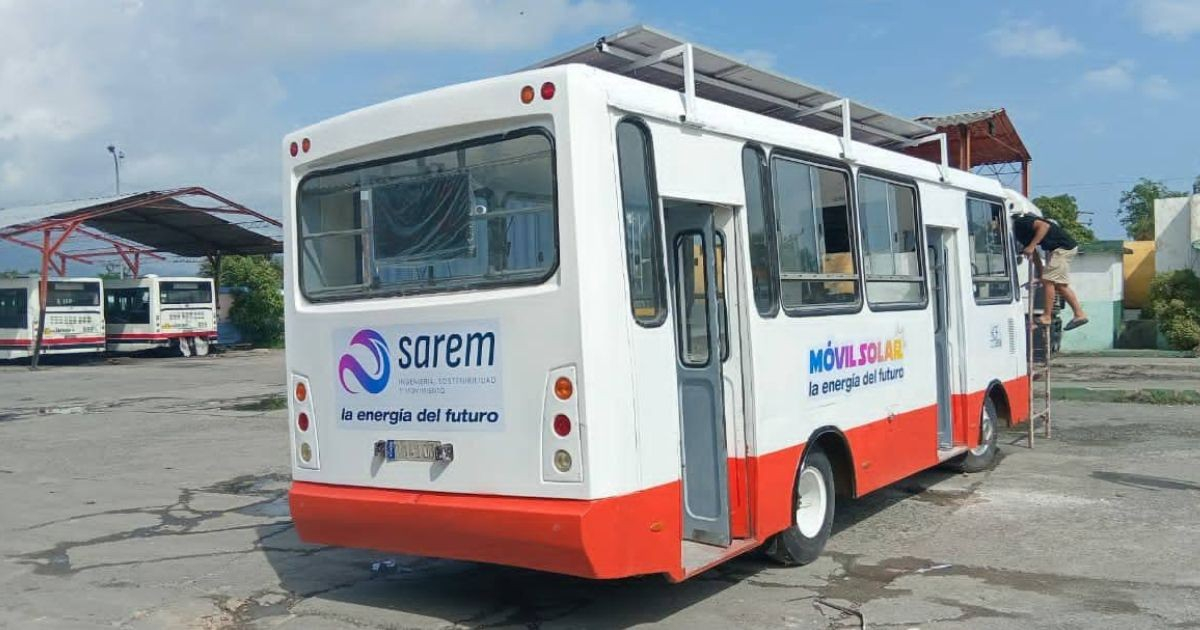
Cuba's challenges are as persistent as they are peculiar, often met with solutions that are as impractical as they are innovative. In Santiago de Cuba, where residents endure up to 20 hours of daily blackouts due to a frequently collapsing power grid, the Provincial Transportation Company has introduced a novel initiative: a solar-equipped bus aimed at providing electricity to affected neighborhoods.
The vehicle in question, a Diana bus—ubiquitous on Cuban roads—has been outfitted with solar panels on its roof and dubbed the "Solar Mobile." This adaptation is intended to transform the bus into more than just a mode of transportation; it is envisioned as a generator of clean energy to bring light to communities struggling with power outages, marking what the company describes as a "decisive step toward energy independence."
Pictures of the bus reveal an interior still under modification, featuring side-mounted outlets, sleek white counter-like furniture, a slip-resistant aluminum floor, and a large screen at the rear protected by a plastic cover.
This technological "advancement" appears set to allow residents to charge devices, possibly cook food, and stay informed through broadcasts like the National Television News or the ever-informative Round Table. However, details regarding the bus's routes, operational hours, energy capacity, or launch date remain undisclosed.
The company has merely assured that the "Solar Mobile" will soon traverse priority areas in Santiago, with further information to be provided shortly.
This announcement comes amid Santiago de Cuba's severe energy crisis, where blackouts range from 14 to 18 hours daily, exacerbated by the repeated outages of the Renté thermoelectric plant's three units.
In November 2025, Hurricane Melissa left the province without power for over a week, and Christmas Eve of that year was marred by further outages. By May 2026, power shortages even disrupted radio and television signals due to insufficient generation and fuel shortages.
Nationally, the electricity deficit surpassed 2,000 MW during peak hours in June 2026, and the system has experienced at least seven total collapses in 18 months, including a nationwide blackout on March 16 of this year.
The Santiago project is not without precedent. In April 2026, the private company Total Electric introduced the STATION-001 in Villa Clara, a solar-powered bus repurposed as a mobile charging station for electric vehicles, independent of the national grid.
The key difference is that Santiago's initiative is state-backed and aims to directly supply electricity to residential neighborhoods, an ambition that raises both hopes and questions.
Currently, Cuba operates 54 photovoltaic solar parks contributing up to 531 MW at noon. However, this energy dissipates by nightfall, precisely when blackouts intensify and Cuban households most need the power.
FAQs About Santiago's Solar-Powered Bus Initiative
What is the purpose of the solar-powered bus in Santiago de Cuba?
The solar-powered bus aims to generate and provide clean electricity to neighborhoods in Santiago de Cuba experiencing frequent power outages.
How does the "Solar Mobile" bus contribute to energy independence?
By generating clean energy independently of the national grid, the "Solar Mobile" bus represents a step toward reducing reliance on traditional power sources and enhancing energy sovereignty.
How does the Santiago solar project differ from other initiatives in Cuba?
Unlike previous projects, Santiago's solar initiative is government-sponsored and designed to deliver electricity directly to residential areas rather than serving as a mobile charging station.