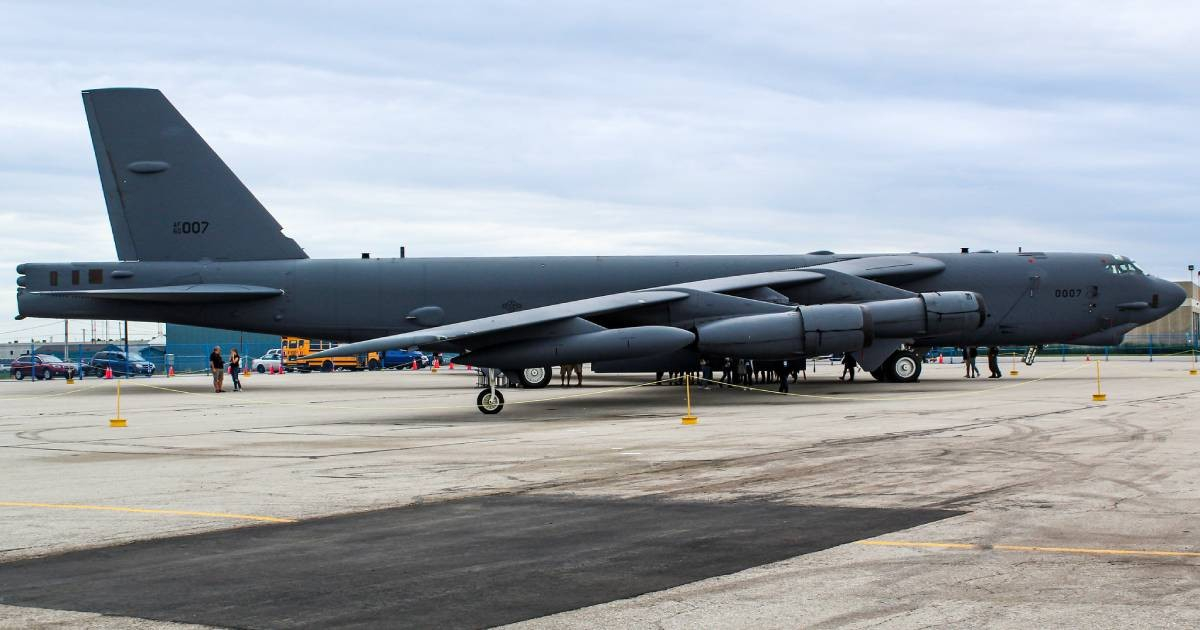
A B-52 Stratofortress bomber from the U.S. Air Force tragically crashed shortly after taking off from Edwards Air Force Base in California’s Mojave Desert on Monday. The aircraft, involved in what was described as a routine test mission, had eight individuals on board.
The incident occurred at 11:20 a.m. Pacific Time, creating a massive plume of black smoke visible from several miles away. The runway was left with a significant darkened mark, and footage from CNN affiliate KCAL revealed the wreckage was indistinguishable in its destruction.
According to an official statement from the Public Affairs Office of the 412th Test Wing, headquartered at Edwards, "preliminary indications are that the crash was not survivable," suggesting that all eight crew members perished.
Emergency teams promptly responded to the crash site as authorities worked diligently to account for all individuals aboard the aircraft.
Following the accident, the airfield was immediately closed. Incoming flights were redirected, and all non-commercial visitor passes were suspended indefinitely while the base focused its resources on emergency response efforts.
The crash is currently under investigation, as confirmed in the official release from the base.
The Legacy of the B-52 Stratofortress
The B-52 Stratofortress stands as one of the oldest bombers in military aviation history. Initially entering service in 1955 and produced by Boeing until 1962, the current operational version, the B-52H, is capable of carrying up to 70,000 pounds of bombs and munitions, including nuclear bombs and nuclear-capable cruise missiles.
The Air Force operates 76 B-52H units, which have been actively deployed in bombing missions, most recently during the conflict between the U.S. and Iran. A peace agreement had been reached just one day before this accident, following a period of heightened tensions characterized by U.S. airstrikes on Iranian targets and retaliatory attacks by Iran on U.S. bases in the region.
A Somber Reminder of Past Tragedies
Typically, the B-52 is manned by a crew of five, but this test mission involved eight individuals, exacerbating the severity of the tragedy. This crash is the deadliest involving a B-52 since 2008, when six Air Force members lost their lives as their aircraft crashed into the Pacific Ocean near Guam while preparing for a flyover at a parade.
Given that the B-52 model is no longer in production, any necessary fuselage replacements must be sourced from the "Boneyard," the aircraft graveyard located at Davis-Monthan Air Force Base in Arizona. This process was previously employed after a non-fatal accident in 2016 that resulted in the destruction of a B-52H in Guam.
The Air Force is currently undertaking an extensive modernization program for the B-52, focusing on the design of new engines, with a total estimated cost of $48.6 billion, as reported by Defense News.
Understanding the B-52 Crash and Its Implications
What caused the B-52 crash at Edwards Air Force Base?
The exact cause of the crash is currently under investigation, and no definitive conclusions have been released by authorities at this time.
How many crew members were on board the B-52 during the crash?
There were eight individuals on board the B-52 during the crash, which is more than the usual crew size of five for the aircraft.
What are the next steps following the B-52 crash?
The next steps involve a thorough investigation to determine the cause of the crash, along with a review of safety protocols to prevent future incidents.