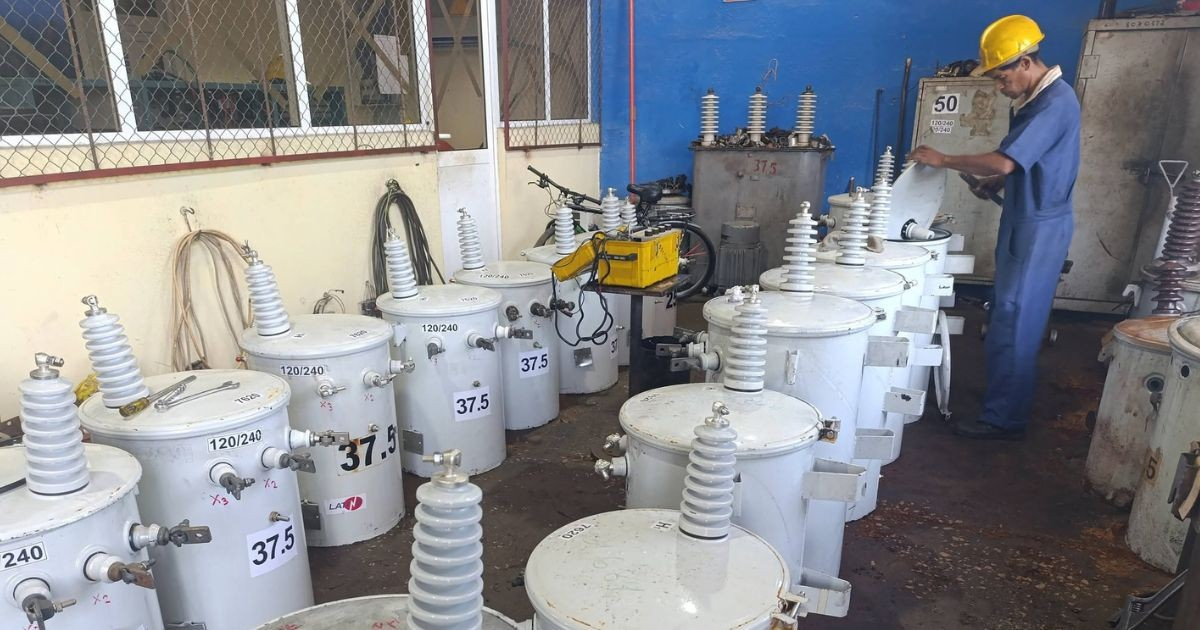
A batch of recovered transformers from Havana made their way to Santiago de Cuba on Monday, aiming—at least in optimistic terms—to mitigate the ongoing electrical challenges plaguing neighborhoods with damaged equipment. This development was shared by the Santiago de Cuba Electric Company through their social media platforms.
The company stated that technicians from the Transformer Workshop wasted no time in conducting transformation ratio tests, completing connector installations, and inspecting insulation. The goal was to deploy these transformers into the neighborhoods within hours.
This update follows a period of at least three weeks during which residents in several areas reported the removal of faulty transformers without any official communication or timeline for replacement. These circumstances led to protests and demonstrations in various parts of the city.
Independent journalist Yosmany Mayeta Labrada highlighted the dire situation, noting, "Darkness has simply taken hold, bringing with it the spoilage of food, nights of extreme heat for the elderly and sick, and the inability to keep medical equipment operational."
On June 5, residents in Micro 2 resorted to banging pots and pans to protest over ten days without power due to a faulty transformer.
Later, on June 12, people from the José Martí Urban Center took to the streets demanding electricity, food, and freedom.
Just this past Sunday, locals from San Ricardo protested after enduring several days without electricity, while others reported the removal of transformers on Carnicería, Trinidad, and Altamira streets with no set date for replacement or explanation provided.
Illegal Connections Compound Electrical Issues
In addition to the announcement about the recovered transformers, the Electric Company disclosed that several transformers in the Trocha and Cristina areas had suffered irreversible damage due to illegal connections. Approximately 30 homes had illicitly tapped into Circuit 10, which supplies power to critical hospital centers in the city.
A coordinated operation involving the National Revolutionary Police, the Inspection Directorate, and the Electric Company also targeted the Luis Dagné district, where several non-state bakeries were unlawfully drawing power from two circuits. Similar actions took place in the Venceremos, Vista Hermosa, Manduley Avenue, and La Ceiba neighborhoods.
These efforts led to the recovery of approximately 1,000 meters of service lines, which will be used to address pending complaints due to material shortages, according to engineer Fernando Javier Hau Corona, director of the UEB Commercial Services.
Hau Corona acknowledged that power surges upon restoring service after extended outages contribute to equipment damage. However, he emphasized that illegal connections significantly exacerbate the issue by adding "a load greater than what should normally be received during electrical service."
Santiago de Cuba is experiencing blackouts lasting up to 40 or 50 consecutive hours amid a national electrical crisis, with deficits surpassing 2,000 MW in June. The available capacity was only 980 MW against a demand of 2,500 MW.
Mayeta Labrada encapsulated the frustration of many Santiago residents with a question circulating among those affected: "What these images reveal, beyond technical recovery, is that resources exist and solutions are possible. The lingering question is why these solutions often only come into play when silence is no longer an option."
Understanding Santiago de Cuba's Power Crisis
What caused the power outages in Santiago de Cuba?
The power outages in Santiago de Cuba were primarily due to damaged transformers and illegal electrical connections, which added excessive load to the system.
How is the Santiago de Cuba Electric Company addressing the issue?
The company is deploying recovered transformers to affected neighborhoods and cracking down on illegal connections to stabilize the electrical system.
What impact do illegal connections have on the electrical grid?
Illegal connections overload the electrical grid, leading to more frequent equipment failures and prolonged outages.